Busan’s Bid for Korea’s Dental Institute Turns on a Larger Question
Busan has framed its bid around translation: from research to product, from product to practice, and from local industrial strength to national relevance. Whether that vision prevails will depend on how the government defines the institute now taking shape.

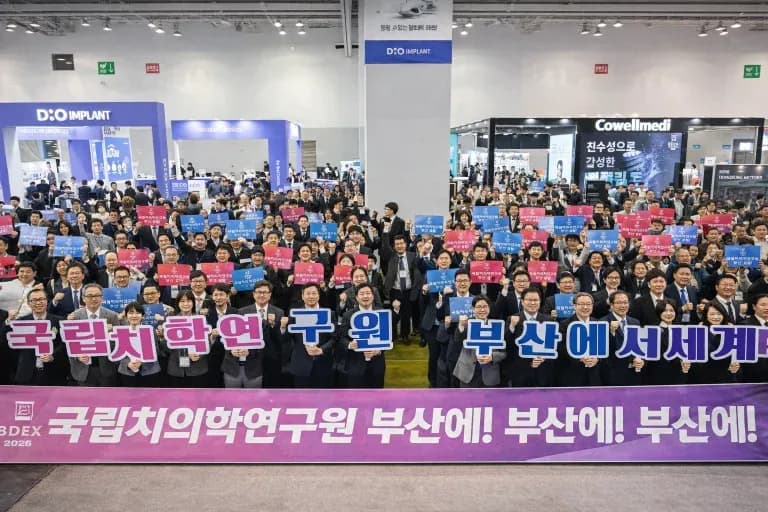
BUSAN — BDEX 2026 opened in Busan this weekend as a showcase for digital dentistry, but the exhibition is carrying a larger argument this year. Behind the trade booths and academic sessions lies a more strategic purpose: Busan’s attempt to establish itself as a credible host for Korea’s planned National Dental Research Institute.
That effort comes at a more serious stage of the process. The institute now rests on an established legal basis, while the government is moving to define the criteria that will shape the selection of its future site. Several cities are vying for the project, each advancing a different rationale. Some are leaning on political continuity and prepared land. Others are pointing to academic concentration, research capacity or medical-industrial clustering. Busan is making a more applied case. Its claim is that dental research should sit close to the manufacturing base, clinical networks and market-facing infrastructure needed to turn knowledge into use.
That distinction is not incidental. The institute is meant to do more than house research. Its mandate reaches into industrial development, standardization, training and international cooperation, making the choice of location a matter of strategic fit rather than symbolic distribution. The issue is no longer which city is campaigning most visibly. It is which city best matches the institutional logic behind the project.
Busan’s answer is built on translation: from research to product, from product to practice, and from local industrial strength to national relevance. Whether that will be enough remains unclear. But the terms of the contest are now more sharply defined. This is not simply a competition among municipalities. It is a test of how Korea intends to organise the relationship between dental research, industry and the next phase of biomedical growth.
What kind of institute is being contested?
The significance of the competition lies in the nature of the institution itself. Korea’s planned National Dental Research Institute is not being conceived as a narrowly defined research centre, nor as a symbolic regional facility to be distributed through political compromise. Under the revised legal framework, its mandate extends across a broader institutional field: advancing dental R&D, supporting industrial development, promoting standardization, disseminating research outcomes, strengthening international cooperation, managing data and statistics, and training specialized personnel. In practical terms, that gives the institute a wider function than a conventional laboratory campus. It is meant to sit at the intersection of science policy, public health and industrial strategy.
That institutional design changes the terms of the site debate. The question is not simply which city can offer land, political backing or the loudest campaign. It is which location can sustain an organisation whose work is expected to move in several directions at once: from research to standards, from standards to clinical adoption, from technical development to industrial application, and from domestic capability to international reach. The government’s current work on selection indicators underscores that point. The Ministry of Health and Welfare has commissioned a study specifically focused on evaluation criteria for choosing the institute’s future site, with the project scheduled to run through August 31, 2026. That suggests the decision is being treated less as a matter of regional allocation than as a question of strategic fit.
This is what makes the contest more consequential than an ordinary inter-city bid. Once the institute is understood as a platform for coordination — linking research, training, industrial support and international engagement — the location question becomes inseparable from institutional purpose. A city with academic depth may stress research legitimacy. A city with prepared land may stress administrative readiness. A city with an established medical manufacturing base may stress application and scale. The choice, in other words, will reveal not only where the institute will stand, but what kind of role the state expects it to play in Korea’s wider dental and biomedical landscape.
The rival cities are making different cases
That divergence is already visible in the way the contenders are framing their bids. The cities now competing for the National Dental Research Institute are not simply offering different locations for the same project. They are, in effect, advancing different ideas about what kind of institution the institute should become.
Cheonan, backed by South Chungcheong Province, has built its case around policy continuity and physical readiness. Its argument is less about exhibition scale or industrial branding than about follow-through. Chungnam has repeatedly stressed that the project was tied to a prior national policy commitment and that a site in the Cheonan-Asan KTX R&D district has already been secured. In this version of the bid, the institute is imagined as a project that should move quickly from decision to construction, anchored by prepared land, transport access and administrative clarity. The emphasis is on readiness rather than visibility.
Daegu is making a more cluster-driven argument. The city has positioned itself as a medical-industrial base where dental manufacturing, research capacity and policy support can be concentrated within a wider innovation ecosystem. Recent reporting on the city’s preparations points to a coordinated push ahead of an expected second-half bidding process, while official materials highlight a sizeable dental-industry base, more than 40 related firms, over 1,600 workers and a network of national medical institutions linked to the Daegu-Gyeongbuk Medical Innovation Foundation complex. Daegu’s bid, in other words, treats the institute as a node within an existing med-tech cluster rather than a standalone research campus.
Gwangju’s case rests on a different sort of legitimacy. It has leaned heavily on academic density, training capacity and research pedigree, presenting itself as a city where the institute could be grounded in a concentrated educational and clinical environment. Regional reporting has stressed that Gwangju’s strongest claim lies in hosting two dental schools within a single city — a distinction no other contender can make — while also linking the bid to AI, advanced medical-device development and the wider innovation infrastructure around High-Tech District 3. In Gwangju’s framing, the institute is above all a research-and-training institution with the capacity to develop talent, clinical knowledge and interdisciplinary convergence over time.
Busan’s argument is more applied than institutionalist. Rather than foregrounding prior political commitments or academic concentration, the city has increasingly framed its case around translation: the ability to move dental research into industrial production, clinical use and wider market deployment. Recent coverage of Busan’s task-force discussions has emphasized a four-part concentration of research, clinical care, industry and demand, while BDEX 2026 itself has been used to showcase the city’s convening power through around 80 companies, 290 booths, seven-country participation and a dedicated joint promotion hall for local dental firms. What Busan is trying to show is not simply that it has enthusiasm for the project, but that it offers a setting in which research can be embedded in production networks and outward-facing commercial channels from the start.
What emerges from this comparison is not a uniform four-way contest, but a competition among institutional models. Cheonan stresses execution and preparedness. Daegu points to clustered medical manufacturing and research infrastructure. Gwangju leans on academic concentration and training depth. Busan is making the case for industrial translation and market-facing application. The eventual choice will therefore do more than identify a host city. It will indicate which conception of the institute — as a ready-to-build project, a cluster-based R&D hub, a research-and-training centre, or a platform for commercialization — has found the strongest support within the state’s own policy logic.
Why Busan’s case is strong, and why it remains unfinished
Busan’s strongest argument is not that it has campaigned more visibly than its rivals, but that it offers the clearest case for translation. The city is trying to position the National Dental Research Institute not simply as a place where research would be conducted, but as a platform where research could move quickly into clinical use, industrial production and outward-facing commercialization. That is the logic Busan has repeated in recent task-force discussions, where officials and experts have framed the city’s advantage around the concentration of four elements in one place: research, clinical practice, industry and demand. In that formulation, the institute is imagined less as an isolated campus than as an operating node within an already functioning dental ecosystem.
That argument gains force from the city’s underlying profile. Recent reporting on Busan’s bid points to 1,335 dental hospitals and clinics, 489 dental laboratories and roughly 9,600 workers in related fields, alongside 11 dental education institutions that produce more than 600 trained personnel each year. The city has also stressed the presence of major implant and dental-device companies, including Osstem Implant, DIO, Cowellmedi and Point Implant, as evidence that Busan can offer more than academic or administrative capacity. The claim, in effect, is that the institute would not need to create an ecosystem from scratch. It would be entering one that already links treatment sites, training pipelines, laboratories, manufacturing capacity and commercial actors.
BDEX 2026 has been used to make that case visible. The exhibition itself is not proof that Busan should win the institute, but it does illustrate the city’s convening power. Official city materials describe an event built around about 80 companies, 290 booths, an international academic conference with participation from seven countries, B2B consultations and a joint promotion hall for local dental firms. Coverage of the exhibition has also pointed to displays of digital treatment systems, 3D printing technologies and AI-based diagnostic tools. That matters because Busan is not arguing merely that it can host a research facility. It is arguing that it can place such a facility inside an environment where clinical knowledge, industrial technology and market exposure already meet in public view.
The city’s preferred site strengthens that applied argument. Busan has been discussing the Gangseo-gu Myeongji district as a candidate location and has tied the area to a wider logistics and healthcare geography that includes Gimhae International Airport, the planned Gadeokdo New Airport, Busan New Port and the Eco Delta smart healthcare cluster. In Busan’s own telling, the point is not simply to secure land, but to build a chain that would connect research to prototyping, production, export and clinical adoption. That is where Busan’s bid differs most clearly from the others. Cheonan stresses readiness. Gwangju stresses academic depth. Daegu stresses clustered med-tech infrastructure. Busan is trying to show that the institute could be inserted directly into a system oriented toward deployment.
That is also why Busan’s case carries a broader strategic meaning. If the institute is ultimately expected to support standardization, industrial development and international cooperation as well as research, then a city built around manufacturing, logistics and external market access has an intelligible claim to host it. Busan’s bid is strongest when the institute is understood as a platform that converts research into use. It is, in that sense, the most explicitly practical bid in the field.
But that is not the same as saying the case is complete. Busan still has to show that it can host not just activity, but an institution. An exhibition, even a large and internationally visible one, is not a governance model. Industrial density, however useful, does not by itself answer questions about long-term institutional design, operating partnerships, research leadership or how universities, hospitals, firms and government would be integrated under a single national mandate. Nor does it fully resolve the political problem posed by rival bids built on pre-secured land, policy continuity or unusually strong academic concentration. Busan’s industrial logic may be compelling, but it will carry more weight if the city can turn that logic into a detailed institutional plan rather than a persuasive regional narrative.
The city’s challenge, then, is not to prove that it has momentum. It has already done that. The harder task is to show that commercialization can coexist with scientific credibility, public purpose and durable national value. If Busan can make that case convincingly, it may emerge as one of the strongest fits for the institute now taking shape. If it cannot, its industrial advantages may still be judged insufficient against rivals whose strengths lie in readiness, academic legitimacy or policy continuity.
What the Choice Will Reveal
The decision ahead will settle more than a matter of location. It will reveal how Korea understands the work of a national dental research institute at a moment when research, manufacturing, clinical care and industrial policy are no longer easily separated. Each city in the race has tried to answer that question in its own way. Some have spoken in the language of preparedness. Others in the language of academic legitimacy or industrial clustering. Busan has spoken most clearly in the language of application.
That matters because application is not a secondary question. It is the point at which research either enters public and industrial life or remains enclosed within the institution built to contain it. Busan’s bid has drawn its force from that distinction. It has argued, in effect, that the next phase of dental innovation should be organised not around distance from industry, but proximity to it; not around institutional insulation, but usable connection.
There is no certainty that the government will choose that logic. Nor is there any reason to assume that the most visible argument will prevail. But when the selection is made, the significance will reach beyond the winning city. The outcome will mark a preference — between different models of research, different ideas of public value, and different ways of placing science inside the national economy. In that sense, Busan’s candidacy already matters. It has forced the competition to confront a harder question than where the institute should stand. It has asked what, in practical terms, the institute should be for.
Continue this reporting
Reporting on the same issue
Related coverage selected from the article's desk, topics and newsroom relationships.
 NewsOct 22, 2026
Busan Port’s LNG and Methanol Plan: Who Pays to Keep Fuel Ready?
Busan already supplies ships with LNG and methanol, drawing on regional and i...
 NewsOct 16, 2026
What Is Still Worth Going to See?
Busan’s biennale faces questions of artistic judgment and institutional care....
 NewsOct 14, 2026
What Became of Busan’s University Streets?
From 2015 to 2023, registered businesses grew near Pusan National University...
More from the author
More from this byline
Stay with the same line of reporting through more work from this byline.
- NewsOct 22, 2026
Busan Port’s LNG and Methanol Plan: Who Pays to Keep Fuel Ready?
 NewsOct 12, 2026
Bukangi, the Shark That Stayed in Busan’s North Port
Reader Signal
Community readWhat did this report leave you with?
Choose the signal that best reflects your reading. Select it again to remove it.
One response per article
No response selected
A moderated conversation about the reporting.
One-level replies and newsroom moderation keep the conversation anchored to this article.
Discussion Status
Open
Please sign in to join the discussion.
Newsletter
Weekly reporting and context from Busan and Korea.