Busan’s AI Strategy Stumbles on Governance
Busan is promoting AI-driven public services, but civil servants are still learning chatbot prompts without legal frameworks, budgets, or deployment plans. Can policy catch up?

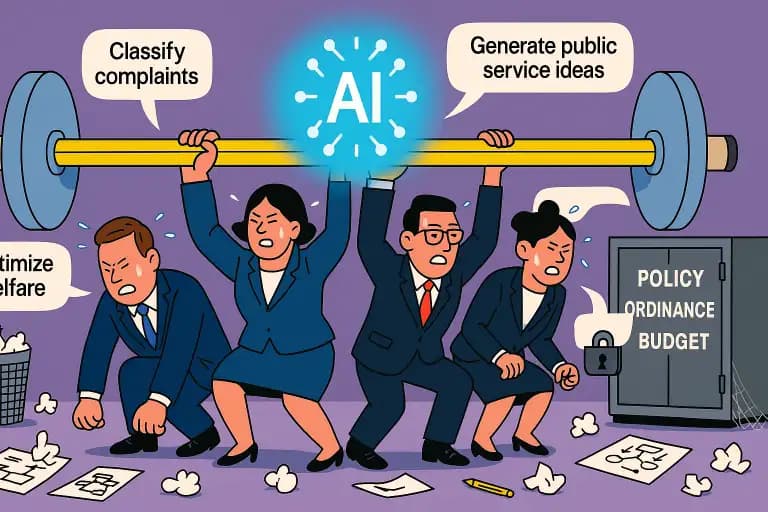
BUSAN, South Korea — Busan says it is training its public officials for an AI future. But so far, that training means learning how to craft prompts for large language models. No law defines how such tools should be deployed, no policy governs their risks, and no budget funds their implementation. The result is a digital strategy with no spine—one where interface replaces infrastructure, and prompt-writing stands in for policy.
In March 2025 the Busan Metropolitan Government unveiled a five-year “Artificial Intelligence Comprehensive Strategy,” promising trillion-won investments to weave machine-learning tools into port logistics, welfare screening, urban mobility and tourism. Officials sketched plans for a GPU super-cluster, an all-city data-governance system and a wave of automated public services. What the announcement lacked was an ordinance, a budget line or a timetable grounded in legislation. Two months later, the technical blueprint for the entire program was outsourced to a single consultancy on a ₩198.7 million contract—barely enough, experts cautioned, to cover a mid-sized feasibility study, let alone a city-wide transformation.
Busan, Korea’s second-largest metropolis with 3.3 million residents and one of Asia’s busiest ports, is angling to recast itself as an AI capital after losing its bid to host the 2030 World Expo. The gamble is bold: algorithms that could soon decide who receives welfare benefits, redirect buses in real time or approve commercial permits—all without a binding legal framework to classify risks, disclose logic or guarantee human oversight. A four-page internal memo urging civil servants not to paste personal data into generative-AI tools stands as the city’s only published safeguard.
International peers have moved faster on governance than on slogans. The European Union’s AI Act and Singapore’s AI Verify program already subject high-risk systems to audits, registrations and fines for non-compliance. The Netherlands lists every municipal algorithm in a public registry. Busan, by contrast, remains in a pre-legislative holding pattern. City officials acknowledge that a draft AI Administration Ordinance is circulating but confirm no formal text has reached the council floor.
The clock is ticking. The consultancy’s Information Strategy Plan—the sixth in the city’s series—is due in November 2025. Its authors must recommend legal instruments, fiscal road maps and performance indicators for sectors as varied as container logistics and social services, all within a 150-day window. Meanwhile, the promised high-performance computing cluster has no allocated funds in the 2025 budget or the draft 2026 framework, and local universities graduate barely a third of the AI specialists industry leaders say the region will need each year by 2027.
Inside conference rooms at City Hall, officials speak of “first-mover advantage”; outside, civic technologists warn of “policy-by-contract,” a scenario in which vendors write the playbook while the referees are still being hired. The question looming over Busan’s shoreline is simple but urgent: can a mid-sized port city leap into algorithmic governance without first writing the rulebook, funding the hardware or training the people who will keep the code in check? The answer, due in November, will reveal whether Busan’s AI dream becomes a model for pragmatic innovation—or another cautionary tale of ambition outrunning infrastructure.
A Vision Without a Statute
When Busan’s mayor unfurled the city’s Artificial Intelligence Comprehensive Strategy on 14 March 2025, the scene suggested a metropolis on the cusp of digital reinvention. Animated mock-ups showed cranes scheduling themselves along rust-red quays, buses streaming through re-timed traffic lights, and tourists following real-time, AI-curated itineraries. The promise was sweeping: a five-year, one-trillion-won push to embed machine learning across port logistics, welfare screening, urban mobility, and tourism. But the press kits and photo backdrops could not conceal an awkward absence. The strategy arrived with no enabling ordinance, no dedicated budget line, and no timeline for passing the legislation that would turn aspiration into enforceable mandate.
The only binding text in force today is a four-page internal memo warning civil servants not to paste personal data into generative-AI tools and urging them to “consult IT staff” before buying automated software. It defines neither penalties nor audit procedures; it does not even attempt to classify algorithmic systems by risk. City officials acknowledge that a draft AI Administration Ordinance exists, yet as of late June the proposal had not reached the council agenda. In practical terms Busan lacks any legal requirement to register public-sector algorithms, submit them to bias testing, or guarantee human review when automated decisions affect citizens’ benefits or mobility.
Two months after the fanfare, the city quietly posted a limited tender on the national procurement portal, awarding a single consultancy a ₩198.7 million contract to design the entire governance architecture. The firm has 150 days to draft Busan’s Sixth Information Strategy Plan, a document expected to propose legislation, map out sector-by-sector roll-outs, cost the hardware, and set key performance indicators through 2030. By the consultancy’s own schedule, stakeholder interviews, legal drafting, technical standards, and budget modelling must be compressed into five months, not the multi-year, multi-stakeholder processes seen in the European Union or Singapore.
Busan’s approach exemplifies what public-administration scholars call “strategic decoupling”: bold objectives are announced long before the legal and fiscal machinery exists to implement them. The promised GPU super-cluster still lacks an appropriation in either the 2025 budget or the draft 2026 framework. Local universities, meanwhile, graduate fewer than 500 AI specialists a year—barely one-third of the talent pool industry analysts say the region will need annually by 2027. Yet pilot systems slated for welfare triage and dynamic bus routing could go live as early as 2027, meaning algorithms may influence frontline decisions while the statutes that govern them remain in limbo.
The consultancy’s masterplan is due in November. To move from slogan to system, city hall must shepherd an ordinance through committee hearings, secure funding for high-performance computing, and devise an oversight regime—within a budget cycle that closes in December. Busan is, in effect, attempting to write its rulebook while the game is already under way. Whether the city can close that legal vacuum before algorithms begin to shape everyday life will determine whether its AI adventure becomes a showcase of pragmatic innovation—or a cautionary tale of ambition outrunning infrastructure.
Financing on Hollow Ground
City Hall still talks up a “trillion-won” AI renaissance, but the 2025 budget says otherwise. Only a token line for “digital capacity building” made it into the books, and the flagship items—GPU super-cluster, city-wide data platform, algorithm audits—were pushed to a vague “mid-term outlook” section marked “subject to feasibility.” Finance officials insist it is prudent to keep placeholders until the council debates real numbers; critics call it proof the city announced a megaproject before finding the money to build it.
That funding vacuum elevates a single consultancy contract to outsize importance. One firm now has just a few months to write Busan’s sixth Information Strategy Plan—drafting legislation, five-year cash flows, sector roll-outs, procurement guides, oversight mechanisms and even a public-engagement script. Veterans of Korean public-IT tenders note the mismatch: cities of similar size usually spend far more time and money on work of this breadth. If the plan slips past early November, budget amendments stall, setting off what staffers call “domino delay”: no ordinance, no appropriation, no cluster, no pilots.
Meanwhile the plan’s physical backbone—a high-performance computing cluster—remains a sketch on a whiteboard, with no funding line in either the current budget or next year’s draft. Departments must either rent overseas cloud capacity—exporting data-governance headaches in the process—or shelve AI pilots that depend on heavy compute. Transport planners lean toward the cloud for real-time bus optimisation; welfare officials hesitate, wary of hosting household data abroad without a clear privacy statute.
Talent shortages only sharpen the dilemma. Local universities turn out a fraction of the AI specialists industry leaders say the region will need, and scholarship-for-service schemes remain stuck until enabling legislation moves. In the meantime, recruiters from Seoul continue to poach Busan’s best graduates with salaries the city’s research labs cannot match.
The Interface Trap: Busan’s Administrative AI Ordinance
If the city’s industrial blueprint suffers from a legislative vacuum, its in-house digital overhaul—the “Ordinance on Fostering AI-Enabled Administration”—offers an equally revealing case. Proposed in May 2025, the bill outlines a five-year plan to infuse city departments with generative-AI tools, chat-based interfaces, and automation systems. The official price tag: ₩13 billion. The missing elements: safeguards, oversight, and structural realism.
Line items describe a familiar tech roll-out: sLLMs trained on city documents, custom prompt-based UIs, and six bureau-specific pilots by the end of 2025. By 2028, officials aim to integrate voice transcription, multimodal feedback loops, and “personal AI agents” across welfare, tourism, and public health. Yet the ordinance fails to assign human accountability when models err, mandate audits before system deployment, or define any escalation path for residents who receive flawed AI-driven decisions.
No clause classifies models by risk, no registry tracks algorithmic use, and no oversight body holds authority to suspend faulty deployments. Instead, Article 9 permits full outsourcing of AI functions to private vendors—without spelling out baseline requirements for security, bias testing or citizen recourse. Ethics appear as a bullet point in training modules, not as binding procedural law.
The fiscal math also draws skepticism. Experts note that the ₩2.8 billion earmarked for 2025 barely covers entry-level GPU infrastructure, let alone secure data-pipeline architecture or external audits. The ordinance forecasts city-wide expansion by 2027 but allocates no operational budget for red-teaming, privacy reviews or model explainability protocols. In essence, the city is budgeting for tools but not for trust.
This bill, unlike the industrial strategy, comes with a cost estimate—but not with the checks and balances that give public AI legitimacy. If passed in current form, it risks institutionalizing a form of “policy-by-interface,” where sleek front-ends mask unaccountable back-ends. Before any rollout, Busan must amend the ordinance to define legal responsibilities, fund audit and compliance mechanisms, and codify citizen rights to human oversight.
Global Standards, Local Gaps
Across the globe, cities that automate first legislate first. Brussels spent five years arguing over the EU AI Act before it finally took effect in 2024, making a “conformity assessment” mandatory for any system that might deny welfare, parole or credit. Singapore’s government went live with its AI Verify test suite in 2023, but only after it had written procurement rules that dock a vendor’s score—and its chance of winning a contract—if the model fails bias or safety checks. The Dutch city of Amsterdam began listing every municipal algorithm in a public registry back in 2021; residents can now look up the data set, purpose and oversight official for anything from parking fines to child-care subsidies. In each case, the chronology was deliberate: statute, budget, watchdog, then code.
Busan has flipped the usual playbook. The mayor’s trillion-won “AI Comprehensive Strategy” debuted with fireworks and slick mock-ups, yet the only binding guidance in force remains a four-page memo instructing civil servants not to paste personal data into ChatGPT. The enabling “AI Administration Ordinance” is still stuck in draft form and has never reached the council floor, while the city’s entire governance blueprint sits with a single consultancy given just 150 days and a modest budget to write it. Even the plan’s physical backbone—a high-performance GPU cluster—appears nowhere in the current budget and nowhere in the draft framework for next year. In effect, Busan is sprinting toward algorithmic decision-making with no statute to guarantee appeals, no line-item to fund hardware, and no watchdog to keep the code in check.
That vacuum is already eroding trust. If a welfare-screening model flags a household for benefit denial next year, the claimant will have no statutory right to a human review. Transport planners cannot sign cloud-computing contracts because the money is locked behind an ordinance that does not yet exist. And logistics giants bound by EU or Singapore transparency rules are reluctant to plug their data into a platform that promises less disclosure at home than it demands abroad.
Three moves could still close the gap before the first pilot goes live. City Hall must push the AI Administration Ordinance through the September 2025 council session, spelling out risk tiers, audit requirements and a guaranteed human override. It needs to bundle the ordinance with a dedicated “AI Oversight and Infrastructure Fund” in the 2026 budget—enough to finance an initial 200-GPU cluster, external red-team audits and a standing ethics unit. And it should commit to launching a public Algorithm Registry by the first quarter of 2026, publishing model cards, training-data sources and audit reports for every system that touches welfare or transport.
Until those guard-rails are in place, Busan’s grand AI narrative remains a ship drawn on the whiteboard: sleek, ambitious—and missing the ballast that keeps real vessels upright once they leave the slipway.
Continue this reporting
Reporting on the same issue
Related coverage selected from the article's desk, topics and newsroom relationships.
 NewsOct 22, 2026
Busan Port’s LNG and Methanol Plan: Who Pays to Keep Fuel Ready?
Busan already supplies ships with LNG and methanol, drawing on regional and i...
 NewsOct 16, 2026
What Is Still Worth Going to See?
Busan’s biennale faces questions of artistic judgment and institutional care....
 NewsOct 14, 2026
What Became of Busan’s University Streets?
From 2015 to 2023, registered businesses grew near Pusan National University...
More from the author
More from this byline
Stay with the same line of reporting through more work from this byline.
- NewsOct 22, 2026
Busan Port’s LNG and Methanol Plan: Who Pays to Keep Fuel Ready?
 NewsOct 12, 2026
Bukangi, the Shark That Stayed in Busan’s North Port
Reader Signal
Community readWhat did this report leave you with?
Choose the signal that best reflects your reading. Select it again to remove it.
One response per article
No response selected
A moderated conversation about the reporting.
One-level replies and newsroom moderation keep the conversation anchored to this article.
Discussion Status
Open
Please sign in to join the discussion.
Newsletter
Weekly reporting and context from Busan and Korea.