Busan's Aging Water Pipes Face Renewal Backlog
Busan maintains one of Korea’s largest water networks, but its aging underground pipes are exposing gaps in maintenance, monitoring, and funding.

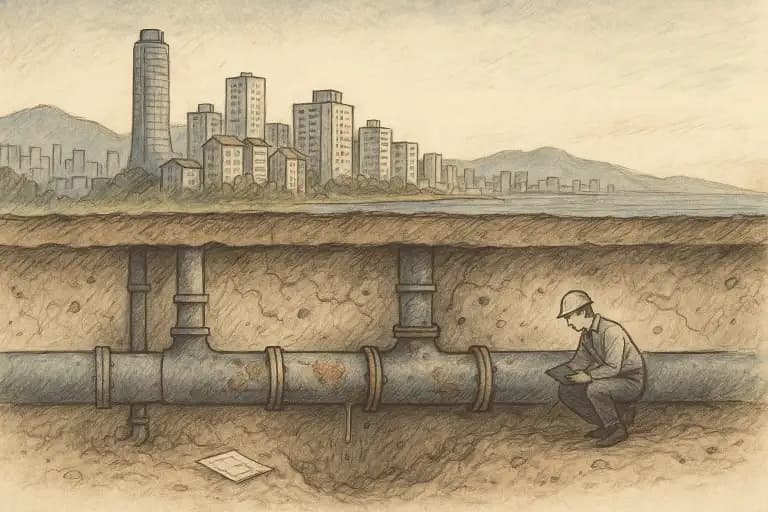
Busan, South Korea — Approximately 400 kilometers of water pipelines across Busan have exceeded 30 years in service. These segments account for nearly 5 percent of the city’s 8,600-kilometer water distribution network. Many were installed in the 1980s or earlier.
In July 2025, a 1993-installed main pipe ruptured beneath a traffic artery in Sasang District. The incident led to street flooding, building damage, and a 72-hour traffic disruption. No advance warning was recorded. Similar failures occurred in Choryang and Bujeon in recent years, affecting water supply to hundreds of households. Post-incident investigations identified material fatigue and joint stress as primary causes.
Water quality complaints remain localized in older districts. Reports of discoloration, metallic taste, and odor continue in Yeongdo, Dong-gu, and Bujeon. Newer areas such as Myeongji, Eco Delta City, and Centum report no significant issues. In those zones, turbidity levels remain below 0.1 NTU.
Water distributed in Busan meets national quality standards at the treatment stage. However, distribution through aging pipelines introduces variability at endpoints. Older neighborhoods with high-density housing and older pipe materials experience more frequent disturbances following maintenance work.
The city’s non-revenue water (NRW) rate—treated water lost before delivery—stands between 6.9 and 7.5 percent, equivalent to approximately ₩36 billion in annual losses. By comparison, Seoul reports an NRW rate of 1.1 percent; Incheon, after post-incident reforms, has reduced its rate to 4.1 percent. The national average is 13.7 percent, according to the Ministry of Environment.
Busan replaces approximately 70 to 80 kilometers of pipeline each year. This pace falls short of the 79 kilometers per year required to address the existing 250-kilometer backlog by 2025. In 2023, the city allocated ₩69.7 billion for water infrastructure, including ₩42.1 billion for pipe replacement and leakage control. Capital and labor constraints remain limiting factors.
Asset tracking varies by district. GIS-based maps are incomplete, and some zones rely on analog records. No citywide asset management system is in operation. ISO 55000-compliant protocols are under review but not implemented. Monitoring infrastructure remains limited in older areas.
The city operates 320 hydraulic zones equipped with pressure sensors and inlet meters. Leakage detection is conducted through acoustic surveys and manual inspections. Smart metering is in pilot use but mechanical meters remain dominant in over 70 percent of households. No predictive modeling system is active.
From 2011 to 2022, Busan replaced 1,087 kilometers of pipe under its first-phase modernization plan. The second phase, launched in 2023, targets full renewal of aging lines by 2030. However, less than 1 percent of the network is replaced annually. Municipal audits have cited inconsistent project timelines, data fragmentation, and insufficient modeling.
Water quality is monitored at 81 locations daily and through quarterly endpoint sampling. There is no automated turbidity alert system. Network flushing is performed manually and is typically reactive, triggered by field observation or resident complaints.
In Seoul, a full-scale asset management system has been implemented, including lifecycle-based scheduling and predictive analytics. K-water operates similar systems across 80 municipalities. Busan does not yet have a digital twin or centralized SCADA system. As of mid-2024, sensor integration remains partial.
Public access to infrastructure data is limited. There is no real-time pipeline condition dashboard or renewal schedule available to residents. City audit reports from 2021 to 2023 emphasized deficiencies in data transparency and risk modeling. No large-scale contamination incidents have occurred in the city within the past three years.
International comparisons underscore structural differences. England, under a privatized water sector since 1989, reports average leakage rates exceeding 20 percent. More than 300,000 untreated sewage discharges were recorded in 2023. In South Korea, water supply remains publicly operated, either by local governments or K-water. Despite disparities in digital modernization, public utilities in Korea maintain stricter oversight of system integrity.
While water companies in England distributed over £57 billion in shareholder dividends from 1991 to 2020, reinvestment in infrastructure lagged behind. In Korea, pricing rigidity and matching fund requirements constrain capital spending. Busan has not adjusted its water tariffs in real terms since 2015.
The city's 2030 modernization target depends on sustained investment, data integration, and operational capacity. Without structural renewal and system-wide diagnostics, the aging network may continue to erode service reliability. Current risks are localized, but the system’s capacity to absorb failure events remains limited by deferred renewal and data absence.
Continue this reporting
Reporting on the same issue
Related coverage selected from the article's desk, topics and newsroom relationships.
 NewsOct 22, 2026
Busan Port’s LNG and Methanol Plan: Who Pays to Keep Fuel Ready?
Busan already supplies ships with LNG and methanol, drawing on regional and i...
 NewsOct 16, 2026
What Is Still Worth Going to See?
Busan’s biennale faces questions of artistic judgment and institutional care....
 NewsOct 14, 2026
What Became of Busan’s University Streets?
From 2015 to 2023, registered businesses grew near Pusan National University...
More from the author
More from this byline
Stay with the same line of reporting through more work from this byline.
- NewsOct 22, 2026
Busan Port’s LNG and Methanol Plan: Who Pays to Keep Fuel Ready?
 NewsOct 12, 2026
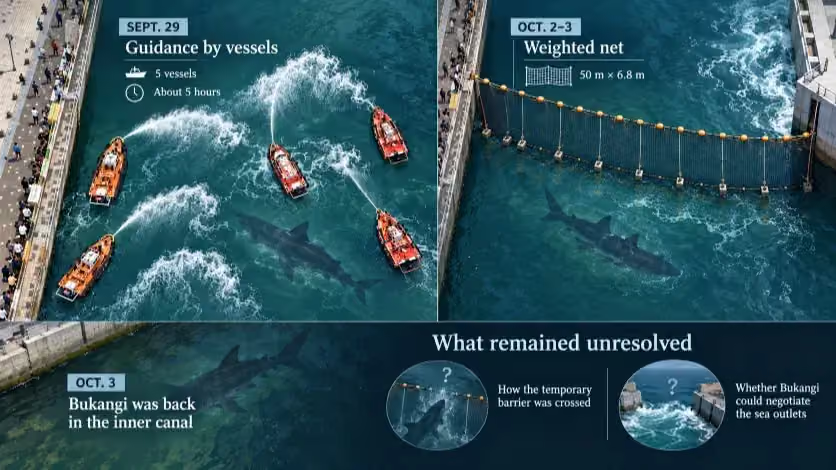
Bukangi, the Shark That Stayed in Busan’s North Port
Reader Signal
Community readWhat did this report leave you with?
Choose the signal that best reflects your reading. Select it again to remove it.
One response per article
No response selected
A moderated conversation about the reporting.
One-level replies and newsroom moderation keep the conversation anchored to this article.
Discussion Status
Open
Please sign in to join the discussion.
Newsletter
Weekly reporting and context from Busan and Korea.