Busan’s 2026 Infrastructure Plans Face Setbacks Despite Record Budgets
Despite significant allocations for airports, metro lines, bridges, and innovation hubs, Busan’s 2026 megaprojects face delays, failed tenders, and engineering risks.


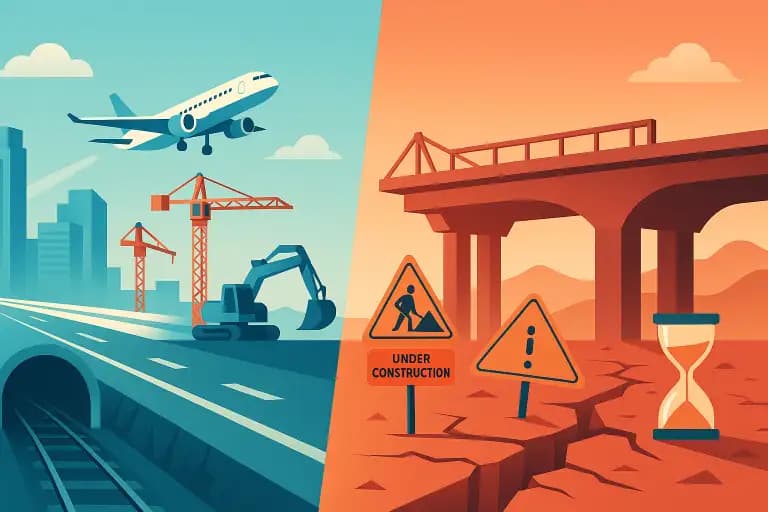
Busan, South Korea — Busan entered the 2026 budget cycle with what appeared to be a major victory. The national government approved about 860 billion KRW for 23 priority projects aimed at reshaping the city’s infrastructure: a long-delayed international airport on Gadeokdo Island, two metro lines across the city’s industrial west, three new bridges over the Nakdonggang River, and a network of innovation hubs intended to draw investment and talent into the region.
2026 Budget · Busan Major Projects
Unit: billion KRW · Total: 868.078
On the ground, however, the story is far less straightforward. The airport project has failed to attract a single qualified bid after four rounds, forcing officials to weigh emergency contracting options as deadlines slip further into uncertainty. One metro line, planned to relieve congestion between Sasang and Hadan, has been plagued by sinkholes deep enough to swallow vehicles, triggering safety investigations and lawsuits over accountability. Another line, from Hadan to Noksan, has already been turned down by major builders citing the risks of tunneling under unstable ground.
The bridges, intended to link commuters with Busan’s future economic zones, face their own obstacles: environmental reviews, land compensation disputes, and a construction timeline stretching well into the next decade. Even smaller projects — from innovation clusters to AgeTech testbeds and cultural tourism sites — risk becoming little more than headlines, as oversight mechanisms remain too weak to ensure delivery.
Busan’s flagship initiatives no longer struggle for funding. They now struggle against time, engineering realities, and the credibility of the promises made when the budgets were announced.
Gadeokdo New Airport – Delays Deepen Despite Record Funding
The Gadeokdo New Airport was meant to be Busan’s showcase project: a development with a total price tag approaching 1 trillion KRW, including 689 billion KRW set aside for 2026 alone. Yet by the summer of 2025, not a single shovel had touched the site. Four separate bidding rounds for the initial site-preparation contract — the largest phase of the build — came and went without success.
Hyundai Engineering & Construction stayed in until the final round but insisted on stretching the construction schedule from 84 months to 108 and demanded additional cost guarantees. Other major firms simply pulled out. They pointed to soft ground conditions, strict liability terms, and an unrealistic timeline as risks they were unwilling to carry.
September brought a shift. The Ministry of Land turned to a negotiated contract, a rare move for a project of this size. Budget officials warned that if the stalemate dragged on, even the 2026 allocation could sit idle while deadlines slipped further into the next fiscal year.
The engineering problems went beyond paperwork. The planned east–west runway cuts across air corridors known for harsh seasonal crosswinds. Environmental studies flagged the Nakdong River estuary as a major hazard for bird strikes — more than 120,000 migratory birds pass through each winter — yet mitigation plans, from radar detection to altered flight paths, remain stuck in draft form.
By late 2025, even the access roads leading to the site had failed to attract contractors after five rounds of bidding. Internal projections now push the opening date well past the original 2029 target, edging toward the early 2030s. The funding may be secure, but without contracts and clear safety measures, the project risks becoming the country’s most expensive construction delay.
Sasang–Hadan Metro Line – Sinkholes and Shifting Ground
The Sasang–Hadan metro line was supposed to unclog Busan’s western industrial belt, linking two of the city’s busiest districts. Instead, it has become a lesson in what can happen when tunneling meets unstable ground. Over the past three years, fourteen sinkholes have appeared along or near the planned route. Some were small enough for overnight repairs. Others left craters several meters wide — one in 2023 swallowed a truck when the pavement gave way near a crowded market.
City Hall initially pointed to leaking water mains beneath decades-old streets. Independent engineers disagreed. Their assessments noted that carving tunnels through layers of alluvial soil beneath dense neighborhoods carries a high risk of collapse, a risk that rises sharply when excavation intersects with groundwater or follows days of heavy rain.
Public confidence eroded as quickly as the soil. In 2025, residents released videos showing the ground subsiding directly above active work zones, contradicting the city’s repeated claims that construction posed no risk to nearby buildings.
The damage is now visible inside homes. Families along the route describe walls cracking and floors tilting weeks after tunneling crews moved on. Compensation claims have mounted as city officials and contractors trade blame over safety monitoring and repairs.
Every stabilization effort adds to the bill. The 30 billion KRW allocated for 2026 is shrinking as costs climb, while delays push completion further beyond the original schedule. National auditors have signaled they may step in if spending continues to run ahead of progress.
Safety dominates discussion in neighborhoods closest to the line. At City Hall, the conversation has shifted to whether one of Busan’s most visible transit projects can move forward without further structural failures — or a backlash over accountability.
Hadan–Noksan Metro Line – No Bidders, No Easy Fix
While tunneling on the Sasang–Hadan line has already triggered sinkholes, the Hadan–Noksan extension has yet to move a single shovel. In June 2025, the city opened bidding for the 13.5-kilometer route. Weeks later, the process closed without a single firm submitting a proposal.
Major builders cited the same reasons: reclaimed land, soft alluvial soil, and the memory of earlier infrastructure projects around Myeongji New City that suffered ground subsidence and runaway stabilization costs.
To keep the project alive, Busan’s transit authority lowered the bar. Companies no longer need an 8.3-kilometer record of similar tunneling experience; the threshold dropped to 5.8 kilometers in hopes of widening the field. The budget remains intact — 148 billion KRW in total, including 37 billion KRW for 2026 — but looser procurement rules do not solve what the soil itself may refuse to permit.
Geotechnical studies show nearly one-fifth of the alignment requires deep excavation beneath water-saturated layers. Engineers warn that even heavy grout injection, diaphragm walls, and round-the-clock monitoring cannot guarantee against water ingress or settlement. A single failed stabilization attempt could halt work completely, repeating the delays already dogging the Sasang–Hadan line.
City officials plan a second round of bidding by late 2025. Contractors remain hesitant, pointing out that once they sign, liability for cost overruns and accidents tends to fall squarely on the builder. Without new risk-sharing terms, the Hadan–Noksan line may follow the same cycle of stalled tenders and last-minute revisions that have slowed other projects across the region.
Nakdonggang River Bridges – Building Links Across Water
Three bridges — Daejeo, Eomgung, and Jangnak — anchor Busan’s plan to connect its expanding western districts with the rest of the city. Together they carry a 46 billion KRW budget and a target completion date set for around 2030.
Work began in stages through 2025, but complications surfaced quickly. At Daejeo Bridge, wetlands protection groups flagged risks to migratory birds, sending the project through multiple rounds of environmental review. Eomgung Bridge ran into land disputes as property owners challenged compensation figures in court, holding up site clearance. Jangnak Bridge, the last in line, entered its design phase under revised traffic forecasts after the national transport ministry questioned whether earlier demand models were overstated.
Separate contracts mean each bridge follows its own schedule, but delays rarely stay isolated. Interchanges, embankments, and approach roads must align across all three projects. A single missed deadline risks leaving entire sections underused for years. Internal reports by late 2025 warned that procurement setbacks had already pushed foundation work into the next fiscal cycle, even as the 2026 budget waits for release.
Environmental review remains the wild card. Korean law allows a single rejection to trigger redesigns lasting years. With the Nakdonggang River designated as a major waterway and wildlife corridor, conservation groups are expected to keep pressing for changes as construction moves toward midstream piers and approach ramps.
By the end of 2025, the bridges stood as much a test of coordination — budgets, permits, schedules across multiple agencies — as of engineering. The question hanging over the projects was no longer whether funding existed but whether the city could align the moving parts before traffic bottlenecks in the 2030s lock in for good.
Innovation and Tourism Projects – High Budgets, Low Transparency
Beyond the transport megaprojects, Busan’s 2026 budget directs 19.7 billion KRW across a cluster of innovation and tourism efforts. These include the North Port Startup Hub (5 billion KRW), AgeTech pilot zones (3 billion KRW), blockchain clusters, the K-Content ecosystem, and new eco-parks along the Nakdong River. The goal is to recast Busan as a center for technology and international tourism rather than a city known only for shipping and heavy industry.
Progress so far is uneven. The Startup Hub broke ground in late 2025, yet internal audits show less than one-fifth of its operating funds tied to concrete programs like venture financing or research partnerships. The AgeTech pilot zone, pitched as a platform for robotics, healthcare devices, and smart-home systems for seniors, still lacks a clear plan for private-sector involvement. That gap raises questions about whether the project will extend beyond small-scale demonstrations.
Tourism projects face their own hurdles. The K-Content initiative promises to draw visitors with music festivals, film events, and esports tournaments linked to new purpose-built venues. But attendance forecasts rely on pre-pandemic baselines that analysts say no longer hold as travel patterns shift and regional competition intensifies. Along the Nakdong River, eco-park construction has slowed after wetlands researchers requested additional flood-risk studies, holding up environmental permits.
The money is in place; transparency is not. Neither Busan City nor the relevant ministries have released consistent data on timelines, cost utilization, or long-term maintenance plans. The risk now is not only delay but the possibility that expensive innovation hubs and cultural sites will open on schedule yet fall short of their economic and social promises.
Systemic Risks and Policy Gaps
Airports, metro lines, bridges, and innovation hubs share the same pattern in Busan’s 2026 portfolio: funding clears parliament, but projects stall over soil risks, failed tenders, environmental reviews, and disputes over liability. Money arrives on time; execution does not.
Procurement rules often load both financial and technical risks onto contractors, a design that keeps major firms from bidding on projects such as the Gadeokdo airport site works or the Hadan–Noksan metro line. Environmental assessments run on timelines disconnected from budget cycles, leaving funds allocated for years while permits remain unresolved. Oversight is fragmented; the Sasang–Hadan sinkholes showed how city departments and contractors can trade blame when no single entity holds clear responsibility.
Policy researchers point to several fixes. Breaking up design and construction contracts could spread risk and attract more bidders rather than locking entire projects into single megadeals. Independent geotechnical surveys before tenders would cut the chance of mid-project redesigns. Real-time dashboards tracking budgets, procurement milestones, and safety incidents could strengthen public transparency. Some lawmakers favor community oversight panels with authority to halt work until environmental or safety concerns are addressed — an approach already tested in parts of Europe and North America.
Adopting any of these measures will depend on political will as much as engineering capacity. Busan’s 2026 program now functions as both an infrastructure agenda and a governance stress test: can the city deliver on schedule while closing the structural gaps exposed across multiple sites?
Governance in an Age of Uncertainty
By the end of 2025, Busan held more confirmed government funding for infrastructure than at any point in its modern history. The numbers promised transformation: a new international airport, two metro lines, three bridges across the Nakdonggang River, and a cluster of innovation hubs. Yet as delays mounted—failed tenders, engineering setbacks, environmental disputes—the question shifted from whether the money existed to whether the city’s institutions could turn budgets into results.
Adaptive governance offers one answer. The idea began as a technical fix: independent geotechnical studies before contracts, real-time public dashboards for safety and spending, procurement rules that share rather than offload risk. But its implications reach further.
Public planning has long assumed stability. A master plan approved decades ago often outlived the political administrations that signed it, persisting even as demographics shifted, technologies advanced, and social priorities evolved. Yet a city facing aging populations, climate shocks, and economic realignments can no longer treat early decisions as immutable. Governance, like science, must accept that no answer is final. A theory is tested, revised, sometimes overturned when new data arrives; urban policy, too, should evolve with similar intellectual humility.
This does not mean abandoning long-term visions. It means designing them with revision in mind: population forecasts recalibrated every few years, budgets tied to measurable outcomes rather than political cycles, environmental models updated as new research emerges. Institutions should not fear changing course; they should see it as evidence of learning.
Busan’s 2026 portfolio, with its budgets secure but timelines slipping, reveals the cost of static planning in a dynamic world. Delivering concrete and steel will require more than engineering capacity or financial discipline. It will demand a culture of governance able to learn, adapt, and sometimes admit that the map itself needs redrawing.
Editor’s Commentary
By the end of 2025, Busan had secured large-scale funding for its 2026 infrastructure projects. Yet its stalled airport tenders, delayed metro lines, and contested bridge projects point to a deeper challenge: institutions built for stability now face a world defined by uncertainty.
Adaptive governance offers a response. It calls for contracts that share risk, environmental and technical reviews before budgets are locked, and public dashboards tracking progress in real time. But beyond procedures lies a philosophical shift: the recognition that, like scientific theories, public plans must be open to revision as new data emerges.
Political philosophy reinforces this idea. In uncertain times, governance must move beyond rigid execution toward what some scholars call deliberative adaptation — decisions that remain open to revision as conditions change, shaped not only by technical expertise but by public reasoning and democratic legitimacy. Like science, which advances by challenging its own assumptions, governance earns trust not by claiming final answers but by creating institutions able to learn, adjust, and act with humility in the face of complexity.
Busan’s 2026 projects thus test more than engineering capacity or fiscal discipline. They ask whether city institutions can learn, adapt, and occasionally redraw the map when circumstances change — treating revision not as failure, but as responsible governance in a world where certainty is no longer guaranteed.
Continue this reporting
Reporting on the same issue
Related coverage selected from the article's desk, topics and newsroom relationships.
 NewsOct 16, 2026
What Is Still Worth Going to See?
Busan’s biennale faces questions of artistic judgment and institutional care....
 NewsOct 14, 2026
What Became of Busan’s University Streets?
From 2015 to 2023, registered businesses grew near Pusan National University...
 NewsOct 12, 2026
Bukangi, the Shark That Stayed in Busan’s North Port
A rescue net guided Bukangi toward the sea, but the dusky shark returned to B...
More from the author
More from this byline
Stay with the same line of reporting through more work from this byline.
 NewsOct 9, 2026
Why “Busan Is Good” Falls Short as a City Brand
 NewsSep 18, 2026
The Other AI Race Is for the Freedom to Change Course
Reader Signal
Community readWhat did this report leave you with?
Choose the signal that best reflects your reading. Select it again to remove it.
One response per article
No response selected
A moderated conversation about the reporting.
One-level replies and newsroom moderation keep the conversation anchored to this article.
Discussion Status
Open
Please sign in to join the discussion.
Newsletter
Weekly reporting and context from Busan and Korea.