Busan–Yangsan–Ulsan Metropolitan Railway Clears Key Government Approval
South Korea has cleared a major hurdle for the Busan–Yangsan–Ulsan metropolitan railway, approving a 47.6 km light rail corridor that will link the country’s southeastern cities in under an hour.

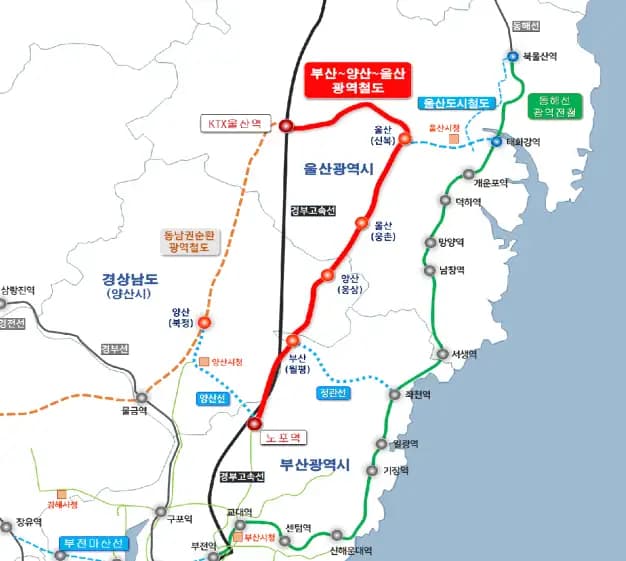
Busan, South Korea — South Korea has cleared a critical hurdle in its bid to physically and economically integrate the country’s southeast. On July 10, the Ministry of Economy and Finance approved the preliminary feasibility study for the Busan–Yangsan–Ulsan Metropolitan Railway, a 47.6-kilometer corridor designed to connect the three industrial cities in under an hour.
The project has lingered on planning desks for years. With formal backing now in place, it is finally moving toward execution. The new line, running from Nopo Station in northern Busan to KTX Ulsan Station, will include 11 stops and tie together a set of transit systems that have so far developed in silos. The estimated cost stands at 2.55 trillion won, and the line will operate as an automated light rail, with 35 daily services expected once it is fully operational.
But the railway represents more than just improved commute times. Government officials view it as the backbone of a more integrated southeastern economic bloc—one that has long shared industrial linkages but lacked cohesive transportation infrastructure. The corridor will link Busan’s logistics-heavy port economy, Yangsan’s growing manufacturing zones, and Ulsan’s heavy industry and research sectors, including the campus of UNIST.
The project has drawn unusually strong cross-government support. Leaders from Busan, Ulsan, and South Gyeongsang Province jointly called for the line’s early approval last year. In June, five National Assembly members representing the region publicly endorsed the plan. The railway was earlier named one of five flagship non-capital rail projects under a 2021 national development initiative, reflecting its strategic role in decentralizing growth from the Seoul metropolitan area.
Much of the focus is now turning to Nopo, a district that until recently served more as a transit terminus than a destination in its own right. Currently the endpoint of Busan Metro Line 1, Nopo is poised to become a major transfer hub, linking the city’s subway with the Yangsan Line, the new metropolitan railway, and eventually the planned Jeonggwan Line. The city hopes that this convergence will transform Nopo into a new urban node in the southeastern corridor.
For Gijang County, which includes Jeonggwan, the project carries particular weight. Residents there have long pushed for direct rail access, and the forward momentum on the metropolitan railway may finally help unlock the stalled Jeonggwan Line. If realized, the extension could link to the Donghae coastal line, improving access to Busan’s eastern districts and beyond.
Nationally, the project fits into a broader government strategy to build so-called “one-hour living zones” outside the capital. The goal is to make commuting and daily mobility across city boundaries possible without relying on highways or intercity buses. In this context, the Busan–Yangsan–Ulsan Metropolitan Railway serves as a test case—not just for rail engineering, but for rethinking how South Korea’s regional cities connect and grow together.
Still, there are years of work ahead. The Ministry of Land, Infrastructure and Transport is expected to begin route planning and environmental assessments later this year. Detailed design, land acquisition, and cost-sharing negotiations will follow. Construction is unlikely to begin before 2027, with operations projected to start around 2031.
Concerns remain. South Korea is already juggling multiple regional rail projects, each with ambitious budgets and tight timelines. Some experts question whether passenger demand will justify the scale of investment, while others point to prior infrastructure projects that ran into delays and cost overruns.
Despite that, optimism remains strong in Busan. Mayor Park Heong-joon described the project as “a chance to rewire the region,” both in physical and economic terms. “This will benefit not only the northeastern districts of our city, but the entire southeastern region,” he said. “It’s how we start correcting the imbalance and building a more connected future.”
Whether that vision survives the slow march of planning, permitting, and construction remains to be seen. But for now, the Busan–Yangsan–Ulsan Metropolitan Railway is no longer just a concept. In a region often overlooked in national planning, simply moving forward is no small feat.
Continue this reporting
Reporting on the same issue
Related coverage selected from the article's desk, topics and newsroom relationships.
 NewsOct 23, 2026
Busan’s Twelve-Year School Account Faces a Test Beyond Access
Busan’s PENZ promises one school account for 12 years, while BeAT brings AI t...
 NewsOct 22, 2026
Busan Port’s LNG and Methanol Plan: Who Pays to Keep Fuel Ready?
Busan already supplies ships with LNG and methanol, drawing on regional and i...
 NewsOct 16, 2026
What Is Still Worth Going to See?
Busan’s biennale faces questions of artistic judgment and institutional care....
More from the author
More from this byline
Stay with the same line of reporting through more work from this byline.
- NewsOct 22, 2026
Busan Port’s LNG and Methanol Plan: Who Pays to Keep Fuel Ready?
 NewsOct 12, 2026
Bukangi, the Shark That Stayed in Busan’s North Port
Reader Signal
Community readWhat did this report leave you with?
Choose the signal that best reflects your reading. Select it again to remove it.
One response per article
No response selected
A moderated conversation about the reporting.
One-level replies and newsroom moderation keep the conversation anchored to this article.
Discussion Status
Open
Please sign in to join the discussion.
Newsletter
Weekly reporting and context from Busan and Korea.