Busan Tourism Hits Record 2 Million Visitors in 2025, On Track for 3 Million by Year’s End
Busan welcomed over 2M foreign visitors by July 2025, a 23% rise YoY. The city is on course to exceed 3M arrivals for the first time.


Busan, South Korea — Busan crossed the two-million mark for foreign visitors in July, the fastest pace since records began and a milestone that officials say puts the city on track for its busiest year yet. According to city data, 2,003,466 overseas travelers arrived between January and July, a 23 percent jump on the same period last year. For a destination that only counted around 150,000 foreign visitors at the height of the pandemic in 2021, the turnaround has been striking.
The scale becomes clearer in comparison. Busan’s previous high point was 2.68 million foreign arrivals in 2019, before borders shut. That figure was already surpassed last year with 2.93 million. Hitting two million in mid-summer this year suggests that the long-promised “three-million era” is no longer a stretch target but an expectation. Nationally, South Korea received about 10.6 million visitors in the first seven months of 2025, which means nearly one in five headed south to Busan.
Busan Tourism 2025 — Snapshot
Source Markets · Share
Entry Routes · Composition
The composition of travelers reveals both diversity and concentration. Taiwanese tourists led the way with just under 380,000 arrivals, roughly 19 percent of the total. They were followed by visitors from China at 315,000 and Japan at 267,000. Americans and Filipinos rounded out the top five. Each group travels differently. Taiwanese arrivals are helped by short-haul flights and clever marketing — one budget airline even offered an in-flight meal styled after Busan’s pork rice soup, a small gimmick that turned into a talking point. Japanese travelers, by contrast, often come by sea, a reminder that ferry links across the Korea Strait remain vital. Chinese numbers, solid already, are expected to climb as visa-free group travel resumes this autumn.
How people get into the city tells its own story. About 42 percent landed directly at Gimhae International Airport, while 15 percent arrived by sea. Another 43 percent entered Korea elsewhere, usually through Incheon, before making their way to Busan by rail or domestic flights. Cruise traffic has returned with force: 185 calls are scheduled this year, carrying close to 300,000 passengers. On docking days, shopkeepers in Nampo-dong report waves of new faces in their narrow alleys, a scene that had been missing for years.
Spending is climbing just as quickly. Credit card use by foreign visitors reached 438.9 billion won (about US$323 million) through July, up more than a quarter from last year and far above the national growth rate of 9 percent. The makeup of that spending has changed as well. Shopping is no longer the overwhelming driver. Dining, nightlife, and leisure activities now take a bigger share. Surveys show more than four in five visitors cite scenery and food as highlights, compared with fewer than six in ten who emphasize shopping. The average stay is 6.2 days, with per-capita spending of $828.
Those numbers are felt on the ground. Hotels in Haeundae say rooms rarely sit empty. Bars and restaurants around Gwangalli Beach have seen steady business from foreign patrons. Seomyeon, once known mainly for domestic nightlife, is now a regular stop for younger visitors from Taiwan and Southeast Asia. Satisfaction ratings back this up: in last year’s survey, more than 99 percent of foreign tourists said they were pleased with their trip. The high figure flatters the city but also hints at expectations that will need to be managed.
Officials are leaning on events to keep the momentum. The Busan International Rock Festival and the Busan International Film Festival return in October. The fireworks festival on November 15 is expected to pack the waterfront. Cirque du Soleil’s touring show “KOOZA,” which opened in late August, has added an international marquee name to the calendar. Tourism authorities hope these spectacles do more than fill hotel rooms — they want them to cement Busan’s image as a cultural city with global pull.
Looking ahead, the projections vary but all point upward. If the second half of 2025 simply matches last year’s performance, Busan would end with just over 3.05 million visitors. With the added lift from Chinese group tours, cruise ships, and headline events, the figure could reach between 3.3 and 3.6 million. There are caveats: airlines have only so many seats to sell, the currency can sway spending power, and typhoons remain an unwelcome wild card. But the direction of travel seems set.
Regionally, Busan is still smaller than tourism heavyweights like Bangkok or Singapore, yet its growth rate is beginning to attract attention. City leaders have been quick to claim credit, pointing to years of work branding Busan as a seaside metropolis with its own character distinct from Seoul. Mayor Park Hyung-joon called the early milestone “an encouraging sign” and said the city would continue to push toward the goal of becoming a global tourism hub.
What stands out is how Busan has managed to turn its limitations into assets. Distance from the capital once left the city overlooked; now it helps define Busan as a separate destination with its own beaches, harbors and festivals. The challenge will be to carry this surge into the years beyond 2025, when novelty fades and competition intensifies. For now, though, the record summer tells a simple story: Busan is no longer just Korea’s second city. It is a destination in its own right, and visitors are responding in numbers the city has never seen before.
Continue this reporting
Reporting on the same issue
Related coverage selected from the article's desk, topics and newsroom relationships.
 NewsOct 22, 2026
Busan Port’s LNG and Methanol Plan: Who Pays to Keep Fuel Ready?
Busan already supplies ships with LNG and methanol, drawing on regional and i...
 NewsOct 16, 2026
What Is Still Worth Going to See?
Busan’s biennale faces questions of artistic judgment and institutional care....
 NewsOct 14, 2026
What Became of Busan’s University Streets?
From 2015 to 2023, registered businesses grew near Pusan National University...
More from the author
More from this byline
Stay with the same line of reporting through more work from this byline.
- NewsOct 22, 2026
Busan Port’s LNG and Methanol Plan: Who Pays to Keep Fuel Ready?
 NewsOct 12, 2026
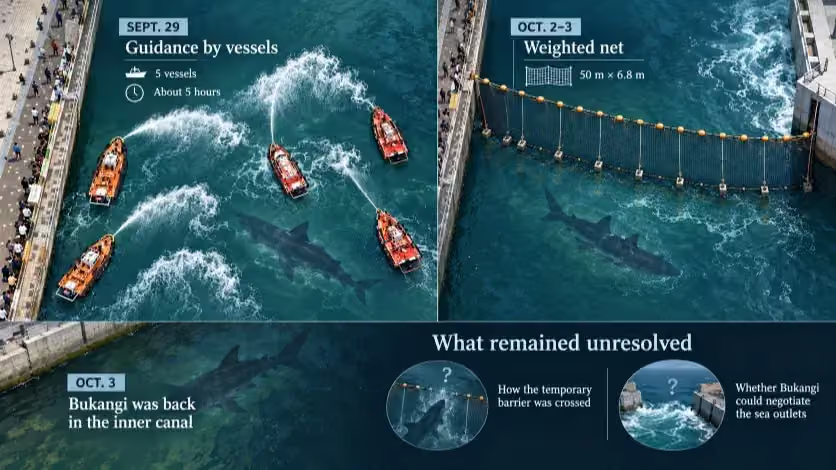
Bukangi, the Shark That Stayed in Busan’s North Port
Reader Signal
Community readWhat did this report leave you with?
Choose the signal that best reflects your reading. Select it again to remove it.
One response per article
No response selected
A moderated conversation about the reporting.
One-level replies and newsroom moderation keep the conversation anchored to this article.
Discussion Status
Open
Please sign in to join the discussion.
Newsletter
Weekly reporting and context from Busan and Korea.