Busan to Waive Rush-Hour Tolls on Eulsukdo Bridge and Sanseong Tunnel
Seven toll roads shape daily life in Busan. New policies remove tolls during peak hours, offering relief to drivers while shifting costs to taxpayers and highlighting the city’s dependence on privatized infrastructure.

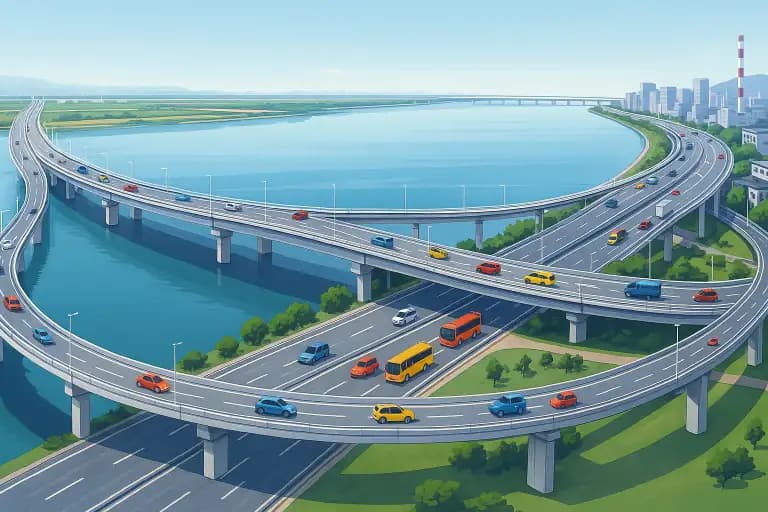
Busan, South Korea — On November 1, Busan will begin waiving tolls during weekday rush hours on two of its busiest routes, the Eulsukdodaegyo Bridge and the Sanseong Tunnel. From six to nine in the morning and again from five to eight in the evening, drivers will pass free of charge. The measure, billed as a way to ease household expenses and smooth daily commutes, marks the first step in what the city describes as a gradual expansion of toll relief across all seven privately operated roads.
For commuters, the impact is immediate and measurable. A resident of western Busan who drives through the Sanseong Tunnel twice a day currently pays about ₩60,000 a month. From November, that cost disappears. City officials hope such savings will soften the sting of rising living costs and signal that local government can deliver tangible relief.
The financial arithmetic, however, points in a different direction. According to city estimates, the free-pass policy on just these two roads will cost the municipal budget around ₩12 to ₩13 billion annually in compensation to concession operators. Should the plan be extended to all six major toll roads under Busan’s jurisdiction (excluding the cross-provincial Geogadaegyo Bridge), the bill could climb past ₩30 billion a year. What looks like a windfall for drivers is, in practice, a transfer from toll booths to the city treasury.
The benefits of Busan’s toll holiday are not evenly shared. The gains accrue almost entirely to car owners in districts where toll roads form the only viable commuting routes. For residents who rely on buses or the city’s limited subway network, there is no equivalent relief. Public transit fares continue to rise, and with them the sense that policy favors motorists over the majority of daily travelers.
That disparity has already drawn quiet criticism from transport researchers, who argue that subsidies directed at toll roads invert the principle of “mobility equity.” In effect, tax revenues collected from all citizens are used to underwrite free passage for a subset of drivers—often those able to afford private vehicles in the first place.
There are also concerns about what toll exemptions will do to traffic flows. Urban planners note the risk of induced demand: once the price signal disappears, more drivers may choose to use the tunnels and bridges at peak times, leading to congestion as severe as before. For the Sanseong Tunnel, already a pressure point in morning traffic, the policy could simply shift costs from wallets to wasted time. Environmental groups warn of a similar rebound in emissions, as lower driving costs encourage greater car use in a city that has yet to curb its carbon output.
Busan’s situation contrasts sharply with that of other Korean metropolises. In Seoul, toll roads are the exception rather than the rule. The capital’s road network is overwhelmingly public, with only a handful of underground expressways such as the Shinyul–Yeoui and the Seobu Expressway under 30-year concessions. Even there, the city couples tolls with congestion management policies: the Namsan tunnels, for example, levy a congestion charge not to recover construction costs but to curb car use.
Incheon presents another model. Its two best-known toll facilities, the Incheon and Yeongjong bridges, are international gateways linking the mainland to Incheon International Airport. Their fees have long been contentious, sparking repeated renegotiations and state subsidies to bring charges down. Yet for most Incheon residents, these toll roads are not part of everyday commuting.
Daegu offers a different lesson. The Apsan Tunnel, opened in 2013 under a 26-year concession, fell short of traffic forecasts. Instead of passing losses to drivers, the city restructured the deal, freezing tolls and sharing refinancing gains. Daejeon and Gwangju, meanwhile, have only one or two minor concession projects each, with far less impact on daily life.
Taken together, the comparison underscores Busan’s distinct position. Where Seoul uses tolling selectively to regulate traffic, and Incheon wrestles with high-profile connectors to an airport, Busan lives with a network in which core commuter arteries are privately operated and tolled. That structural reliance magnifies both the promise and the peril of any toll-relief scheme.
Busan’s reliance on toll infrastructure is not an accident of policy but a by-product of geography and timing. Hemmed in by steep mountains and a jagged coastline, the city had little choice but to rely on bridges and long tunnels to connect its districts. Unlike Seoul, where arterial roads could be built across relatively flat plains, most of Busan’s expansions required costly engineering works over water or through rock.
During the late 1990s and early 2000s, when fiscal capacity was constrained by the Asian financial crisis, city authorities leaned heavily on build–operate–transfer (BOT) concessions to finance those projects. Private operators supplied the capital in exchange for toll collection rights lasting 25 to 40 years. By the time the Eulsukdodaegyo Bridge opened in 2010 and the Sanseong Tunnel in 2018, Busan’s road network had become interlaced with privatized segments that function less as optional bypasses than as essential commuter arteries.
Today, seven toll roads cut across the city, with concession contracts running into the 2040s and beyond. The arrangement means Busan’s residents pay twice—once at the toll gate, and again through taxes that compensate operators whenever the government steps in. Unlike other metropolitan areas, where toll roads are peripheral or occasional, in Busan they cut directly through the city’s commuting backbone.
The new rush-hour exemption delivers clear benefits for drivers. For thousands of daily commuters, the savings are immediate. Yet each toll waived is reimbursed from the public purse, and those payments will continue for as long as contracts remain in force. Unless renegotiated or supported by central government, the city is accepting a recurring fiscal obligation that may squeeze other priorities.
The measure also raises sharper questions. Should taxpayers subsidize private car travel while transit fares climb? Will removing the toll charge simply invite more vehicles onto already saturated roads? And how can a city so reliant on privately operated arteries align its infrastructure legacy with ambitions for fairer, lower-carbon mobility?
For now, Busan’s toll relief offers short-term ease while leaving longer-term trade-offs unresolved.
Continue this reporting
Reporting on the same issue
Related coverage selected from the article's desk, topics and newsroom relationships.
 NewsOct 22, 2026
Busan Port’s LNG and Methanol Plan: Who Pays to Keep Fuel Ready?
Busan already supplies ships with LNG and methanol, drawing on regional and i...
 NewsOct 16, 2026
What Is Still Worth Going to See?
Busan’s biennale faces questions of artistic judgment and institutional care....
 NewsOct 14, 2026
What Became of Busan’s University Streets?
From 2015 to 2023, registered businesses grew near Pusan National University...
More from the author
More from this byline
Stay with the same line of reporting through more work from this byline.
- NewsOct 22, 2026
Busan Port’s LNG and Methanol Plan: Who Pays to Keep Fuel Ready?
 NewsOct 12, 2026
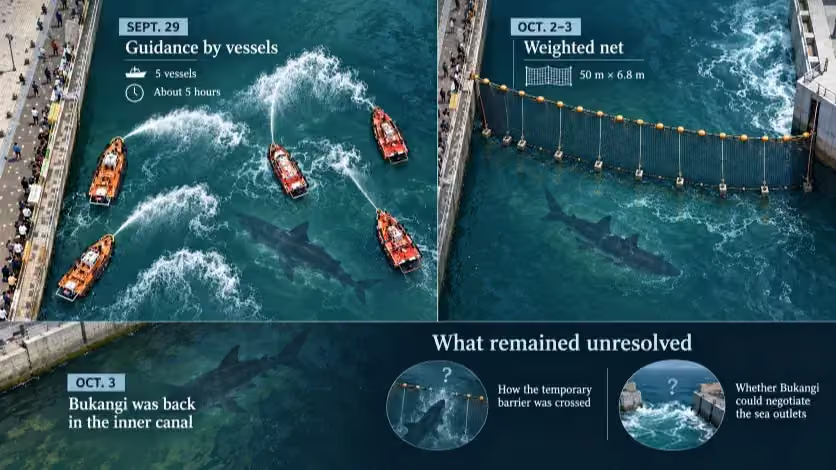
Bukangi, the Shark That Stayed in Busan’s North Port
Reader Signal
Community readWhat did this report leave you with?
Choose the signal that best reflects your reading. Select it again to remove it.
One response per article
No response selected
A moderated conversation about the reporting.
One-level replies and newsroom moderation keep the conversation anchored to this article.
Discussion Status
Open
Please sign in to join the discussion.
Newsletter
Weekly reporting and context from Busan and Korea.