Busan to Redesign 1.2km Stretch of Dadaepo Beach by 2026
Busan will begin a 5.6 billion-won public design project along a 1.2km stretch of Dadaepo Beach in 2025.

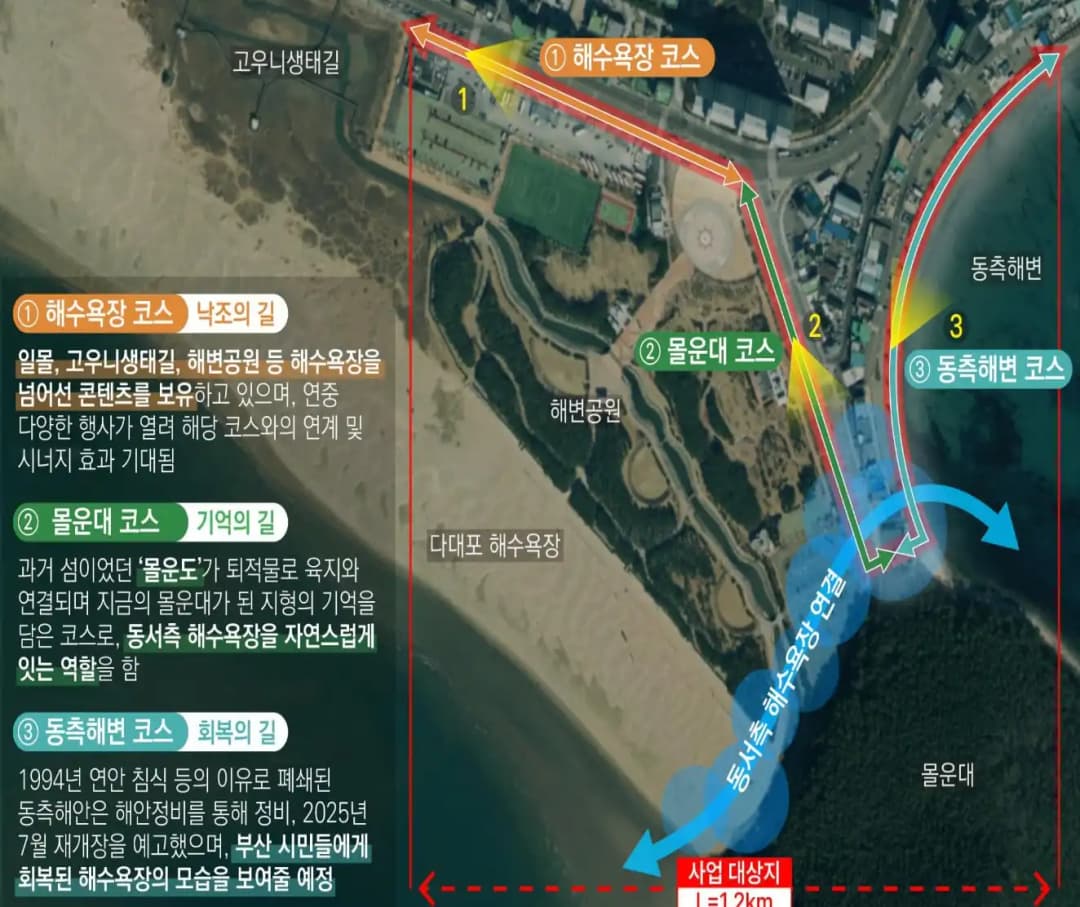
Busan, South Korea — Dadaepo is one of those places that feels distant, even when it’s not. It sits quietly at the far edge of Busan, where the land pulls back into wetlands and wide beach. For many locals, it’s the last stop—both geographically and figuratively. The city’s subway ends here. So do most people’s expectations.
The beach itself is large and gentle. The tides stretch far and the horizon is broad. Sunsets here draw photographers and couples more than swimmers. Despite being one of Busan’s seven official beaches, Dadaepo has never attracted the same crowds as Haeundae or Gwangalli.
Busan is moving ahead with plans to improve a 1.2-kilometer stretch along Dadaepo Beach, from the subway station to the eastern trail. The city focuses on access and continuity— making the space easier to use.
The budget is set at just over 5.6 billion won, about 4.2 million dollars. Most of that will go into design execution: replacing old street furniture, installing new path lighting, and reworking way finding systems. The city describes the project as part of a broader move toward coordinated design in public spaces—less decorative, more functional.
Dadaepo’s numbers are steady but modest. Last year, the beach saw roughly 1.15 million visitors—about one-eighth of Haeundae’s traffic. The city doesn’t expect that to change overnight, nor is that the goal. What it wants is a space that encourages people to stay longer. To walk the whole stretch, to use the beach not just as a destination, but as a route.
Dadaepo was chosen in part because it hasn’t been heavily redeveloped. The shoreline is still open. The trails were recently restored. Few design interventions exist there now, which made it easier to start fresh.
Benches, lighting, and other elements along the route are based on public design proposals selected through a city-run competition last year. Some of the winning pieces were tested earlier this year near Gwangalli Beach. Dadaepo will be the first site where the designs are implemented at scale.
But implementation here won’t mean copy-pasting. The terrain and atmosphere are different. The street furniture will be adjusted for site conditions. For example, seating will be placed along wind-sheltered sections of the path. Signage will support four languages. Lighting will be directed low to minimize glare and protect nighttime views of the sky.
At points, the intervention will be barely noticeable. That’s intentional. Officials say the goal is to make the area legible—easier to read as a space. The new design doesn’t call for grand forms or showpiece architecture. Instead, it asks how people move, where they pause, and what they might need if they decide to stay a little longer.
This part of Busan—the southwest—has rarely been the focus of city-led design projects. Most recent efforts have centered around the more visible and high-traffic areas of the east and central districts. Dadaepo presents a different condition: quieter, slower, more open. It’s the kind of place where small changes carry weight.
The city hopes the Dadaepo project can serve as a model—not in terms of style, but in process. The use of open competition, selection through review, and site-specific application is a framework that can be adapted elsewhere. Several other districts have similar needs, though none will have the same solution.
Work is scheduled to start in early 2026 and finish by May. The schedule is tight, but manageable. Maintenance will be coordinated from the outset, based on previous experience where neglected upkeep weakened otherwise good design. That part, officials note, is essential.
What Dadaepo becomes after that isn’t entirely up to the city. It will depend on whether people use the space the way it’s being imagined: not as a spectacular new attraction, but as a better version of what’s already there. A walk, a rest, a route home. Sometimes, that’s enough.
Continue this reporting
Reporting on the same issue
Related coverage selected from the article's desk, topics and newsroom relationships.
 NewsOct 22, 2026
Busan Port’s LNG and Methanol Plan: Who Pays to Keep Fuel Ready?
Busan already supplies ships with LNG and methanol, drawing on regional and i...
 NewsOct 16, 2026
What Is Still Worth Going to See?
Busan’s biennale faces questions of artistic judgment and institutional care....
 NewsOct 14, 2026
What Became of Busan’s University Streets?
From 2015 to 2023, registered businesses grew near Pusan National University...
More from the author
More from this byline
Stay with the same line of reporting through more work from this byline.
- NewsOct 22, 2026
Busan Port’s LNG and Methanol Plan: Who Pays to Keep Fuel Ready?
 NewsOct 12, 2026
Bukangi, the Shark That Stayed in Busan’s North Port
Reader Signal
Community readWhat did this report leave you with?
Choose the signal that best reflects your reading. Select it again to remove it.
One response per article
No response selected
A moderated conversation about the reporting.
One-level replies and newsroom moderation keep the conversation anchored to this article.
Discussion Status
Open
Please sign in to join the discussion.
Newsletter
Weekly reporting and context from Busan and Korea.