Busan to Introduce Full Free Childcare for Ages 3–5 from 2026
Busan will implement full free childcare for children aged three to five beginning in 2026, eliminating all remaining out-of-pocket costs for parents and extending new benefits to foreign-national families.

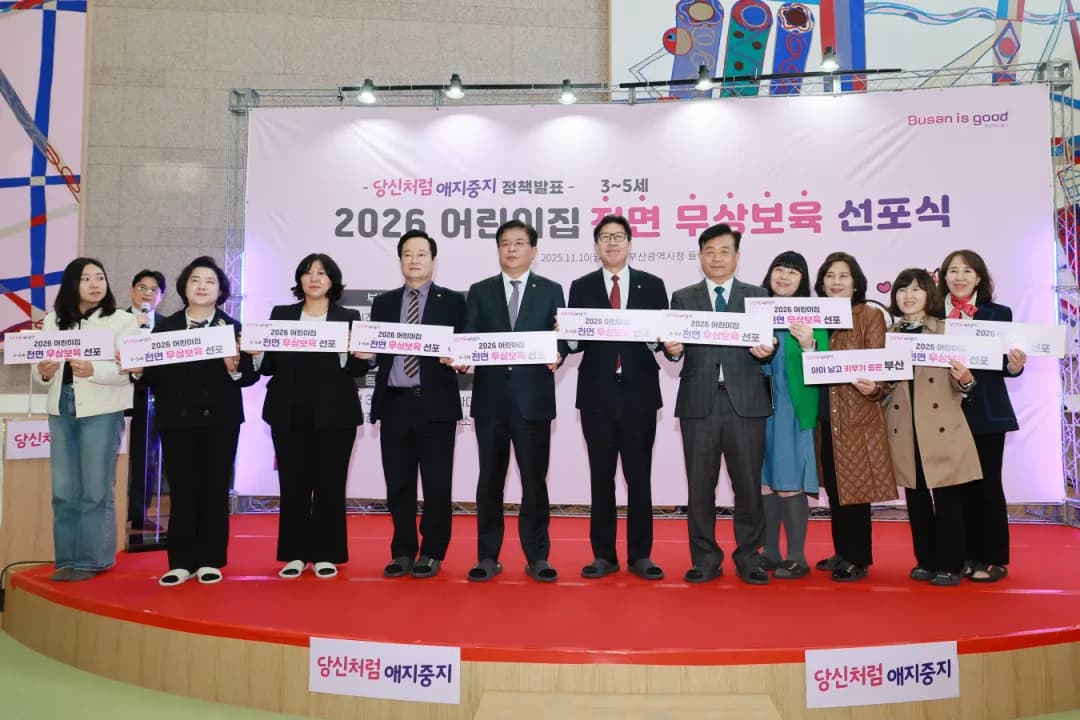
Busan, South Korea — Busan Metropolitan City announced on Monday that it will introduce full free childcare for children aged three to five starting in 2026, expanding its welfare policies to reduce the cost burden on parents and raise the quality of early childhood education. The declaration was made at City Hall’s Deullaknalak Hall, where Mayor Park Heong-joon, City Council Chair Ahn Seong-min and members of the Welfare and Environment Committee outlined the city’s new childcare plan.
The program will abolish the remaining “necessary expenses” that parents have paid on top of free national childcare tuition. From next year, Busan will grant an additional forty thousand won per month for each child aged three to five to cover special activities, field trips, parent-participation events and specialized learning materials. The new support will bring total monthly assistance to roughly 137,000 won per child, effectively ending out-of-pocket costs for families.
For infants aged under three, the city will increase meal and snack subsidies from eight thousand to twelve thousand won per month, narrowing the gap between age groups. Busan will also, for the first time, provide a one hundred thousand won monthly childcare subsidy for foreign-national children aged three to five, addressing a long-standing gap in national welfare coverage that excludes non-Korean citizens. Officials estimate about 150 children will initially benefit.
To make care more flexible, Busan will expand the number of “365 Open-Time Daycare Centers” — which operate during evenings, weekends and holidays — from ten to thirteen. Ten new part-time daycare classes will be created, and two additional joint workplace daycare centers will open in March 2026, bringing the total to seven. Officials said these measures aim to improve access for working parents and strengthen the local childcare network.
According to the city, the 2026 initiative will support a total of 42,537 children — 12,371 aged three to five, including about 150 of foreign nationality, and 30,166 infants. The overall budget stands at 23.88 billion won, with 22.1 billion won earmarked for the necessary-expense program. Funding will come from 16.4 billion won in municipal funds and 5.7 billion won from the Ministry of Education. The plan forms part of Busan’s “Like You Cherish” policy brand, launched in 2024 to encourage higher birthrates and promote a family-friendly environment.
Mayor Park said the policy represents a major step toward an integrated “parenting city” that links childcare, education, housing and jobs, describing the goal as a Busan “where children’s laughter can be heard everywhere.” City Council Chair Ahn Seong-min stressed that ensuring the quality of public childcare at the same level as home care is vital to addressing the country’s low-birthrate challenge.
Busan’s decision places it among the country’s leading local governments pursuing universal childcare. Seoul currently reimburses about half of daycare fees for foreign-national children through its “Happy Parent” card program, with support levels varying by age — roughly 283,000 won monthly for infants and 140,000 won for preschoolers — but unregistered migrant children remain ineligible. Incheon became the first metropolitan government to fully cover “necessary expenses” for five-year-olds in 2025 and now provides 200,000 won per month in daycare support and up to 400,000 won for kindergartens for foreign-national children. Busan’s design merges both approaches, combining complete coverage of incidental costs for ages three to five with a fixed cash benefit for non-Korean children.
In Gyeonggi Province, a separate provincial program has been in place since 2023, granting 100,000 won per month to registered foreign children in daycare, raised to 150,000 won in 2025 to reflect inflation. Daedeok District in Daejeon also launched a 100,000-won monthly subsidy for foreign children in 2025, while several regional governments, including Gangwon Special Self-Governing Province, have tied support for multicultural families to the national Multicultural Family Support Act. Busan’s inclusion of foreign nationals regardless of family status or visa category sets a precedent for a broader, more inclusive local welfare framework.
Gyeongsangnam-do (South Gyeongsang Province) has already taken steps in a similar direction. The province introduced full coverage of daycare “necessary expenses” for five-year-olds in 2023 and expanded the program to four- and five-year-olds in 2024, with plans to include three-year-olds by 2025. Its budget that year totaled approximately 16.18 billion won — 4.85 billion from provincial funds and 11.33 billion from city and county governments — benefiting about 8,700 children. The covered items include special activity fees of 60,000 won per month, field trip fees of 40,000 won per quarter, vehicle operation costs of 30,000 won per month, parental event expenses of 100,000 won per year, and specialized program fees of 30,000 won per month. Gyeongnam also launched its own subsidy for foreign-national children aged three to five, offering 100,000 won monthly to those enrolled in daycare centers. For 2025, the province’s overall childcare budget reached about 809.9 billion won, encompassing six major projects to strengthen childcare and reduce parental burdens.
Compared with Gyeongnam’s phased approach, Busan’s plan is broader in scope and explicitly targets all three- to five-year-olds at once, while simultaneously addressing both Korean and non-Korean families. Gyeongnam’s earlier measures have helped set the stage for regional competition in childcare policy, but Busan’s initiative distinguishes itself by unifying financial aid, facility expansion and inclusion measures under one metropolitan framework scheduled for citywide implementation in 2026.
Nationwide, tuition for children aged three to five has long been covered under the government’s Nuri Curriculum, but parents have continued to pay out of pocket for field trips, special programs and other incidental costs. As Incheon, Seoul and Gyeongnam roll out their own versions of expanded support, Busan’s 2026 plan signals that regional governments are treating childcare policy as a central pillar in their demographic and social strategies. Officials believe the combined measures could not only ease economic strain on families but also help sustain the modest recovery in birth numbers seen in Busan since 2024, when the city’s total fertility rate rose to 0.68 — its first increase in nine years — and births grew by 1.5 percent.
The new initiative still requires formal budget approval, but city officials expect it to pass early next year. If carried out as planned, Busan will become the first major metropolitan government to deliver de facto full free childcare for every child aged three to five, while also extending equal benefits to foreign residents and multicultural families. The city says its long-term goal is to ensure that all children in Busan, regardless of nationality or family background, can grow up together in the same classrooms with equal opportunities for care, learning and belonging.
Continue this reporting
Reporting on the same issue
Related coverage selected from the article's desk, topics and newsroom relationships.
 NewsSep 20, 2026
What It Takes for U.S. Navy Repair Work to Become a Busan Industry
HJ Shipbuilding has brought U.S. Navy maintenance work to Yeongdo. Whether it...
 NewsSep 17, 2026
Busan’s Finished Homes, Unfinished Projects
Busan’s unsold homes sit in one monthly total, but they belong to very differ...
 NewsSep 16, 2026
Busan’s Young-Adult Migration Turns Sharply at 25–29
Busan can still draw young adults into the city, but keeping them becomes far...
More from the author
More from this byline
Stay with the same line of reporting through more work from this byline.

Editorial Record
Corrections, sourcing notes and newsroom disclosures remain part of the published record. View Newsroom Notes →
Reader Signal
Community readWhat did this report leave you with?
Choose the signal that best reflects your reading. Select it again to remove it.
One response per article
No response selected
A moderated conversation about the reporting.
One-level replies and newsroom moderation keep the conversation anchored to this article.
Discussion Status
Open
Please sign in to join the discussion.
Newsletter
Weekly reporting and context from Busan and Korea.