Busan Showcases ‘Busan-Style’ Design in 2025 Architecture Awards
Busan has named eight winners of its 2025 Architecture Awards, honoring designs that reflect the city’s coastal identity and community spirit.

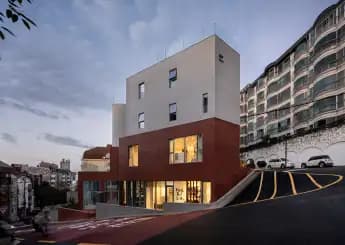
Busan, South Korea — Busan has named the winners of its 2025 Busan-style Architecture Awards, placing the spotlight on buildings that do more than stand upright and meet code. Announced on Friday morning, the list includes eight projects—public and private—that city officials believe capture the character of this waterfront city, a place where hills slide into harbors and history still lingers in the street plan.
The awards are handed out each year, but this round feels unusually grounded in the idea that architecture should belong to its surroundings, not just occupy them.
The top honor went to the Jure Open Library in Sasang District. On approach, it doesn’t read like a traditional library at all—glass, terraces, and a gentle slope leading you upward, more like a park that grew walls. Inside, children’s spaces spill toward family rooms, open staircases draw you between floors, and daylight moves through the building without obstruction.
It sits on a plot once meant for an apartment complex, now reclaimed by the district for something the community had been asking for: a place to read, to meet, to linger. City planners have called it a working model of the “15-minute city,” an urban ideal in which culture and daily needs are never far from home.
Across town, on the curve of Dalmaji Hill in Haeundae, the Gold Prize winner is tucked into a triangle of land that most developers might have dismissed. The building is called Ecke—German for “corner”—and it leans into its odd geometry.
Multiple street-level entrances pull you in from different directions, and at the heart of it all is an open courtyard that doubles as a public stairway, stitching together the upper and lower halves of the neighborhood. It’s small in scale but stubbornly local, a mix of boutique shops, cafés, and short-stay rooms that have become part of the area’s rhythm.
Other projects were recognized as well: a new library in Nam District designed with an eye toward flexibility, a compact hospitality spot in Busanjin, a purpose-built concert hall for classical music, and a waterfront commercial space in Suyeong that knows how to frame a view. Two more—an industrial office remake in Saha and a welfare center in Yeonje—were noted for proving that specialized facilities can still feel connected to city life.
Each one, in its own way, tries to open rather than close, to face outward instead of in.
While the jury praised the winning designs for their openness and sensitivity to context, some observers have noted that most of the projects are concentrated in already well-served districts, leaving peripheral neighborhoods underrepresented. Others question whether the “Busan-style” label, though evocative, is more slogan than standard—a concept still waiting for clear benchmarks that could guide future developments.
There are also concerns about longevity; public buildings, in particular, can suffer from underfunded maintenance and fading programming once the ribbon-cutting is over. Without sustained investment, even the most thoughtful design can lose its intended public value.
The formal ceremony will come in mid-September, folded into the Busan Architecture Festival at BEXCO. For five days the winning projects will be displayed under one roof before the exhibition moves out into the districts, closer to the people who might actually use these spaces.
There is, in all of this, a quiet insistence from City Hall: that “Busan-style” is not a tagline for glossy brochures, but a habit of building that takes the sea, the slopes, and the streets seriously.
It is not a perfect formula, and the city knows it. But the 2025 winners hint at a direction—one where new buildings might feel as if they have always been here, and where the lines between public space and private threshold stay deliberately thin.
In a place like Busan, that may be the most enduring kind of modern.
Continue this reporting
Reporting on the same issue
Related coverage selected from the article's desk, topics and newsroom relationships.
 NewsOct 22, 2026
Busan Port’s LNG and Methanol Plan: Who Pays to Keep Fuel Ready?
Busan already supplies ships with LNG and methanol, drawing on regional and i...
 NewsOct 16, 2026
What Is Still Worth Going to See?
Busan’s biennale faces questions of artistic judgment and institutional care....
 NewsOct 14, 2026
What Became of Busan’s University Streets?
From 2015 to 2023, registered businesses grew near Pusan National University...
More from the author
More from this byline
Stay with the same line of reporting through more work from this byline.
- NewsOct 22, 2026
Busan Port’s LNG and Methanol Plan: Who Pays to Keep Fuel Ready?
 NewsOct 12, 2026
Bukangi, the Shark That Stayed in Busan’s North Port
Reader Signal
Community readWhat did this report leave you with?
Choose the signal that best reflects your reading. Select it again to remove it.
One response per article
No response selected
A moderated conversation about the reporting.
One-level replies and newsroom moderation keep the conversation anchored to this article.
Discussion Status
Open
Please sign in to join the discussion.
Newsletter
Weekly reporting and context from Busan and Korea.