Busan Outlines Energy Transition Strategy Through 2030
The city of Busan will expand renewable power, reduce greenhouse gas emissions, and limit energy demand growth under a newly adopted regional energy plan. Officials expect a 13.5% self-sufficiency rate and a 15% cut in energy use by the end of the decade.

Busan, South Korea — The city of Busan has finalized its 7th Regional Energy Plan, outlining mid-term energy policy goals through 2030. The plan, mandated under Article 7 of Korea’s Energy Act, is part of a nationwide framework requiring local governments to adopt energy strategies aligned with the national Basic Energy Plan.
Key targets under the newly adopted plan include increasing the share of locally generated renewable electricity to 13.5%, reducing projected final energy consumption by 15.3%, and cutting greenhouse gas emissions by 13.2% compared to 2022 levels. The plan also calls for a 274% increase in decentralized power generation, including fuel cells and energy storage systems.
Busan’s plan was approved following a review by the municipal Energy Policy Committee in June 2025, and will serve as a guiding framework for infrastructure investment, energy market restructuring, and public-private collaboration in the coming years.
Busan’s plan was prepared as a mid-term legal document. It is positioned below the national Basic Energy Plan and reflects directives issued by the Ministry of Trade, Industry and Energy. The plan is designed to localize national targets within the administrative boundaries of Busan. It includes projections for energy supply, demand, and emissions, and outlines sector-specific measures to be implemented by 2030.
The planning process involved internal review by municipal departments and consultation with relevant stakeholders. The city’s Energy Policy Committee reviewed the draft and approved the final version on June 25, 2025. The plan is now the official basis for energy-related investment and regulatory planning in Busan.
Busan's 2030 energy plan outlines quantitative targets based on 2022 and 2023 benchmarks. Renewable electricity generation is set to increase from 738 GWh in 2023 to 3,620 GWh in 2030. This output corresponds to a projected power self-sufficiency rate of 13.5 percent, reflecting planned expansion in solar, offshore wind, and fuel cell deployment.
Distributed generation, which includes non-centralized systems such as fuel cells and energy storage units, is scheduled to reach 3,936 GWh by 2030, up from 1,054 GWh in 2023. The city plans to support this through urban-scale integration and infrastructure adjustments in industrial and residential zones.
Final energy consumption is targeted at 6.226 million TOE by 2030. This represents a 15.3 percent reduction from the projected business-as-usual demand of 7.352 million TOE. Demand-side strategies focus on industry, transportation, and building energy use.
The greenhouse gas emissions target for 2030 is 21.64 million tCO₂eq, a 13.2 percent decrease from the 2022 baseline. Emissions reduction is projected to result from combined effects of supply transition, energy efficiency measures, and distributed systems. Calculations follow national inventory standards and are intended to align with national reduction commitments.
These targets serve as operational thresholds for city-level policy instruments. Each figure is linked to designated implementation pathways across energy supply, demand, and environmental management units.
The implementation framework consists of 74 identified projects, categorized by supply, demand, and system-level intervention. Project selection is based on feasibility, projected energy savings, and alignment with national policy instruments.
On the supply side, the city will expand solar installations on industrial facilities, parking lots, and public buildings. Offshore wind projects are planned in multiple coastal zones, including Dadaepo and Gijang. Fuel cell deployment is also included, with additional units slated for port infrastructure and municipal facilities. Bioenergy projects, such as waste-to-gas systems at wastewater treatment plants, are included under municipal resource recovery strategies.
Demand-side measures focus on industrial retrofitting, smart factory upgrades, and high-efficiency equipment adoption. Programs targeting the transport sector include EV and hydrogen vehicle subsidies, infrastructure for charging and refueling, and modal shift strategies such as transit network expansion. Residential and public buildings are targeted through insulation upgrades, efficient lighting, and the expansion of green remodeling initiatives.
Support mechanisms include direct subsidies, low-interest financing, and technical assistance programs. Vulnerable households are covered through energy voucher schemes and basic equipment replacement plans.
The city also plans to integrate digital platforms for monitoring and reporting. QR-based payment systems are being introduced in local business zones to encourage participation in decentralized generation and efficiency programs.
Implementation will be coordinated by sectoral working groups formed under the municipal energy governance structure. Progress will be reviewed annually, and metrics will be updated in accordance with mid-term evaluation results and legislative revisions.
The city’s targets remain moderate when compared to national decarbonization commitments, but are calibrated to local conditions including industrial density, geographical constraints, and energy infrastructure maturity. By formalizing these parameters in a five-year legal instrument, Busan positions itself to align municipal policy with national energy transition efforts without overextending technical capacity.
The plan reinforces the integration of energy with land use, transportation, and welfare programs. By linking emission reduction goals with specific interventions in buildings, mobility, and industrial operations, the city introduces a multi-track approach to energy governance.
Implementation risks remain, particularly in areas requiring private sector capital investment and inter-agency coordination. Long-term success depends on the consistency of institutional support, the city’s ability to secure external financing, and the enforcement of regulatory measures tied to efficiency and emissions.
The plan will serve as the operational foundation for Busan’s energy-related public policy through 2030, subject to revision through statutory procedures. It also provides a reference framework for municipal collaboration with state-owned utilities, private developers, and international actors engaged in urban decarbonization initiatives.
Continue this reporting
Reporting on the same issue
Related coverage selected from the article's desk, topics and newsroom relationships.
 NewsOct 22, 2026
Busan Port’s LNG and Methanol Plan: Who Pays to Keep Fuel Ready?
Busan already supplies ships with LNG and methanol, drawing on regional and i...
 NewsOct 16, 2026
What Is Still Worth Going to See?
Busan’s biennale faces questions of artistic judgment and institutional care....
 NewsOct 14, 2026
What Became of Busan’s University Streets?
From 2015 to 2023, registered businesses grew near Pusan National University...
More from the author
More from this byline
Stay with the same line of reporting through more work from this byline.
- NewsOct 22, 2026
Busan Port’s LNG and Methanol Plan: Who Pays to Keep Fuel Ready?
 NewsOct 12, 2026
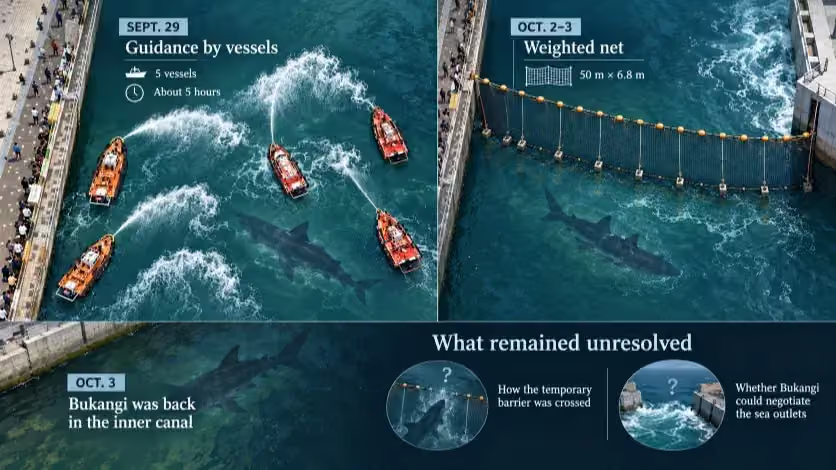
Bukangi, the Shark That Stayed in Busan’s North Port
Reader Signal
Community readWhat did this report leave you with?
Choose the signal that best reflects your reading. Select it again to remove it.
One response per article
No response selected
A moderated conversation about the reporting.
One-level replies and newsroom moderation keep the conversation anchored to this article.
Discussion Status
Open
Please sign in to join the discussion.
Newsletter
Weekly reporting and context from Busan and Korea.