Busan Is Running, but It No Longer Circulates
Busan’s decline isn’t collapse — it’s stillness. A gradual slowing of motion, a city alive but not living.

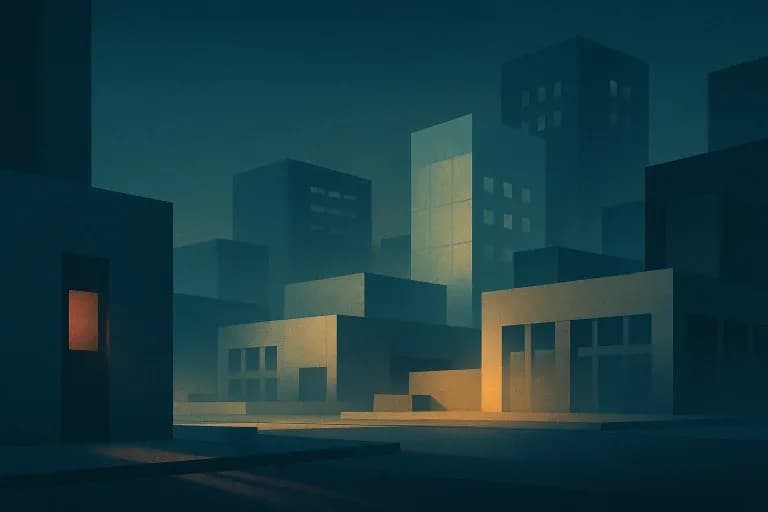
Busan, South Korea — At dusk, the lights outside Pusan National University shimmer faintly on the wet pavement. The street once known for its late-night bars and crowded study cafés now lies in half-shadow. Neon signs buzz, some missing letters; a row of convenience stores glow over empty sidewalks.
A decade ago, this neighborhood in Geumjeong was the pulse of Busan’s youth — packed with students, music spilling out of basements, steam rising from food stalls along the subway exit. Tonight, the air feels still. A coffee shop stays open out of habit, not business. Across the street, a landlord’s banner flaps in the wind: For Lease.
From a distance, Busan still shines. Its skyline glows across the river, towers catching the evening light. But inland, around the university belts that once kept the city young, the rhythm has slowed. The crowds that once lingered after lectures now scroll on their phones, eating alone in dorms or ordering in.
Three million people still live here. The subway runs. The harbor hums. Yet something essential — the flow of small exchanges, the casual heartbeat of a living city — has weakened.
In the early 2000s, students filled these alleys until dawn, spending freely in a place that felt infinite. Now the same streets echo. Rents hold steady, but optimism does not. The disappearance isn’t sudden; it’s gradual, like a tide retreating.
Busan remains bright in photographs — Haeundae’s skyline, the bridges lit gold across the bay. But in the old and inner districts, where youth once drove its economy, the energy is ebbing. The lights are still on, but the pulse beneath them — human, economic, electric — flickers low, as if the city itself has forgotten how to move.
Data That Tell a Quieter Story
By numbers alone, Busan should still be humming. The city’s economy remains the second largest in South Korea, its port among the busiest in Asia. Yet behind the skyline’s glow, the rhythm of spending — the daily pulse of cafés, small stores, and side-street vendors — has slowed to something almost imperceptible.
In 2020, the city’s commercial vacancy rate stood at 7.8 percent. By early 2025, it had doubled to 14.2. In Geumjeong, the district surrounding Pusan National University, nearly one in five storefronts now sits empty. Saha and Buk-gu aren’t far behind. The numbers look less like a dip and more like a quiet unspooling — each year, a few more shutters pulled down for good.
Even in neighborhoods where people still gather, cash registers tell a different story. The national local consumption index, benchmarked at 100, places Busan at 78.3 — a figure that speaks of people living, but spending less. Youth departures have drained what was once the city’s most reliable current: spontaneous, daily consumption. Over the past five years, Busan’s population in its twenties has fallen by 9.4 percent. At the same time, nearly one-third of its residents are now over sixty-five, most living on fixed incomes.
The shape of the city’s economy has changed in quieter ways too. Retail rents, long kept high by speculative owners, have barely adjusted to the slowdown. Few can afford to take the risk of reopening a store. Those who do are less merchants than placeholders — owners keeping the lights on to avoid a sense of finality.
Online platforms have finished what demographics began. Busanites still buy, but they buy invisibly. A meal once shared on a street now arrives through an app. Money that once circulated locally flows instead to headquarters in Seoul. The city’s spending hasn’t vanished; it’s been outsourced.
Every figure points to motion without contact — consumption without connection. The buses still run, the students still walk to class, the skyline still photographs well. But the city’s economic circuit, once a closed loop between residents and their streets, now leaks outward.
In Busan’s downtown, landlords quote rents from another decade; in the new residential belts, shopfronts stay empty because no one needs to leave home. The city is not dying in the traditional sense. It is losing continuity — a quiet severing between presence and participation, between life and livelihood.
The data is precise, but the reality it describes is not. It is slower, softer, harder to measure — like a heartbeat heard through glass.
The Double Hollowing — Old Towns That Aged, New Towns That Never Grew
In Busan, the decline does not arrive in a single form.
It spreads in opposite directions — through the alleys that grew old, and the avenues that never filled. Both are quiet, both fading, but for different reasons.
In Dongnae, the smell of roasting beans still drifts from a few old cafés, the kind that once served generations of students and office workers. The buildings lean inward as if listening to the past. Their owners unlock the doors each morning not out of profit, but habit — a rhythm they can no longer break. The streets are narrow, tiled in the muted colors of the 1980s. A sign painted long ago reads “Print Shop,” though the shop has been closed for years.
These districts were once the body of the city, the places where Busan learned how to spend: neighborhood bakeries, small clinics, vinyl bars, music shops. But time has drained them of their youth. The customers who once filled them have grown old; their children live in newer neighborhoods an hour away. On weekends, shutters roll down before sunset. The air feels heavy, as if the buildings themselves have accepted their age.
Across the river, the opposite kind of silence takes hold.
In the glossy new districts of Myeongji and Gangseo, everything looks perfect — freshly painted facades, identical retail units lined beneath high-rise apartments, clean pavements with no scuff marks. Yet half the storefronts remain locked. The architecture anticipates crowds that never came.
When the city rezoned its western edge in the 2010s, it imagined self-contained towns — affordable housing paired with walkable retail. What emerged instead were vertical suburbs with no pulse: people live, but rarely linger. The first-floor shops were built faster than the communities that were meant to sustain them. Rent prices, inflated by speculative optimism, stayed high even as demand evaporated.
At night, the streets shimmer with the reflection of passing cars but no pedestrians. A single convenience store glows like a beacon in the sterile dark. The stillness feels engineered, as if silence had been part of the design.
And then there are the edges — the waterfronts of Haeundae and Gwangalli, radiant and alive on weekends. There, Busan looks young again, music pulsing through the glass bars and rooftop decks. But this brightness is thin, tidal. The same economy that fills the beaches empties the rest of the city. Money rushes toward the coast and then drains back to Seoul when the season ends.
Seen from above, Busan glitters unevenly — a handful of brilliant lines stitched across a fabric slowly fraying. The city is not collapsing, exactly; it is drifting apart, each district moving to its own tempo, disconnected from the rest.
Old towns have grown too tired to reinvent themselves. New towns were born too complete to evolve. One has history but no momentum; the other, structure without soul. Between them lies a silence that no redevelopment plan can fill — a stillness that has less to do with buildings and more to do with belief.
The old quarters fade because people left; the new ones fade because no one ever truly arrived.
The city’s geography has fractured into islands of habit and islands of hope, with nothing in between. And in that widening space — between what Busan was and what it tried to become — the hum of everyday life has almost disappeared.
Anatomy of Collapse — Why This Isn’t Just About Money
Busan’s decline cannot be measured in revenue charts or GDP slices. The numbers speak, but they whisper; the real story lies beneath them — in how the city’s systems, habits, and beliefs no longer move in time with one another.
The first fracture runs through people themselves.
The city has aged faster than it has grown. Nearly a third of Busan’s residents are now over sixty-five. The energy that once came from youth — from risk, from the simple habit of going out — has ebbed. The university belts that once produced both labor and laughter have thinned. You can feel it on a weekday afternoon in Geumjeong, where the sidewalks used to swarm with students. Now, most of them are gone — working in Seoul, studying abroad, or living in digital spaces that have no geography at all.
What remains is a city living on the memory of movement. Older residents keep routines as rituals — morning markets, park walks, the same cafés at the same hour — but these rituals no longer generate exchange. They sustain presence, not participation. Consumption has turned into maintenance.
The second fracture runs through the way people spend.
Busan’s economy has not stopped; it has disconnected.
Transactions that once formed local circuits now leap across invisible wires. A meal ordered in Sasang registers as profit in Seoul. A shoe purchase in Seomyeon is booked to an online warehouse in Suwon. The geography of consumption has dissolved. Money still flows, but it no longer returns.
Even the act of buying feels private now, detached from place. There is no conversation, no noise, no friction. The city’s pulse — once measured in the rhythm of open doors and passing coins — has been flattened into a silent digital hum. The economy didn’t vanish; it went virtual.
Urban space itself has followed suit.
The logic of Busan’s expansion was meant to balance the city — spreading growth from the dense east to the quieter west. Instead, it stretched the city too thin. The core emptied faster than the periphery could fill. The new housing belts — Myeongji, Gangseo, Jangrim — promised community but delivered distance. They were built like finished products, with no room to evolve.
Urban planners called it “distributed development.” On the ground, it feels more like scattering — energy diffused until no single place can hold it. Streets are wider, apartments taller, but the essential density that sustains a city — proximity, friction, the accidental encounter — has disappeared. Busan has become a city of separated efficiencies, where everything works but nothing connects.
And then there is the matter of belief.
For decades, Busan’s identity was built on motion — migration, trade, reinvention. The port was never still; its people, never static. The decline now feels heavier because it contradicts that memory. A city that once lived by the sea’s rhythm has forgotten how to move with it.
Economic fixes alone cannot touch this kind of stillness. Lowering rents may reopen doors, but it cannot restore the instinct to gather. Infrastructure may improve, but without faith in the city’s future, no one stays long enough to fill it.
The collapse, then, is not simply financial.
It is metabolic — the slowing of an urban organism.
Its arteries are intact, but the circulation falters.
Its lights are on, but the current flickers weakly through empty rooms.
Busan’s challenge is not to rebuild its skyline but to rediscover its pulse — to find again the rhythm that made daily life more than the sum of transactions. Until then, the city remains suspended in a quiet paradox: alive, functioning, but somehow no longer living.
Policy Illusions — Money Spent, Circulation Unmoved
Every few years, Busan promises itself revival. The words change — “urban regeneration,” “smart commerce zones,” “creative districts” — but the tone stays the same: hopeful, bureaucratic, distant. Behind each new slogan is the same equation—more funding, more construction, more facades of renewal. Yet the rhythm of the streets remains unchanged.
Billions of won have flowed into redevelopment zones and “small business vitality” programs. From Seomyeon to Gamcheon, the city has built plazas, painted murals, and opened cultural centers in the name of activation. Some of these projects glow for a season, then fade into maintenance budgets. The problem is not bad faith; it’s misplaced faith—in architecture, not atmosphere.
Money circulates, but energy does not.
A plaza cannot manufacture community. A café strip cannot create demand. The city treats stillness like a design flaw to be fixed with concrete and color, but what’s broken is not the surface. It’s the circuit beneath: people, purpose, participation.
Consider the “urban regeneration zones” mapped across Busan’s older wards. In Yeongdo, funds restored the roofs of traditional markets, but the stalls below remained half-empty. In Dongnae, an art alley opened with local fanfare, then slowly turned into a corridor of empty frames and fading posters. Each project leaves behind the same image—a renovated quiet.
Busan’s planners are not blind to this. They know the data, see the vacancy rates, count the departing youth. But policy still equates renewal with visibility. So the cranes return, the announcements multiply, and another “cultural hub” rises where foot traffic never was.
The newer districts suffer from a mirrored illusion.
In Myeongji and Gangseo, public funds built infrastructure years ahead of population. Subway lines stop in fields waiting for riders who may never come. Wide pedestrian boulevards gleam, empty of pedestrians. The investment is real, but circulation—the living movement of people, money, and meaning—refuses to follow.
The illusion extends beyond economics. Local government measures progress by completion, not continuity. Success is the ribbon-cutting, not the decade after. Once a building opens, the story ends. What happens inside—how it breathes, who uses it, whether it grows or shrinks—falls outside the frame.
But cities don’t live in headlines. They live in repetition: who returns, who spends, who stays after dark.
And Busan, for all its projects, has not learned how to repeat.
Experts call it “over-instrumentation” — the idea that urban vitality can be engineered by metrics. The city counts square meters of renovated space, visitors per quarter, social media mentions. Yet it fails to track what truly matters: dwell time, interdependence, and belonging.
When you walk through Seomyeon today, you see the architecture of effort — new pavements, LED-lit corners, pop-up kiosks. But you also hear the silence between those efforts. It’s not the absence of money; it’s the absence of meaning.
Public spending has kept Busan alive on paper, but not in spirit. What the city has achieved is a simulation of vibrancy: projects that photograph well but do not breathe.
The irony is that the city has built everything except reasons to stay.
To repair this will take more than design or subsidy. It will require something cities rarely plan for — intimacy. Spaces that invite return. Policies that measure not just activity, but attachment. Renewal that begins with trust, not budgets.
Busan does not need another slogan. It needs a pulse that doesn’t depend on scaffolding.
What Remains — Listening for the Pulse
Busan has always been a city built on movement. Ships came and went, trains ran from the coast inland, and people — millions of them — drifted through its markets and alleys in search of work, warmth, or something better. The city’s story was never one of stillness. Even its dialect carried motion, its vowels rising and falling like waves.
That rhythm hasn’t vanished completely. It hides in small, persistent gestures — the taxi driver waiting in an empty rank near Dongnae station, the baker who opens at dawn though no crowd follows, the student running a tiny studio above an abandoned bar because rent there, at least, is kind. Busan breathes through these pockets of resistance, each one a quiet refusal to accept the slow fade.
Yet survival and vitality are not the same.
What Busan has now is endurance — the ability to keep operating even when the circulation weakens. The city functions, but in fragments. Its economy moves, but without friction. The system hums, but the hum no longer carries melody.
Every attempt at revival has sought to quicken the body without understanding the heart. Policy treats vibrancy as something that can be programmed: fix the streetlights, rezone the blocks, announce another cultural hub. But no algorithm can restore what has been lost — the unpredictable pulse of daily life, the way a city breathes through chance and choice.
What Busan is confronting is not decline in the conventional sense. It is a crisis of connection — between people and place, between space and meaning. The city’s machinery still runs; what’s missing is belief. A sense that what happens here matters, that the streets still belong to their walkers.
There is no single cure for that. Economists will talk about rent flexibility, sociologists about demographic renewal, planners about transit and zoning. But the problem is both smaller and larger than any of these.
It begins with the simplest question: why would someone stay?
To answer that is to ask what a city is for.
For Busan, it has always been the threshold — a place between land and sea, tradition and escape. Its greatness came from that tension, the pull between leaving and remaining. Now, as the tides of consumption and ambition flow elsewhere, the city must relearn how to hold people again — not just house them, not just employ them, but hold them.
That may not look like growth. It may begin with humility — smaller scales, slower plans, attention paid to the texture of daily life rather than the geometry of skylines.
It may mean thinking less about what to build and more about what to keep: the cafés that survive, the benches that gather conversation, the markets that still smell of salt and morning.
Cities do not die in silence; they die when no one listens. Busan’s task now is to listen — to its neighborhoods, its elders, its young who have not yet left. To find again the rhythm that made this port more than a place of transit.
From a distance, the skyline still gleams, untroubled. But walk closer, and you can hear the city’s true sound — the quiet hum of resilience beneath the static of decline. It is faint, but it’s there: a pulse, slow yet steady, waiting to be remembered.
Busan’s problem was never emptiness. It was forgetting the sound of its own life — the rhythm of exchange, of laughter, of time spent together. The city will survive. The question is whether it will live.
Continue this reporting
Reporting on the same issue
Related coverage selected from the article's desk, topics and newsroom relationships.
 NewsOct 22, 2026
Busan Port’s LNG and Methanol Plan: Who Pays to Keep Fuel Ready?
Busan already supplies ships with LNG and methanol, drawing on regional and i...
 NewsOct 16, 2026
What Is Still Worth Going to See?
Busan’s biennale faces questions of artistic judgment and institutional care....
 NewsOct 14, 2026
What Became of Busan’s University Streets?
From 2015 to 2023, registered businesses grew near Pusan National University...
More from the author
More from this byline
Stay with the same line of reporting through more work from this byline.
- NewsOct 22, 2026
Busan Port’s LNG and Methanol Plan: Who Pays to Keep Fuel Ready?
 NewsOct 12, 2026
Bukangi, the Shark That Stayed in Busan’s North Port
Reader Signal
Community readWhat did this report leave you with?
Choose the signal that best reflects your reading. Select it again to remove it.
One response per article
No response selected
A moderated conversation about the reporting.
One-level replies and newsroom moderation keep the conversation anchored to this article.
Discussion Status
Open
Please sign in to join the discussion.
Newsletter
Weekly reporting and context from Busan and Korea.