Busan Hosts Global Energy Super Week Amid Rising Power Demands
Busan’s Energy Super Week brings together global ministers, the IEA, and the World Bank to discuss how rising digital power demand, renewable integration, and hydrogen innovation will shape South Korea’s energy transition.

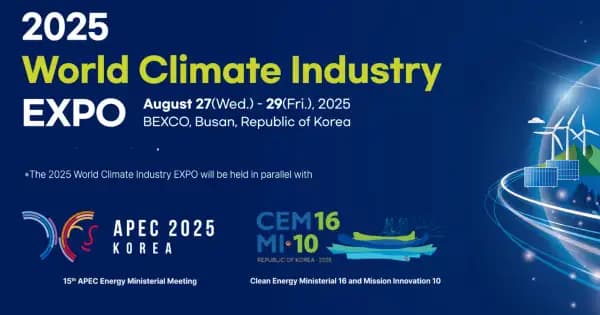
Busan, South Korea — Busan has rarely seen an international gathering on the scale of this week’s “Energy Super Week.” For five days, the city is hosting the World Climate Industry Expo alongside three separate ministerial conferences: the Clean Energy Ministerial, the Mission Innovation Ministerial, and the APEC Energy Ministerial. Forty countries are represented, joined by the International Energy Agency and the World Bank.
More than 500 companies and research institutions have set up pavilions at BEXCO, while government delegations convene at venues across the city. It is an unusual concentration of diplomatic and industrial weight in one place, and it arrives at a moment when the energy debate is increasingly shaped by the growth of artificial intelligence.
The choice of theme, “Energy for AI & AI for Energy,” reflects a global preoccupation. Artificial intelligence has moved rapidly from research laboratories into daily commerce, finance, media, and manufacturing. Behind this expansion lies a physical footprint of servers and data centers that consume ever larger quantities of electricity.
The IEA has projected that by 2030 global data centers could consume close to 1,000 terawatt-hours a year, roughly twice today’s demand. For countries already struggling to decarbonize their power systems, the prospect of such an increase presents a clear risk: the gains from renewable deployment may be offset by rising digital demand.
Digital infrastructure is now a source of added demand but is also being used to strengthen the way power systems operate. Utilities have begun applying more precise forecasting to anticipate changes in consumption, balance supply with greater accuracy, and identify weaknesses in equipment before they interrupt service.
Universities and research institutes in Europe, North America, and Asia are testing methods to connect renewable generation more smoothly to existing grids and to build networks that can cope with heavier loads. What is being discussed in Busan reflects this situation: the growth of data infrastructure places new stress on electricity systems, while at the same time offering technical tools that can help manage that stress.
For South Korea, the issues under debate are closely tied to conditions that have been visible for more than a decade. The government has announced plans for a nationwide high-voltage direct current line, often described as an “energy expressway,” to carry electricity from coastal regions where renewable resources are concentrated to areas where demand is highest.
A task force involving several ministries has been formed to handle permits and funding. The plan addresses a familiar problem: renewable capacity has increased, but the transmission network has not kept pace. As a result, solar and wind projects are at times forced to reduce output. The imbalance between supply regions in the south and west and the concentration of demand around Seoul remains one of the central strains on the system.
Analysts remain cautious about Korea’s targets for 2030. Official roadmaps call for a tripling of renewable capacity within the decade, but grid expansion is slow and opposition to new transmission lines is strong in many communities. Market mechanisms for clean power procurement are also limited.
Corporate buyers seeking to sign long-term renewable power purchase agreements face regulatory hurdles, and the renewable portfolio standard has been criticized for its limited effectiveness. Without reform, there is a risk that Korea’s energy transition will stall even as political commitments are repeated on international stages such as Busan.
The city itself is not only a host but also an actor with its own agenda. Busan has developed plans to become a hub for hydrogen technology, with local firms and institutions forming an alliance to introduce fuel cells and related applications in maritime industries. The port is experimenting with smart logistics systems that can reduce emissions by electrifying equipment and providing shore power to vessels at berth.
There are also pilot projects in carbon capture and storage, an area where Korea hopes to contribute both technology and offshore storage capacity. By highlighting these initiatives within the expo, Busan is attempting to frame itself as more than a backdrop — instead as a model for how a city can align its industrial development with global climate objectives.
The potential economic benefits are considerable but uncertain. Large international companies, including technology giants and energy firms, are participating in the exhibitions. Alongside them, domestic conglomerates and smaller Korean enterprises are showcasing technologies from grid equipment to renewable integration software.
Organizers have scheduled job fairs, business matching events, and forums intended to connect international demand with local supply. If successful, these could reinforce Busan’s claim to be an anchor for climate-related industries. But the history of similar gatherings suggests caution. Investment announcements and memoranda of understanding do not always translate into lasting projects, and the real impact will depend on how many deals survive once the spotlight fades.
The risks are not limited to economic outcomes. Ministerial gatherings often end with joint statements that outline shared objectives but stop short of binding obligations. Their significance depends on whether those declarations are followed by measurable targets—such as additional generating capacity, expanded transmission networks, or secured financing.
Korea’s plan for a high-voltage “Energy Expressway” illustrates this point. Its credibility will rest not on speeches in Busan but on whether construction moves forward on time, permits are processed without long delays, and communities accept the new infrastructure in practice. The same applies at the international level. Governments may pledge to balance digital expansion with climate goals, yet without concrete and verifiable steps, such promises have limited effect.
Despite these caveats, the significance of the Busan gathering should not be dismissed. The presence of the IEA and the World Bank signals that the issues under discussion — the strain of AI-driven demand, the modernization of power grids, the financing of clean energy — are not marginal but central to the global energy transition. The coincidence of the APEC meeting with the Clean Energy Ministerial and Mission Innovation sessions also creates an unusual opportunity for alignment across regions and institutions that normally operate in separate tracks.
Busan is using this week as an opportunity to reposition itself within the national and international economy. Once defined mainly by its port and manufacturing base, the city is now presenting a case for itself as a center of climate-related technology, linking its maritime industries with hydrogen development and digital infrastructure.
Whether that positioning endures will depend on what remains after the meetings conclude. Performances and displays, such as the drone show at Gwangalli Beach, will draw public attention, but the lasting measure will be the progress of infrastructure projects and industrial investment.
The importance of Energy Super Week will be tested in the period that follows, rather than in the size of the event itself. The attendance of senior officials and international organizations has raised Busan’s profile, but the weight of the gathering will depend on whether it produces follow-up actions: the start of new transmission projects, workable arrangements for renewable procurement, and practical tools to stabilize the grid.
If those measures advance, the meetings in Busan will mark a step in moving plans into implementation. If they do not, the week is likely to be remembered more for its ceremony than for lasting outcomes.
Continue this reporting
Reporting on the same issue
Related coverage selected from the article's desk, topics and newsroom relationships.
 NewsOct 22, 2026
Busan Port’s LNG and Methanol Plan: Who Pays to Keep Fuel Ready?
Busan already supplies ships with LNG and methanol, drawing on regional and i...
 NewsOct 16, 2026
What Is Still Worth Going to See?
Busan’s biennale faces questions of artistic judgment and institutional care....
 NewsOct 14, 2026
What Became of Busan’s University Streets?
From 2015 to 2023, registered businesses grew near Pusan National University...
More from the author
More from this byline
Stay with the same line of reporting through more work from this byline.
- NewsOct 22, 2026
Busan Port’s LNG and Methanol Plan: Who Pays to Keep Fuel Ready?
 NewsOct 12, 2026
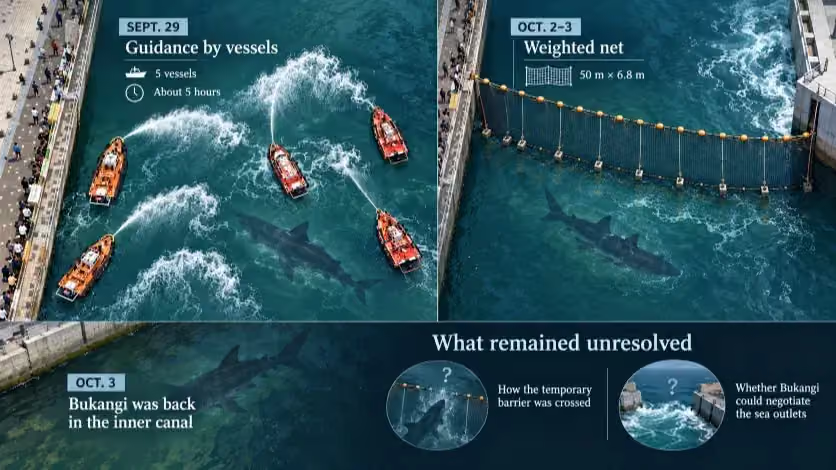
Bukangi, the Shark That Stayed in Busan’s North Port
Reader Signal
Community readWhat did this report leave you with?
Choose the signal that best reflects your reading. Select it again to remove it.
One response per article
No response selected
A moderated conversation about the reporting.
One-level replies and newsroom moderation keep the conversation anchored to this article.
Discussion Status
Open
Please sign in to join the discussion.
Newsletter
Weekly reporting and context from Busan and Korea.