Busan Finalizes Design for Royal Russell’s First Overseas Campus
The British private school Royal Russell is set to open its first international campus in Busan’s Myeongji International City by August 2028.

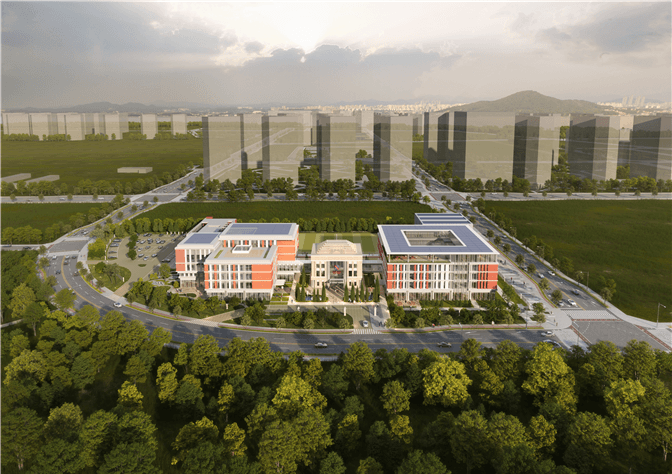
Busan, South Korea - Busan Metropolitan City, in collaboration with Korea Land and Housing Corporation (LH), has finalized the design selection for the Royal Russell School’s first international campus in Busan. Located in Myeongji International City, the school is scheduled to open in August 2028.
The selected proposal, submitted by a consortium led by a Seoul-based architecture firm, projects a six-story campus—five levels above ground and one below—spanning approximately 18,936 square meters.
Once completed, the facility is expected to serve around 1,350 students across elementary and middle school grades. Plans include a swimming pool, a multipurpose auditorium, and a variety of instructional spaces, some of which are still under refinement.
Still, this project isn’t only about architecture. Royal Russell’s Busan campus will operate as a “foreign educational institution” under Korean law—a legal classification that offers greater operational freedom than most international schools overseen by local education authorities. That includes independence in curriculum, staffing, and governance.
In effect, the school won’t need to follow the Korean national curriculum. It bypasses many domestic approval procedures and retains the ability to run a distinctly British program without major adjustment.
Officials have indicated that Korean students will be admitted, though under enrollment limits that are not yet finalized. Based on prior cases, domestic students may make up between 30 and 50 percent of the total. Tuition, meanwhile, remains unspecified. The term used was “competitive,” though what that means in practice is still open to interpretation.
The school is only one part of a broader plan. Busan is aiming to become a long-term destination for internationally mobile families. That includes not just education, but housing, legal frameworks, and community infrastructure designed with foreign residents in mind.
A central piece of this vision is the British Cultural Village, a themed urban district intended to surround the school. The area remains mostly conceptual for now, but is expected to include British-style townhouses, retail zones, and communal amenities. Wellington College, another U.K.-based school, is also expected to open nearby by 2028.
If completed as planned, the district could evolve into a concentrated zone for British education and lifestyle abroad. That said, cultural ecosystems don’t emerge on schedule. City projections estimate that as many as 400 expatriates may relocate to the area. Whether that reflects actual demand or hopeful modeling is unclear.
Comparisons to Seorae Village in Seoul or Incheon’s Songdo Global Campus are often raised. But places like those took time. They were lived into existence. Culture doesn’t scale like infrastructure, and zoning maps don’t create loyalty.
At this stage, Royal Russell’s Busan project is several things: a design, a framework, a timeline. A functioning community? Not yet. That depends on who arrives—and whether they choose to stay.
The lines have been drawn. Regulations are aligned. Intentions, declared.
What happens next won’t unfold in briefings or renderings, but in days, quietly lived.
Continue this reporting
Reporting on the same issue
Related coverage selected from the article's desk, topics and newsroom relationships.
 NewsOct 22, 2026
Busan Port’s LNG and Methanol Plan: Who Pays to Keep Fuel Ready?
Busan already supplies ships with LNG and methanol, drawing on regional and i...
 NewsOct 16, 2026
What Is Still Worth Going to See?
Busan’s biennale faces questions of artistic judgment and institutional care....
 NewsOct 14, 2026
What Became of Busan’s University Streets?
From 2015 to 2023, registered businesses grew near Pusan National University...
More from the author
More from this byline
Stay with the same line of reporting through more work from this byline.
- NewsOct 22, 2026
Busan Port’s LNG and Methanol Plan: Who Pays to Keep Fuel Ready?
 NewsOct 12, 2026
Bukangi, the Shark That Stayed in Busan’s North Port
Reader Signal
Community readWhat did this report leave you with?
Choose the signal that best reflects your reading. Select it again to remove it.
One response per article
No response selected
A moderated conversation about the reporting.
One-level replies and newsroom moderation keep the conversation anchored to this article.
Discussion Status
Open
Please sign in to join the discussion.
Newsletter
Weekly reporting and context from Busan and Korea.