Busan Expands Job Fair for International Students, Linking Employment to Visa Pathways
Busan is hosting its largest job fair for international students, bringing together thirty-five companies and hundreds of foreign graduates. The event links recruitment directly to F-2-R and E-7 visa schemes, part of the city’s strategy to ease labor shortages and counter demographic decline.

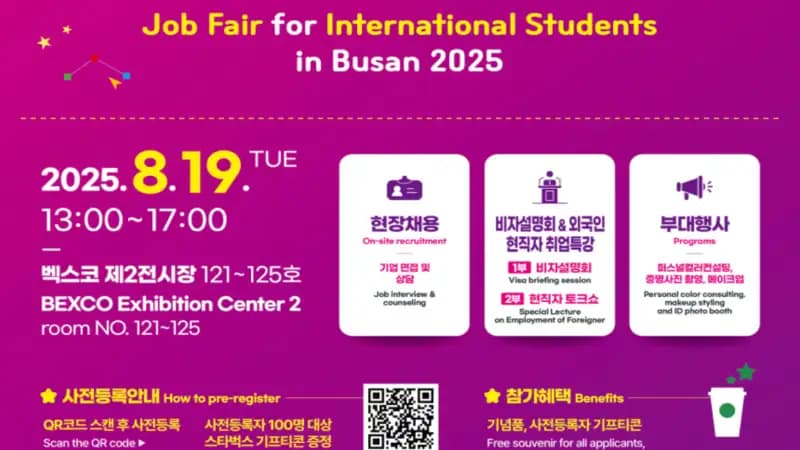
Busan, South Korea — Busan will open the doors to its largest job fair for international students today, an event that city officials hope will connect foreign graduates with local industries and, more ambitiously, anchor them in the region for the long term.
The fair, held at BEXCO’s second exhibition hall, brings together thirty-five companies from manufacturing, logistics, trade, hospitality, and convention services. That figure represents a sharp increase from twenty-one firms last year, an expansion meant to signal not only corporate interest but also a municipal commitment to integrating international talent into the city’s shrinking labor force.
Unlike conventional career expos, this gathering is designed as a policy instrument as much as an employment platform. Graduates who secure offers from participating firms may become eligible for either the Regional Residency Visa, known as F-2-R, or the Special Activity Visa, classified as E-7. The F-2-R scheme, introduced as part of a national effort to counter demographic decline, allows foreign talent to settle in designated districts facing population loss.
In Busan, eligibility for the F-2-R visa is confined to the districts of Seo, Dong, and Yeongdo, with the city allotted 150 places for 2025. Roughly two-fifths have already been taken, leaving eighty-five still available. Alongside this program, the E-7 visa serves as a pathway for skilled and professional roles, offering international graduates a more direct route from study to sustained employment.
Behind these measures lies a demographic and economic reality that has grown harder to ignore. Korea recorded more than 108,000 unfilled positions in the first quarter of this year, and by April the figure had climbed to nearly 470,000. Busan itself continues to suffer from an aging population and steady youth outmigration, trends that threaten its industrial competitiveness.
International students have been identified as a potential corrective. Nationwide, their numbers rose to 263,775 in 2024, a year-on-year increase of over sixteen percent. Busan has set its sights on attracting 30,000 students by 2028, with an explicit target of doubling the share of graduates who successfully convert their student visas into work or residency status.
The timing also coincides with rising demand in the service economy. Tourism and convention industries in Busan are expanding at a brisk pace: more than 1.06 million foreign visitors arrived in the city in the first four months of this year, the fastest such growth on record. That boom has created pressure for skilled multilingual labor in hospitality, event management, and logistics, sectors that feature prominently among the firms represented at today’s fair.
The design of the event underscores a comprehensive approach. Beyond recruitment booths, the fair offers immigration guidance sessions led by officials, legal briefings on visa requirements, and practical services ranging from résumé clinics to free ID photographs and interview styling. Organizers portray this as a “one-stop” pipeline that reduces friction for both employers and graduates, removing the uncertainty that often drives international talent to seek opportunities elsewhere.
Yet the limits of such an initiative run deeper than the fanfare of a career fair. These gatherings are often better at producing photographs and attendance figures than durable job matches, with résumés exchanged in bulk but few positions translating into secure contracts. Even when employment materializes, the harder challenge begins afterward: salaries that barely cover rising living costs, precarious housing options, and workplaces offering little in the way of professional growth. Each of these factors erodes the likelihood that international graduates will commit to Busan for the long term.
Small and medium enterprises, which dominate Busan’s economy, are particularly vulnerable in this regard, often lacking the resources to sustain international hires beyond the initial recruitment. Added to this is a geographic constraint: by confining the F-2-R residency visa to only three districts, the city narrows the program’s appeal to graduates who might otherwise prefer broader choices in where they establish their lives.
Competition from abroad further complicates Busan’s ambitions. Countries like Canada and Australia have spent years refining immigration systems that offer international students a predictable path from graduation to permanent residency. Korea, by contrast, still relies on a patchwork of visa categories, quotas, and regional conditions that can appear opaque even to specialists. Unless those structural hurdles are eased, Busan’s initiative risks becoming a holding pattern rather than a destination, with graduates ultimately drawn to places where the rules—and the prospects—are clearer.
The significance of the fair lies less in the spectacle of crowded booths than in what it signals about policy direction. Busan is beginning to treat international students not as temporary guests but as a core component of its demographic and economic strategy. The surge in company participation, paired with direct visa linkages, suggests an effort to integrate education, immigration, and labor policy in a way that Korea has often struggled to achieve.
Still, the real test will unfold quietly in the months and years ahead. A handful of contracts signed at BEXCO will matter little if graduates cannot secure housing, build careers, or imagine a future in the city. If those conditions take root, the initiative could help slow Busan’s demographic erosion and lend fresh momentum to industries short of talent. If not, the fair risks joining a familiar category of policy experiments—well publicized, briefly promising, but ultimately remembered as another stopgap against structural decline.
Continue this reporting
Reporting on the same issue
Related coverage selected from the article's desk, topics and newsroom relationships.
 NewsOct 22, 2026
Busan Port’s LNG and Methanol Plan: Who Pays to Keep Fuel Ready?
Busan already supplies ships with LNG and methanol, drawing on regional and i...
 NewsOct 16, 2026
What Is Still Worth Going to See?
Busan’s biennale faces questions of artistic judgment and institutional care....
 NewsOct 14, 2026
What Became of Busan’s University Streets?
From 2015 to 2023, registered businesses grew near Pusan National University...
More from the author
More from this byline
Stay with the same line of reporting through more work from this byline.
- NewsOct 22, 2026
Busan Port’s LNG and Methanol Plan: Who Pays to Keep Fuel Ready?
 NewsOct 12, 2026
Bukangi, the Shark That Stayed in Busan’s North Port
Reader Signal
Community readWhat did this report leave you with?
Choose the signal that best reflects your reading. Select it again to remove it.
One response per article
No response selected
A moderated conversation about the reporting.
One-level replies and newsroom moderation keep the conversation anchored to this article.
Discussion Status
Open
Please sign in to join the discussion.
Newsletter
Weekly reporting and context from Busan and Korea.