Busan Converts Closed School Into Environmental Learning Center
Banyeo Elementary in Haeundae District reopens as Busan’s Eco-School, combining climate education with community facilities.

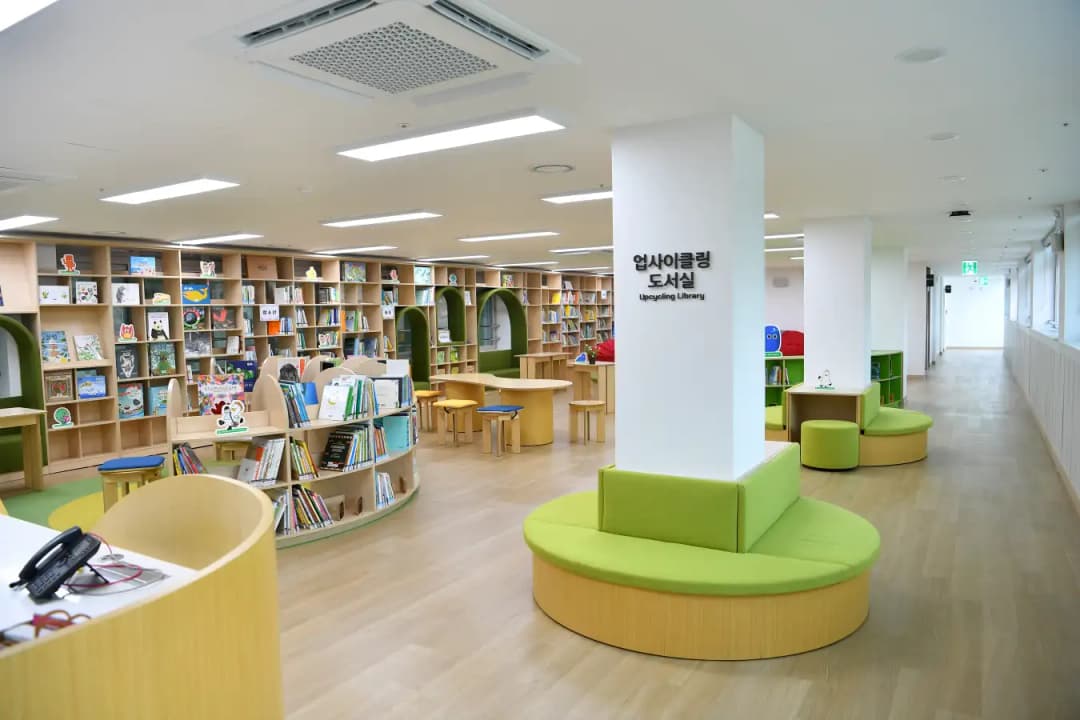
Busan, South Korea — South Korea’s shrinking student population has left thousands of school buildings without purpose. Since the 1980s, more than 4,000 schools have been closed, with around 50 of them in Busan alone. Some have been sold, others sit unused. On September 18, one of those campuses reopened in a new role.
Banyeo Elementary in Haeundae District, closed since 2020, has been converted into the Busan Environmental Experience Edu Center. The 3,384-square-meter building was renovated at a cost of about 100 billion won, roughly $73 million, funded by the national government and the city. It is the first site to open under the Ministry of Environment’s Eco-School pilot program, which selected Busan and Seoul in 2020 to test whether closed schools could be turned into centers for climate education.
The remodeled east wing bears little resemblance to its former classrooms. The ground floor combines a compact library focused on recycling and sustainability with play-based spaces for young children and workshop rooms for practical lessons. On the second floor, exhibitions trace the causes and consequences of climate change and outline South Korea’s carbon neutrality goals, linking broad themes to daily practice. The top floor has been set aside for public use, with a seminar room, a small recording studio, an “open classroom” for civic groups, and a hall that can host community meetings or performances.
What makes the project notable is the way the site is divided among different authorities. The city led the renovation of the east wing into the environmental center. The municipal education office is preparing to adapt the north wing and playground for related educational use. Haeundae District plans to operate a community school in the annex, add an underground parking lot to ease local shortages, and redevelop the nearby forest park as a recreational area. Rather than a single-purpose facility, the campus has become a shared redevelopment project in which different layers of government manage different functions.
Officials present the Busan center as a first of its kind. It is not the first reuse of a closed school—many have been turned into cultural venues, community centers, or artist spaces—but it is the first completed project dedicated to environmental education. Seoul’s Gongjin Middle School was also selected for the Eco-School program, but its conversion is still underway. Comparable efforts can be found elsewhere: in Japan, former schools have become libraries or welfare facilities; in parts of Europe, they host artist residencies. Busan’s experiment is distinguished by the explicit focus on climate literacy.
The decision to invest in Banyeo illustrates a broader policy question. As school closures continue, cities face pressure to find uses for empty campuses that serve more than a symbolic purpose. By tying the project to a national program, Busan secured funding and gave the site a function that extends beyond the district.
The challenge will be keeping it active. Renovations and exhibitions are easier to finance than operating costs. Without steady programs and staff, the center risks becoming another static display. Teachers may bring students for visits, but long-term relevance depends on how well it integrates with local schools and how often residents choose to use the facilities. For people living nearby, the promised parking spaces, the community school, and the improved forest park may prove more important than the exhibitions upstairs.
The Banyeo project shows both the potential and the uncertainty of reusing closed schools. On paper it meets multiple goals: preventing a building from falling into disrepair, providing public amenities, and creating a site for environmental learning. Its real significance lies in what happens after the opening ceremony. If it becomes a regular part of community life, it could serve as a model for the many other closed schools across the country. If not, it will join a list of projects that struggled to find a lasting role.
For now, a campus that once served neighborhood children has reopened with a different mission. Whether it stands as a test case for policy or as an isolated experiment will depend on how the space is managed, and whether the public continues to use it once the first visitors have gone home.
Continue this reporting
Reporting on the same issue
Related coverage selected from the article's desk, topics and newsroom relationships.
 NewsOct 23, 2026
Busan’s Twelve-Year School Account Faces a Test Beyond Access
Busan’s PENZ promises one school account for 12 years, while BeAT brings AI t...
 NewsOct 22, 2026
Busan Port’s LNG and Methanol Plan: Who Pays to Keep Fuel Ready?
Busan already supplies ships with LNG and methanol, drawing on regional and i...
 NewsOct 16, 2026
What Is Still Worth Going to See?
Busan’s biennale faces questions of artistic judgment and institutional care....
More from the author
More from this byline
Stay with the same line of reporting through more work from this byline.
- NewsOct 22, 2026
Busan Port’s LNG and Methanol Plan: Who Pays to Keep Fuel Ready?
 NewsOct 12, 2026
Bukangi, the Shark That Stayed in Busan’s North Port
Reader Signal
Community readWhat did this report leave you with?
Choose the signal that best reflects your reading. Select it again to remove it.
One response per article
No response selected
A moderated conversation about the reporting.
One-level replies and newsroom moderation keep the conversation anchored to this article.
Discussion Status
Open
Please sign in to join the discussion.
Newsletter
Weekly reporting and context from Busan and Korea.