Busan Builds Korea’s First Distributed Power Zone
A 500 MWh energy-storage system and AI-powered grid management anchor a new experiment in industrial efficiency. The deeper challenge is not hardware but governance.

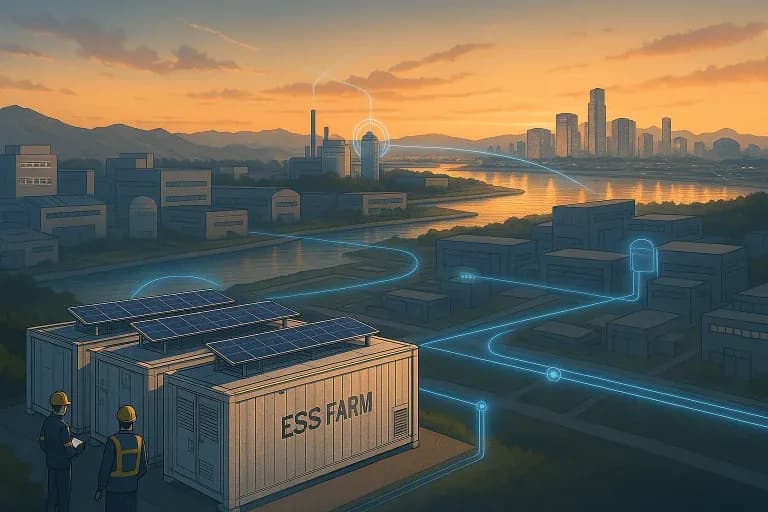
Busan, South Korea — South Korea has entered a new phase of its energy transition, one that tests the boundaries of how electricity is produced and governed. Earlier this month, the Ministry of Climate and Energy designated a section of Busan’s western industrial belt as the country’s first Distributed Energy Special Zone—a legal framework allowing electricity to be generated, stored, and traded locally instead of passing through the national grid. The 49.9-square-kilometer zone, stretching across the city’s Eco-Delta City and six adjoining industrial parks, will host a 500-megawatt-hour (MWh) energy-storage system based on lithium-iron-phosphate (LFP) batteries. Managed through an AI-powered energy management system, it enables companies to charge during off-peak hours and discharge when demand surges, potentially reducing electricity costs by up to eight percent while easing grid congestion.
The Busan project, however, is not merely an infrastructure upgrade—it is an institutional experiment. By allowing direct power exchange between industrial users, the government is effectively suspending the centralized monopoly that has defined South Korea’s power market for decades. The zone will serve as both a technological and regulatory test bed: a place where artificial intelligence, localized storage, and real-time energy trading converge under new legal permissions. For a nation long dependent on a single-buyer model dominated by the state utility KEPCO, Busan represents a deliberate experiment in controlled decentralization—one that may reshape how the country thinks about energy sovereignty itself.
Formalized through government notice No. 2025-88, the plan effectively allows industrial users to act as both producers and consumers—prosumers—within the same boundary, a practice long barred under the nation’s prohibition on dual generation and retail. To policymakers, this is a test bed for grid efficiency and carbon neutrality; to energy economists, it is a controlled disruption of the monopoly logic that has underpinned Korea’s power governance for decades. The question is not whether the batteries will work, but whether the rules surrounding them can.
For four decades, South Korea’s power grid has functioned as a single, centrally managed organism—optimized for baseload generation from thermal and nuclear plants, and governed by one utility, the Korea Electric Power Corporation (KEPCO). That model delivered stability, but it also produced rigidities: electricity flowed one way, from a few large plants to millions of passive consumers. As the country expanded its solar and wind capacity, that structure began to show strain—rising curtailment costs, regional imbalances, and growing resistance to new transmission corridors. The government’s 2023 Special Act on Distributed Energy Activation was an attempt to correct that imbalance by allowing limited, regulated experiments in local self-sufficiency.
Busan’s designation in November 2025 is the first tangible outcome of that law. Under Notice No. 2025-88, the Ministry of Climate and Energy granted Busan a legal exemption to operate a “responsible-supply” market inside its zone: companies can generate and store their own electricity, provided at least seventy percent of their contracted load comes from local resources. The rest can still be purchased from KEPCO through a hybrid settlement structure. Policymakers describe it as an industrial pilot that relieves national peak load and encourages private investment in storage and smart-grid systems. Yet the deeper wager is institutional—whether a top-down energy system can absorb localized autonomy without fragmenting the market that sustains it.
Within the Busan zone, power will circulate through a self-contained network that mirrors a miniature market rather than a branch of the national grid. Electricity will be produced from hydrogen fuel cells, rooftop solar arrays, and small-scale renewable generators distributed across six industrial districts. These sources connect to a 500 MWh battery farm—the physical and financial core of the project—charged during off-peak hours and discharged when demand peaks. The system relies on lithium-iron-phosphate (LFP) chemistry for stability and longevity, managed by an AI-based Energy Management System (EMS) that forecasts consumption, controls dispatch, and optimizes load balance in real time.
A consortium led by NuriFlex, LG CNS, EnSolve, and KEPCO KDN operates the system’s digital infrastructure. Its algorithm reads factory-level data, predicts hourly demand, and decides when to buy, store, or release electricity. Each transaction is recorded through a local digital settlement platform instead of the central Korea Power Exchange, effectively creating a micro-ledger of intra-zone trades. In design, the network acts as a market that clears every few seconds, moving electricity toward its highest immediate value. In policy terms, it tests whether such efficiency can coexist with a national grid still built for uniformity.
The Economics of Decentralization
Busan officials frame the project as an economic case for decentralization. The city estimates that factories inside the zone could lower their electricity costs by up to eight percent, translating into an annual saving of roughly ₩15.7 billion(US$11–13 million). The mechanism is straightforward in theory: batteries are charged during low-tariff hours and discharged when prices surge, flattening the city’s daily demand curve. Such time-shifted consumption could ease the need for new grid investment that has long burdened KEPCO, the state utility.
Another ₩250 billion (US$185–200 million) in capital expenditure could be avoided as semiconductor and data-center operators replace private uninterruptible systems with shared ESS subscriptions. Officials also forecast an annual ₩4.4 billion (US$3.3 million) reduction in renewable-energy curtailment costs by storing excess solar output that would otherwise be wasted. To policymakers, this arithmetic underwrites the zone’s political narrative: efficiency through autonomy.
But the numbers are contingent on conditions that remain untested. Industrial participation rates are still uncertain, the spread between off-peak and peak tariffs remains state-regulated, and network-use fees for intra-zone transmission are yet to be defined. These projections rely less on the physics of storage than on the economics of reform. If tariff incentives and governance align, Busan could become the first Korean city to show that decentralization can be profitable. If not, the zone risks becoming a costly prototype—a reminder that technology alone cannot outpace regulation.
The Limits of Autonomy
The Busan experiment unfolds in a geography not naturally suited to renewables. The city’s solar potential is constrained by dense development and limited land, while offshore wind remains commercially untested in nearby waters. Much of its “local generation” will therefore depend on hydrogen fuel cells—cleaner than gas turbines but still tied to gray hydrogenderived from natural gas. Busan’s push for energy self-reliance thus begins with a contradiction: a decentralized system still tethered to carbon-intensive inputs.
The physical infrastructure brings its own risks. Large-scale LFP batteries require thermal controls, insurance provisions, and end-of-life management—all areas where Korean regulations remain incomplete. Fire-safety concerns linger after a series of national ESS incidents between 2017 and 2019, and insurers have yet to standardize coverage for multi-tenant storage facilities.
The institutional challenges are deeper. Korea’s electricity market was designed around a single-buyer model in which KEPCO procures all generation and sells to users at regulated prices. The Busan zone disrupts this by allowing direct contracts between producers and consumers—but only within a narrow legal perimeter. Tariffs for network access and surplus sales remain undefined, and without a national pricing model, the zone could distort rather than complement the broader market.
Social equity adds another asymmetry. Residential users in Eco-Delta City—the smart district symbolizing Busan’s future—will see little or no direct benefit, since the pilot is restricted to industrial consumers. The outcome is a layered transition: technology advancing faster than inclusion.
Ultimately, the Busan zone is less a milestone than a probe into how far Korea’s energy order can bend before it resists. The infrastructure is tangible—a 500-megawatt-hour battery farm, an AI control layer, and a legal scaffold—but the deeper experiment lies in the permissions that allow it to operate. By sanctioning direct trade within a bounded region, the state is testing whether a command-driven system can accommodate negotiation without losing coherence.
Busan’s case suggests that decentralization in Korea will evolve not as a revolution but as a series of managed concessions. Each reform—tariff flexibility, peer-to-peer trade, or local storage—must be negotiated within a framework built for uniformity. The zone thus functions as both a micro-market and a stress test for the state’s willingness to distribute authority. If it runs smoothly, regulators will claim efficiency; if it falters, they will reaffirm stability. Either way, the architecture of control remains visible. What Busan ultimately exposes, more than any kilowatt-hour saved, is the narrow but crucial space in which innovation is permitted to exist.
Continue this reporting
Reporting on the same issue
Related coverage selected from the article's desk, topics and newsroom relationships.
 NewsOct 22, 2026
Busan Port’s LNG and Methanol Plan: Who Pays to Keep Fuel Ready?
Busan already supplies ships with LNG and methanol, drawing on regional and i...
 NewsOct 16, 2026
What Is Still Worth Going to See?
Busan’s biennale faces questions of artistic judgment and institutional care....
 NewsOct 14, 2026
What Became of Busan’s University Streets?
From 2015 to 2023, registered businesses grew near Pusan National University...
More from the author
More from this byline
Stay with the same line of reporting through more work from this byline.
- NewsOct 22, 2026
Busan Port’s LNG and Methanol Plan: Who Pays to Keep Fuel Ready?
 NewsOct 12, 2026
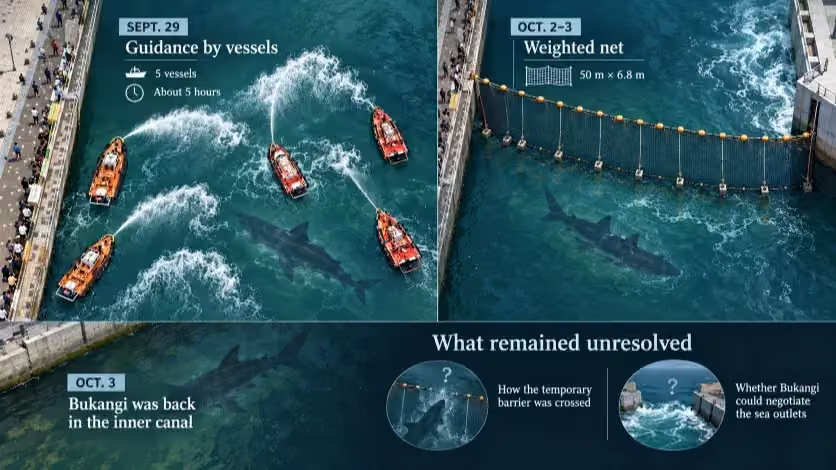
Bukangi, the Shark That Stayed in Busan’s North Port
Reader Signal
Community readWhat did this report leave you with?
Choose the signal that best reflects your reading. Select it again to remove it.
One response per article
No response selected
A moderated conversation about the reporting.
One-level replies and newsroom moderation keep the conversation anchored to this article.
Discussion Status
Open
Please sign in to join the discussion.
Newsletter
Weekly reporting and context from Busan and Korea.