Busan Aims for Global Maritime Hub Status—Execution Key
Busan’s roadmap to maritime leadership includes relocating key maritime institutions and advancing smart port technology, but real progress will depend on implementation.

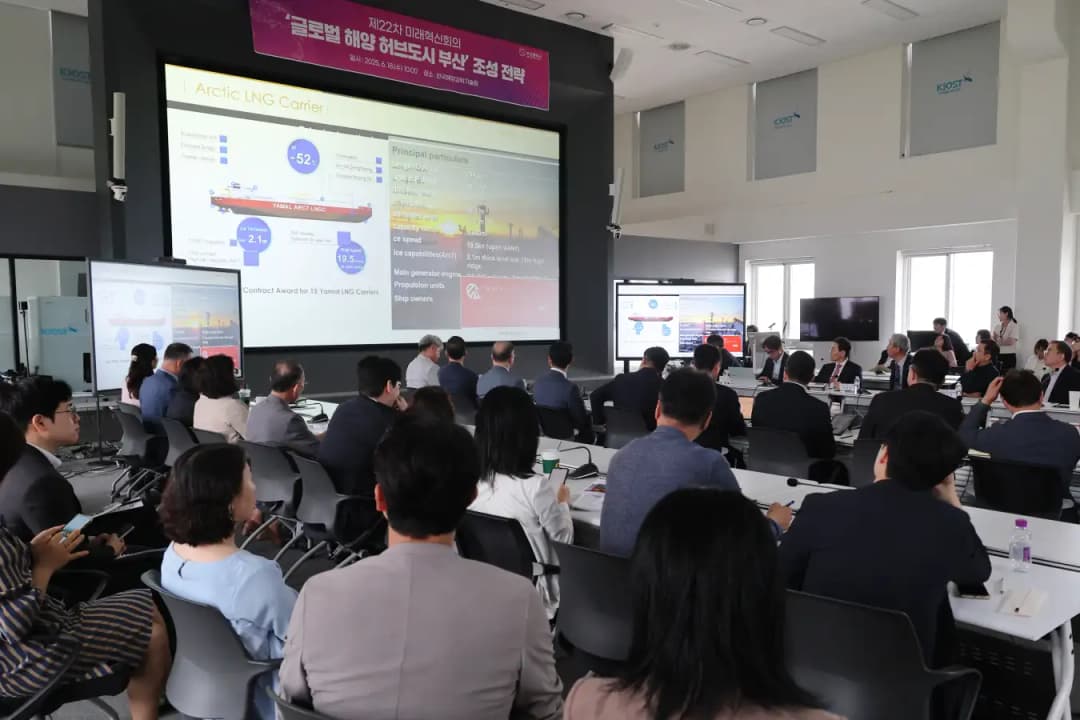
Busan, South Korea – Amid intensifying competition in global shipping and logistics, Busan is pressing forward with a bold, multi-dimensional strategy to establish itself as a world-class maritime center. At the 22nd Busan Future Innovation Meeting, held on June 18 at the Korea Institute of Ocean Science and Technology (KIOST), the city unveiled an ambitious vision structured around three strategic pillars: strengthening maritime governance, accelerating digital transformation in marine industries, and advancing a sustainable blue economy.
At the heart of the plan lies the proposal to relocate the Ministry of Oceans and Fisheries (MOF) and its affiliated public institutions from Seoul to Busan. Advocates argue that relocating core maritime governance functions to the country’s largest port city is not only logical but necessary for balanced national development. The potential economic windfall is estimated at over ₩6.7 trillion, alongside the creation of 4,300 new jobs. However, without clear timelines or formal legal instruments, the initiative remains aspirational. Previous central government pledges have fallen short due to political inertia and inter-agency turf battles. For Busan, the challenge is not only winning legislative approval but securing long-term administrative commitment to decentralization.
Another long-standing but still unrealized initiative is the establishment of a specialized maritime court in Busan. As South Korea’s primary port and logistics hub, Busan handles more than 75% of the country’s maritime trade, yet lacks a judicial body equipped to handle the complexities of international maritime law. Currently, shipping disputes are processed through general civil courts, often lacking the technical expertise and procedural nuance required for such cases. Stakeholders—including shipping firms, maritime lawyers, and academic institutions—argue that establishing a dedicated court would improve efficiency, reduce legal risk, and align Busan with global benchmarks such as Rotterdam, Hamburg, and Singapore.
Complementing these governance reforms are industrial policies aimed at clustering maritime-related functions—including logistics, shipping finance, marine R&D, and port innovation—into designated urban development zones. While areas such as North Port and the innovation districts of Yeongdo and southern Busan have been identified for such clustering, critics caution that the regulatory framework remains underdeveloped. Without targeted zoning laws, long-term lease guarantees, or infrastructure incentives, efforts to attract leading domestic and global players may falter. Public-private partnerships (PPPs), critical to this type of development, also remain underutilized due to lack of enabling legislation and risk-sharing mechanisms.
In parallel, Busan is positioning itself at the forefront of maritime digitalization. The Smart Port 2.0 project integrates AI, IoT, and big data into port logistics and operations. At the center of this effort is the fully automated Pier 7 terminal, developed using domestic technologies and aimed at boosting throughput while reducing emissions. These developments are supported by the central government’s ₩14 trillion investment plan for smart port infrastructure by 2045. Yet digital transformation is not without risks: the shift toward automation has raised concerns over job losses in traditional port labor, prompting calls for new social policies and robust workforce retraining programs.
In response, educational and training institutions in Busan are adapting. Korea Maritime and Ocean University, in partnership with KIOST and other research bodies, is rolling out interdisciplinary programs that fuse maritime science with AI, data science, and environmental studies. These initiatives seek to produce a new generation of professionals capable of navigating both ecological imperatives and technological complexity. However, experts warn that the current educational ecosystem is fragmented, with insufficient alignment between curriculum design and labor market needs. More coordinated governance, potentially via a regional maritime education council, has been proposed but not yet implemented.
Busan’s blue economy strategy—the third pillar of its vision—emphasizes sustainable development. The city aims to develop Arctic shipping routes in line with green fuel transitions, invest in marine biodiversity conservation, and scale ESG (environmental, social, governance) initiatives across the seafood and shipping industries. Busan is set to host the 2025 Our Ocean Conference and the 2026 PNLG Forum, elevating its profile as a center for marine diplomacy and environmental leadership. The city has also proposed the creation of a National Marine Eco Park and “blue carbon” zones to offset emissions and promote climate resilience.
Yet here, too, execution remains a sticking point. While international partnerships have been announced—such as collaborations with the Port of Hamburg on hydrogen and methanol fuel—the local regulatory system has yet to catch up. Licensing for alternative fuels, standards for green cargo handling, and subsidies for clean tech retrofitting remain inconsistent. The proposed eco park, while well-received, has yet to secure environmental impact approval or national designation.
Throughout the forum, one consistent theme emerged: Busan’s aspirations are sound and its comparative advantages—deep-sea ports, academic capacity, and global logistics—are strong. But without a parallel focus on institutional reform, legal infrastructure, and fiscal execution, the vision risks becoming another entry in South Korea’s long list of well-intentioned but under-delivered regional development blueprints.
Experts point out that cities like Singapore and Rotterdam did not achieve maritime dominance through declarations alone. Rather, their success stems from sustained legal innovation, education-to-industry pipelines, coherent port governance, and long-term investment strategies backed by both state and market actors. Busan has begun to sketch a similar roadmap, but the road ahead demands more than rhetoric.
If Busan is to emerge as a true global maritime hub, it must move swiftly to institutionalize its commitments. That means introducing enabling legislation for the maritime court, securing central government alignment for the relocation of maritime agencies, and operationalizing funding models for smart infrastructure and workforce development. The vision is no longer the challenge; execution is.
As the global maritime race accelerates, the cities that succeed will not be those with the boldest rhetoric, but those who can turn vision into measurable outcomes—through legal frameworks, industry partnerships, and human capital. Busan has the opportunity, but it must deliver.
Continue this reporting
Reporting on the same issue
Related coverage selected from the article's desk, topics and newsroom relationships.
 NewsOct 22, 2026
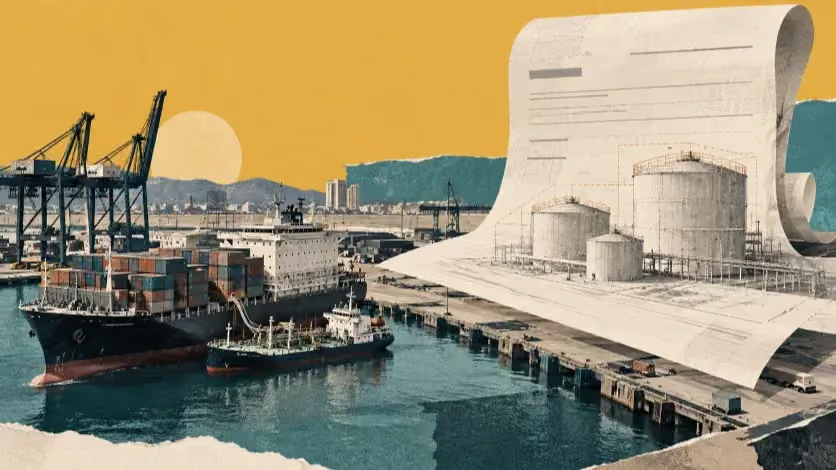
Busan Port’s LNG and Methanol Plan: Who Pays to Keep Fuel Ready?
Busan already supplies ships with LNG and methanol, drawing on regional and i...
 NewsOct 16, 2026
What Is Still Worth Going to See?
Busan’s biennale faces questions of artistic judgment and institutional care....
 NewsOct 14, 2026
What Became of Busan’s University Streets?
From 2015 to 2023, registered businesses grew near Pusan National University...
More from the author
More from this byline
Stay with the same line of reporting through more work from this byline.
- NewsOct 22, 2026
Busan Port’s LNG and Methanol Plan: Who Pays to Keep Fuel Ready?
 NewsOct 12, 2026
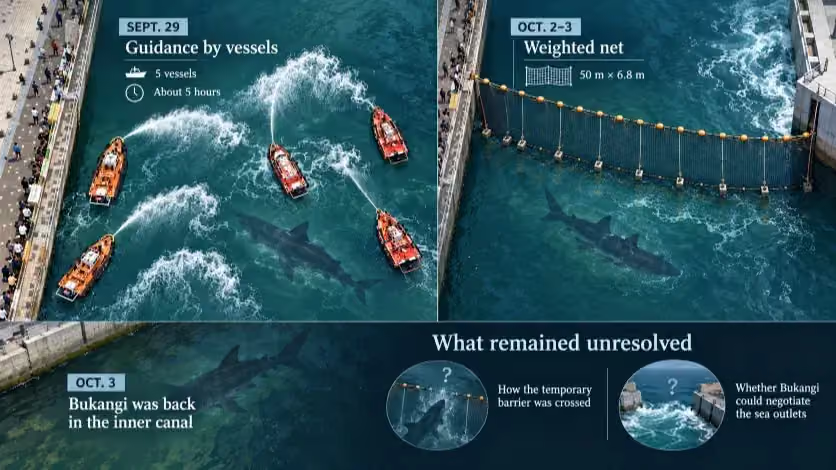
Bukangi, the Shark That Stayed in Busan’s North Port
Reader Signal
Community readWhat did this report leave you with?
Choose the signal that best reflects your reading. Select it again to remove it.
One response per article
No response selected
A moderated conversation about the reporting.
One-level replies and newsroom moderation keep the conversation anchored to this article.
Discussion Status
Open
Please sign in to join the discussion.
Newsletter
Weekly reporting and context from Busan and Korea.