Busan Advances Gangseo Tram, Testing Western Growth
Ridership data show an existing commuter base at Daejeo Station, but the line’s success depends on operating speed and the pace of development in Eco Delta City.


Busan has advanced its proposed Gangseo tram line to the national feasibility review stage, targeting fast-growing western districts rather than the city’s shrinking core.
Ridership data at Daejeo Station show an existing commuter base, but the line is structured as a feeder dependent on transfers, surface-level operations, and the unfinished Eco Delta City development.
The story examines whether the project’s design and operating constraints align with the city’s policy ambitions, using population and station-level data rather than political messaging.
Busan, South Korea — Busan has moved forward with plans for the Gangseo tram line, a 21.1-kilometer light rail project designed to link the city’s western new towns with its existing subway network. On December 22, the project was selected for a preliminary feasibility study by South Korea’s Ministry of Economy and Finance, allowing the city to formally assess costs, ridership, and economic viability.
The proposed line would run from Daejeo Station on Subway Line 3 through the Eco Delta City development area to Myeongji Ocean City, with 25 stations planned along the route. Busan estimates the total cost at 725.2 billion won ($530 million), to be funded through a mix of central government subsidies, municipal spending, and development-related contributions tied to the Eco Delta City project.
The Gangseo corridor differs from most parts of Busan. While the city’s overall population continues to decline, Gangseo District is still growing, driven by large-scale housing developments in Myeongji and the ongoing construction of Eco Delta City. These areas are attracting working-age households who commute daily to employment centers elsewhere in the city.
At the center of the plan is Daejeo Station, the northern terminus of Subway Line 3 and a transfer point to the Busan–Gimhae Light Rail Transit system. Passenger data from the Busan Transportation Corporation show that the station handles more than 15,000 boardings and alightings on an average weekday, with clear commuter peaks in the morning and evening.
The Gangseo line would not provide a direct rail connection to Busan’s central business districts. Instead, it is intended to channel new-town residents into existing rail lines through transfers at Daejeo and other junctions. Its performance will therefore depend on transfer times, operating speed, and the pace at which population and employment increase in Eco Delta City, where large portions of the development remain under construction.
Observed Demand at the Transfer Point
Daejeo Station functions as the northern terminus of Busan’s Subway Line 3 and a transfer node to the Busan–Gimhae Light Rail Transit system. Passenger records from the Busan Transportation Corporation show that the station processes roughly 15,000 to 16,000 boardings and alightings on an average weekday.
Traffic at the station is concentrated during peak commuting hours. Between 7 a.m. and 9 a.m., alightings consistently exceed boardings, reflecting inbound movement toward Line 3 from surrounding districts and regional rail connections. During the evening peak from 5 p.m. to 7 p.m., the flow reverses, with boardings rising sharply as passengers exit the rail network toward residential areas.
In terms of overall volume, Daejeo ranks in the middle-to-upper tier among Busan’s more than 100 subway stations. Its daily usage is comparable to several transfer stations in northern and western Busan rather than to low-volume terminal stops at the edge of the network.
Passenger movement at Daejeo is dominated by circulation rather than final destination activity. Most riders pass through the station to change lines instead of beginning or ending trips there, producing pronounced peaks and limited off-peak traffic.
This pattern places Daejeo within Busan’s existing commuter framework, where rail lines converge at peripheral nodes before dispersing riders toward multiple employment and residential zones across the city and adjacent municipalities.
Population and Development as the Source of Demand
Gangseo District diverges from broader demographic trends in Busan. While the city’s total population has continued to contract, Gangseo has recorded net population growth, driven primarily by new housing supply in Myeongji and adjacent reclaimed areas.
The population increase is concentrated among working-age households. Residents in their 30s and 40s account for a larger share of the district’s population than the citywide average, and the proportion of children is higher than in older urban districts. Much of the growth has occurred in newly built apartment complexes designed for family households.
Daily travel patterns reflect this demographic structure. Employment opportunities within Gangseo remain limited, and most residents commute to jobs located elsewhere in Busan or in nearby cities such as Gimhae. Destinations are dispersed across western Busan, central districts including Seomyeon and Yeonsan, and industrial areas beyond the city boundary.
Car ownership in the district is widespread, supported by road layouts and residential planning that prioritize private vehicles. Public transport use increases during peak commuting hours but drops sharply outside those periods, particularly where trips require transfers or involve longer travel times.
Eco Delta City sits at the center of this growth corridor but remains under development. The project spans roughly 11.7 square kilometers and is planned to house about 76,000 residents when completed. Residential construction has advanced in selected zones, while commercial facilities, schools, and employment centers are being delivered in stages.
A designated smart city pilot area within Eco Delta City is scheduled to host research and technology-related functions, but these activities have yet to generate substantial local employment. As a result, population growth has outpaced the formation of self-contained urban functions, leaving daily mobility dependent on connections to the wider metropolitan rail and road network.
Operating Structure and Constraints
The Gangseo line is structured to link new residential districts in western Busan to the city’s existing rail network rather than to operate as an independent corridor. The alignment does not extend into Busan’s central business districts and does not offer direct, single-seat access to major employment centers such as Seomyeon or Yeonsan.
Instead, the route is designed to terminate at Daejeo Station, where passengers would transfer to Subway Line 3 or the Busan–Gimhae Light Rail Transit system. Travel beyond western Busan would therefore require at least one transfer in most cases, placing the line in a feeder role within the broader network.
The choice of a street-level tram shapes how the line would operate. Unlike grade-separated subways, trams share intersections with road traffic and are governed by signal systems. Average operating speed depends on the extent of dedicated lanes, signal priority at crossings, and enforcement of right-of-way along the corridor.
Station spacing adds another constraint. With 25 stops planned over 21.1 kilometers, intervals average less than one kilometer. Frequent stops combined with intersection delays can accumulate, particularly during peak hours, narrowing any time advantage over existing bus services that already serve Myeongji and surrounding areas.
Bus routes along the corridor provide high-frequency service but are exposed to congestion on arterial roads. For the tram to attract riders from these routes, it would need to deliver either faster end-to-end travel times, more consistent reliability, or reduced transfer friction. Where operating speeds converge, mode shift becomes less likely.
Small delays carry amplified effects in a transfer-based system. Missed connections at Daejeo during peak periods extend total door-to-door travel times, especially for commuters traveling to dispersed destinations across Busan and neighboring cities.
City officials have framed the Gangseo line as part of broader policy goals, including a “15-minute city” and stronger regional integration. These outcomes depend on operating conditions that will be determined during detailed design and feasibility review, including right-of-way allocation, signal priority, and station integration.
Continue this reporting
Reporting on the same issue
Related coverage selected from the article's desk, topics and newsroom relationships.
 NewsOct 22, 2026
Busan Port’s LNG and Methanol Plan: Who Pays to Keep Fuel Ready?
Busan already supplies ships with LNG and methanol, drawing on regional and i...
 NewsOct 16, 2026
What Is Still Worth Going to See?
Busan’s biennale faces questions of artistic judgment and institutional care....
 NewsOct 14, 2026
What Became of Busan’s University Streets?
From 2015 to 2023, registered businesses grew near Pusan National University...
More from the author
More from this byline
Stay with the same line of reporting through more work from this byline.
- NewsOct 22, 2026
Busan Port’s LNG and Methanol Plan: Who Pays to Keep Fuel Ready?
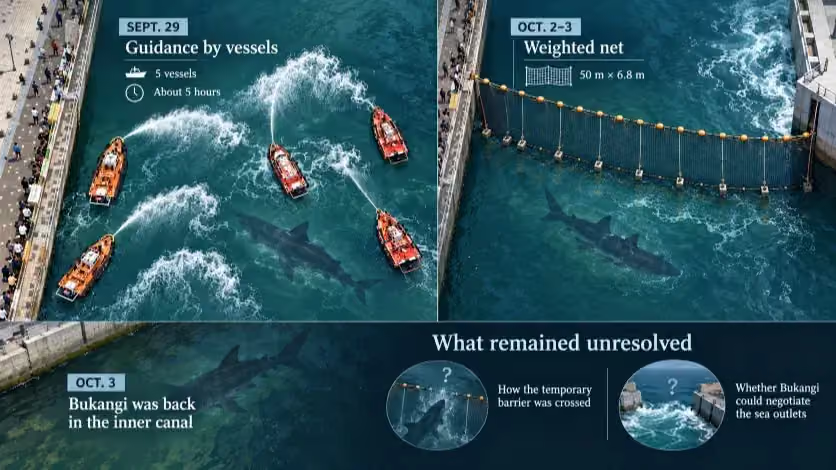 NewsOct 12, 2026
Bukangi, the Shark That Stayed in Busan’s North Port
Reader Signal
Community readWhat did this report leave you with?
Choose the signal that best reflects your reading. Select it again to remove it.
One response per article
No response selected
A moderated conversation about the reporting.
One-level replies and newsroom moderation keep the conversation anchored to this article.
Discussion Status
Open
Please sign in to join the discussion.
Newsletter
Weekly reporting and context from Busan and Korea.