Behind Busan’s Tourism Milestone, a City Losing Its Footing
Visitor growth has surged past 3 million, yet population loss, rising vacancy and weakening urban life reveal a deeper challenge.


Busan, South Korea — Busan marked a symbolic milestone this year: more than 3.02 million foreign visitors arrived in the city between January and October, the highest figure since records began. City officials hailed the moment as evidence that Busan is entering a “new phase” as a global tourism destination. Headlines echoed the optimism. The numbers, they suggested, spoke for themselves.
But the streets tell a different story. In Nampo-dong, one of Busan’s oldest commercial districts, nearly 26.4 percent of retail space now sits vacant—roughly twice the national average for comparable urban areas. The district’s resident population has shrunk to barely 840 people, and more than 37 percent of them are aged 65 or older. Seomyeon, once the city’s most reliable barometer of youth culture and small-business energy, shows long daytime lulls and aging buildings with empty upper floors. A city that attracted millions of visitors in 2024 is simultaneously losing the people who once animated its core.
This contrast—between headline tourism growth and quiet urban hollowing—is the central tension shaping Busan today. The milestone of three million visitors is real. But whether it signals meaningful strength is far less clear. Much of the visitor increase reflects national and regional forces: Korea recorded more than 15 million inbound travelers by late 2024, driven by a resurgence of East Asian tourism and low-cost flight networks rebuilding after the pandemic. Busan is riding this wave—not directing it.
City officials frame the numbers differently. In press briefings, they highlight a 31.5 percent jump in foreign card spending, a target of five million annual visitors by 2028, and a portfolio of new branding initiatives, cultural investments and infrastructure projects meant to elevate Busan’s global profile. In their narrative, the arrival figures are proof that these strategies are working.
But a closer look at the data suggests a more complicated picture. Nearly 43 percent of the people Busan counts as “foreign arrivals” did not enter Korea through Busan at all—they landed in Seoul or Incheon first, then came south as part of multi-stop itineraries that have long defined regional travel patterns. Another 14 percent entered by sea, many on cruise ships whose passengers spend only a few hours in the city. Only about 42 percent flew directly into Busan.
The milestone, in other words, does not automatically mean what the city says it means. It does not show that Busan is becoming the primary draw for foreign travelers, nor that new municipal policies are reshaping demand. And it says little about the state of the city’s own neighborhoods—places where population loss, aging demographics and weakening commercial corridors are reshaping the urban landscape more profoundly than any visitor count can capture.
But the milestone obscures key details. The composition of Busan’s arrivals and the pressures shaping its inner districts raise questions about how much of this growth reflects the city’s own momentum—and how much stems from forces outside its control.
What Busan Says It Has Achieved
Busan officials have built a clear narrative around the three-million milestone.
In their view, the surge in foreign arrivals is not only a statistical achievement but the first proof point of a broader transformation: the emergence of Busan as a “global tourism city.” Their briefing materials highlight the number prominently—3,019,164 visitors by the end of October—and frame it as evidence that the city has moved beyond recovery and into a new competitive tier.
The administration pairs the headline with another figure: ₩859.2 billion in foreign card spending during the same period, a 31.5 percent increase from the previous year and, according to the city, the fastest growth rate among Korean regions. Officials cite this as a sign that Busan is capturing not only more visitors but more value from them.
They also point to the composition of inbound markets. Taiwan led all foreign sources with roughly 564,000 visitors, followed by China (483,000), Japan (431,000), the United States (209,000), and the Philippines (146,000). Eight markets—including Taiwan, China, Vietnam, India, the Philippines, Russia, Hong Kong and the United Kingdom—recorded year-on-year increases of more than 20 percent. Busan places these figures alongside the national inbound total to argue that it is emerging as a principal entry point within Korea’s tourism economy.
Building on this momentum, the city has set an ambitious target: attracting five million foreign visitors annually by 2028 and lifting foreign tourist spending to ₩1.5 trillion. It has organized its strategy around five pillars—global tourism branding, improved accessibility, expanded tourism zones, diversified experiences and higher-value segments such as MICE, wellness and remote-work stays.
The supporting initiatives are numerous. The city emphasizes forthcoming cultural infrastructure such as the Busan Opera House and the Pompidou Center Busan, both positioned as future anchors of an enhanced cultural district. It highlights planned improvements to flight connectivity at Gimhae Airport, the addition of a third exhibition hall at BEXCO, redevelopment around the Suyoung Bay marina and the expansion of the VisitBusan digital platform to include AI-based recommendations and integrated city passes for foreign travelers.
Officials also outline a territorial strategy that divides the metropolitan area into themed tourism zones—east Busan as a premium resort district, west Busan as a nature-focused zone, and the old city center as a history-culture belt—intended to broaden the geographic spread of visitors. A regional tourism corridor, linking Busan with neighboring southern provinces, is presented as the next stage of scale-building.
The city’s content strategy rounds out the plan: new night-time programs, expanded food initiatives, amphibious buses, sea taxis, marine leisure offerings, and enhanced eco-tourism tied to assets such as the Nakdong River and Geumjeongsan. Workation schemes, meanwhile, aim to draw longer-stay visitors into co-living arrangements that officials hope will stimulate underused neighborhoods.
Taken together, these initiatives form the basis of the city’s argument that Busan is not simply benefiting from wider regional travel recovery but actively steering its own ascent. The milestone, in this narrative, is confirmation that the strategy is working—and that the city is already on the path toward the five-million mark.
A Closer Look at the Numbers
The numbers underpinning Busan’s milestone look straightforward at first glance.
But when broken down, they reveal a pattern very different from the story the city projects.
Of the 3.02 million foreign visitors Busan counted by October, only 1.28 million—roughly 42 percent—arrived directly by air. Another 435,000 (14 percent) entered through the port, many as part of cruise itineraries that allow only a few hours on shore. The remaining 1.29 million, nearly 43 percent, first entered Korea through another city—primarily Seoul or Incheon—before making their way to Busan.
This distribution matters. It shows that Busan is often a secondary stop in itineraries shaped outside the city’s control. The growth Busan recorded is substantial, but it occurred within a national rebound that saw South Korea surpass 15 million foreign visitors by late 2024—a more than 50 percent year-on-year increase. Busan’s 23 percent rise sits comfortably inside this broader wave, rather than apart from it.
The composition of the city’s arrivals underscores the point. Visitors from Taiwan, Japan and China—Busan’s largest inbound markets—are among the most responsive to airfare changes, visa arrangements and K-culture cycles. Their travel patterns typically center on Seoul, the country’s dominant gateway, with Busan added as a coastal complement. In this context, Busan’s foreign-arrival figures track more closely with regional demand dynamics than with municipal policy interventions.
Cruise traffic further amplifies the headline total while contributing little to its depth. The 435,000 sea arrivals counted this year include passengers who often disembark for only half a day, follow fixed routes near the port and spend modestly before reboarding. Their presence raises Busan’s visitor tally but not necessarily its economic footprint—at least not in the way the city’s narrative implies.
Even the card-spending figure, though impressive at first sight, tells a more nuanced story. The ₩859.2 billion in foreign card expenditures marks the fastest growth rate of any Korean region, but Busan still accounts for a relatively small share of national tourist spending. And that spending is highly concentrated: most of it flows through a narrow coastal corridor anchored by Haeundae and Gwangalli, with limited spillover into the older districts the city hopes to revive.
Taken together, the structure of Busan’s numbers suggests momentum, but not necessarily the kind the city claims. The growth reflects volume, not reorientation—a rising tide of regional travel rather than a fundamental shift in how visitors choose or experience the city. And it raises a question that the milestone itself cannot answer: if the surge is driven primarily by forces outside Busan, what does it truly say about the city’s trajectory?
The External Forces Behind the Increase
If Busan’s surge in foreign arrivals is not primarily the product of its own policies, what is driving it? The answer lies in forces operating far beyond the city’s boundaries—forces that shape regional travel patterns regardless of municipal strategy.
Foremost among them is the post-pandemic rebound in East Asian travel, which has unfolded unevenly across markets but robustly enough to lift destinations across South Korea. Taiwan, Japan and China—Busan’s three largest inbound sources—have all experienced sharp recoveries in outbound tourism since late 2023, driven by looser travel restrictions, rising disposable incomes and a renewed appetite for short-haul leisure trips. Their travelers tend to build itineraries that prioritize convenience and price, not city-specific branding or localized policy shifts.
This pattern intersects with the structure of Korea’s aviation system, which tilts overwhelmingly toward the capital region. More than four-fifths of the country’s international passenger traffic flows through Incheon and Gimpo, making Seoul the default entry point for long-haul and many short-haul arrivals. Travelers who visit Busan typically do so afteranchoring their trip in the capital—a dynamic reflected clearly in Busan’s own numbers, where nearly 43 percent of counted “arrivals” first entered the country elsewhere.
Low-cost carriers have amplified this movement. Airlines such as Jeju Air, T’way and Air Busan restored seat capacity on routes linking Busan with Taipei, Kaohsiung, Fukuoka and Osaka earlier and more aggressively than on long-haul sectors. The result has been a price-driven expansion of short-break itineraries: two- or three-night trips that incorporate Busan as a convenient coastal stop rather than as a destination chosen for specific attractions or campaigns. These travelers rarely stay long, and their spending tends to be concentrated in predictable leisure corridors.
Package tourism adds another layer. Regional travel agencies across Taiwan, Japan and Southeast Asia continue to market Korea through standardized circuits—Seoul for shopping and culture, Busan for scenery and seafood, with a third destination added depending on season. In these products, Busan’s role is defined by itinerary balance and operational efficiency, not by municipal competitiveness. The city’s inclusion is a commercial decision made upstream by tour operators, who adjust schedules and pricing far more rapidly than local governments can respond.
Cruise tourism further inflates the headline figures while contributing little to the city’s strategic aims. Vessels docking at Busan’s port accounted for more than 435,000 of this year’s arrivals, yet their passengers typically disembark for only a few hours, visit prearranged sites near the waterfront and return before evening. Their impact is visible but shallow—an uptick in crowds near the port and a modest rise in spending on snacks, souvenirs and guided walking routes. For a city framing itself as a global tourism hub, this segment boosts volume more than value.
A final element is cultural, and perhaps the most decisive. The continued pull of K-culture—from pop music and television dramas to food, fashion and digital media—has expanded Korea’s overall desirability as a travel destination. This interest is national, not municipal: Busan benefits because it is part of the Korean travel map, not because it has fundamentally reshaped its appeal. Visitors drawn to the cultural wave often come looking for the familiar icons of Korean popular culture, most of which remain centered in Seoul.
Together, these forces explain much of Busan’s rise in foreign arrivals without invoking new initiatives or local policy shifts. They show regional demand cycles, structural realities in aviation and travel distribution, and commercial decisions made by actors that operate at scales far larger than a single city.
The Shrinking Core Behind the Visitor Rise
Even as Busan celebrates record tourism, the physical and demographic center of the city is moving in the opposite direction. The contrast is most visible in the districts that once defined its commercial life—Nampo-dong, Seomyeon and the older downtown neighborhoods that historically functioned as the city’s economic spine.
Nowhere is the shift sharper than in Nampo-dong. What was once a dense retail corridor has thinned into long stretches of empty storefronts and aging buildings. The district’s commercial vacancy rate reached 26.4 percent earlier this year—nearly double the national average for comparable retail zones. Its residential base has all but collapsed: only around 840 people still live in the district, and 37.6 percent of them are over 65. Busan’s oldest commercial quarter has, in effect, become an elderly enclave wrapped around a hollowed-out retail grid.
Seomyeon, long considered Busan’s pulse of youth culture, now shows a subtler form of decline. Weekend evenings still draw crowds, but daytime foot traffic has grown thin, and the buildings that once housed cafés, boutiques and creative businesses have begun to show their age. Upper floors sit empty, and turnover among small tenants is frequent. These shifts reflect not a temporary slowdown but a demographic recalibration: Busan has lost around 670,000 residents since the mid-1990s, with the steepest declines among people in their 20s and 30s—the demographic whose spending sustains everyday urban vitality.
This erosion is not limited to commerce. Older public spaces in the downtown core—alleyways, pedestrian streets, small plazas—show signs of uneven maintenance and declining investment. The infrastructure itself is functional, but it no longer conveys the sense of momentum that attracts either new residents or new businesses. In many blocks, landlords rely on short-term tenants or tourist-focused pop-ups to fill space. These formats generate activity but not stability; they do little to rebuild the dense, self-sustaining ecosystems that once animated the area.
Tourism, meanwhile, rarely reaches these districts in a meaningful way. The vast majority of foreign spending occurs in a narrow coastal arc centered on Haeundae and Gwangalli, far from the old downtown. Cruise passengers seldom venture more than a few blocks from the waterfront. Even independent travelers who explore the city tend to allocate only one or two nights to Busan, following routes that prioritize beaches, seafood markets and oceanfront views. Their itineraries reinforce the geographical divide: the coastal districts thrive on visitor flows, while the historic core continues to hollow out.
Demographic trends deepen the problem. Busan’s aging trajectory—now among the steepest of any major Korean city—reduces the consumer base that local businesses depend on and weakens the cultural infrastructure that makes urban neighborhoods feel alive. Young residents are leaving for Seoul or the greater capital region, where economic opportunities and cultural amenities are concentrated. Without a stable and growing population, revitalization becomes hard to sustain, regardless of how many tourists pass through.
The result is a widening disconnect between the city’s visitor economy and its urban fundamentals. Tourism can generate volume and seasonal energy, but it cannot replace the daily rhythms produced by residents, nor can it substitute for the long-term demand that anchors retail, culture and neighborhood life. Busan’s rising visitor numbers coexist with a core that is shrinking in both population and purpose—a dynamic that complicates any claim that the city is entering a new era of urban strength.
Why Tourism Cannot Fix Structural Decline
Busan’s strategy assumes that stronger tourism infrastructure, more diverse programs and expanded branding will translate into a more competitive and resilient city. But the policies the city highlights most prominently sit uneasily against the structural conditions unfolding on the ground. The gap is not simply one of scale; it is one of direction.
The cultural facilities at the center of Busan’s long-term vision illustrate the tension. The Busan Opera House and the Pompidou Center Busan—both still under construction—are presented as future anchors of a revitalized cultural district. Yet similar projects in other Korean cities have struggled to sustain attendance once the novelty fades, especially in regions facing demographic contraction. Large cultural institutions depend on a stable, culturally active resident base, not episodic tourism flows. Busan’s own demographic profile—shrinking population, steep aging and persistent youth outmigration—raises questions about whether such facilities can function as the economic drivers the city imagines.
Transportation policy shows a comparable disconnect. The city stresses its ambition to expand mid- and long-haul routes at Gimhae Airport as a step toward becoming a more globally connected hub. But the airport faces long-standing structural constraints: limited runway capacity, noise regulations and a geographic position that makes it difficult to attract carriers away from Seoul. More than 80 percent of Korea’s international airline traffic flows through Incheon and Gimpo, a concentration reinforced by market economics rather than municipal aspiration. Incremental improvements at Gimhae are possible, but meaningful shifts in Korea’s aviation landscape remain outside Busan’s authority.
The city’s MICE ambitions confront similar limits. Busan has developed a capable convention infrastructure around BEXCO, and the planned third exhibition hall is intended to strengthen its competitiveness. But large-scale conventions gravitate toward cities with dense corporate ecosystems, international organizations and decision-making centers—all of which remain heavily concentrated in Seoul. Busan can host events, but shaping the market for them requires assets the city does not possess, and that cannot be built quickly or solely through facility expansion.
Other elements of the city’s strategy reveal a different kind of mismatch—one of scale and impact. Programs such as night markets, amphibious buses, sea taxis, pop-up cultural zones and seasonal festivals offer color and visibility, but they operate at the margins of the tourism economy. They attract weekend crowds and generate promotional images, yet their economic and spatial footprints are small. More importantly, they do not address the conditions that have allowed downtown vacancy to rise or that have accelerated the flight of younger residents.
Even the city’s emphasis on gastronomy risks conflating branding with substance.
Expanding Michelin recognition and hosting high-profile culinary events can boost Busan’s profile among a narrow international audience, but visitors from its largest markets consistently prioritize affordability, convenience and authentic local character over fine-dining credentials. Without improvements to street-level vitality and neighborhood amenities, culinary branding alone cannot shift Busan’s competitive position.
The workation initiative, another pillar of the city’s vision, faces structural constraints that the strategy does not fully confront. Remote workers who choose long stays typically look for neighborhoods with strong urban amenities, walkability, accessible housing and an active creative ecosystem. These are precisely the areas where Busan is weakest. The districts best suited for such stays—Nampo-dong, Seomyeon and the old downtown—lack the density of coworking spaces, residential options, cultural venues and everyday vibrancy that make long-term stays appealing. Naming a market does not create one.
Underlying all of this is a more fundamental issue: the city’s tourism strategy treats visitor growth as a pathway to urban revitalization, when in most cases the causal chain runs the other way. Cities with strong tourism sectors generally begin with robust local economies, dense populations, vital cultural ecosystems and functioning urban cores. Tourism amplifies those strengths; it does not generate them. In Busan, the policies being promoted are layered atop weakening fundamentals, creating a veneer of momentum that does not address the roots of urban decline.
The city’s initiatives are not misguided in intent. What is unclear is whether they meaningfully engage the forces shaping Busan’s future: demographic contraction, aging urban infrastructure, structural economic centralization around Seoul and the hollowing-out of the city’s commercial heart. Until those fundamentals are confronted directly, tourism-led development will remain more aspiration than strategy.
What Visitors Actually Experience
For most foreign travelers, the Busan they encounter is narrower and more contained than the version promoted in official brochures. Their itineraries follow a predictable arc shaped less by municipal programming than by the spatial logic of the city itself.
The journey usually begins in Haeundae or Gwangalli, the districts that shoulder the bulk of Busan’s tourism economy. These areas function smoothly: hotel clusters are dense, beaches are well maintained, and essential services for foreign visitors—signage, transport links, food options—are easy to navigate. The coastline delivers what most short-haul travelers seek: accessible scenery, a relaxed pace and enough dining and nightlife to fill a weekend. For many visitors, this beachfront corridor becomes the entirety of Busan.
Once they move beyond it, the experience shifts. Travelers expecting a vibrant center of urban life frequently arrive in Nampo-dong to find a district caught between past and present. Shopfronts alternate between shuttered units and low-margin souvenir stores; older buildings dominate the streetscape; foot traffic thins markedly after dark. Visitors often describe the area—on travel forums, reviews and social media—as “quiet,” “dated,” or “past its peak.” The mismatch is not one of safety or hospitality but of expectation: guidebooks still frame Nampo-dong as the historic commercial heart of the city, but its built reality reflects years of demographic decline and retail contraction.
Seomyeon offers a similar tension, though in a more fragmented way.
Certain blocks retain an energetic mix of bars, cafés and shops, particularly at night. But the atmosphere changes quickly as one moves outward. Daytime rhythms feel muted, older commercial towers carry visible vacancies, and the urban density that once supported a lively midtown has eroded. Foreign visitors who arrive expecting a smaller analogue of Seoul’s Hongdae or Osaka’s Namba often find a district less cohesive and less animated than anticipated.
Even when the experience is positive, it tends to be shallow rather than expansive. Travelers consistently praise Busan’s food—especially seafood—but their engagement is concentrated in a handful of well-publicized markets such as Jagalchi. Hiking trails, coastal walks and viewpoints offer attractive excursions, yet these activities rarely occupy enough time to extend stays. Survey patterns and booking data show that most foreign visitors spend only one to three nights in Busan, and seldom more than a day outside the main beachfront districts.
The city’s newer tourism programs—night markets, seasonal festivals, marine leisure activities—rarely alter this rhythm. Many operate on limited schedules or in locations not intuitively accessible to foreign travelers. Few appear in visitor reviews unless the timing happens to align. For short-stay tourists, discoverability is an invisible constraint: experiences matter only if they can be easily found, not just promoted.
Transport plays an understated but real role as well. Busan’s metro system is clean and reliable, but the city’s attractions are geographically dispersed. Moving from Haeundae to Seomyeon to Gamcheon or Taejongdae can require long transfers and multiple transit modes. Compared with compact urban destinations in Japan or Taiwan, the city’s spatial spread increases the friction of exploration. Many visitors respond by narrowing their itineraries rather than expanding them.
What emerges from these impressions is not dissatisfaction, but limited depth.
Visitors enjoy Busan, but within a confined frame: beaches, seafood, a coastal skyline and a handful of discrete points of interest. They do not engage with the city as a continuous urban experience, nor do they encounter the neighborhoods the city most hopes to revive. Their time is short, their movement is concentrated, and the gaps in the urban fabric—vacant blocks, aging districts, thinning commercial corridors—remain largely invisible to them.
This is perhaps the most telling feature of Busan’s tourism rise. The city’s appeal to foreigners is real, but it is thinly distributed—strong in a few coastal zones and largely absent elsewhere. Tourism brings people to Busan, but it does not meaningfully anchor them within the city. For a municipality hoping to use visitor growth to catalyze urban regeneration, that distinction is not minor.
The Economic Realities the Tourism Narrative Leaves Out
The limits of Busan’s tourism-led narrative become clearer when placed against the city’s broader economic and demographic trajectory. Tourism can generate visibility, traffic and seasonal energy, but it cannot substitute for the underlying forces that determine whether a city grows, stabilises or quietly contracts.
The most consequential of those forces is demographic. Busan has lost around 670,000 residents since the mid-1990s, one of the steepest sustained population declines among major Korean cities. The outflow has been sharpest among residents in their twenties and thirties—the very group that anchors consumption, cultural production and small-business formation. As this cohort thins, so does the city’s everyday economic metabolism. Cafés, bars, bookstores, shared studios and informal creative networks all depend on a young and active population; when that population shrinks, so does the infrastructure that gives a city its cultural and commercial depth.
Meanwhile, the districts most affected by this demographic thinning have undergone a silent restructuring of their commercial base. In the old downtown, low-cost souvenir shops and short-term tenants have filled the void left by shrinking local demand. These businesses function, but they do not form durable commercial ecosystems. Their dependence on intermittent visitor flows makes them responsive to tourism cycles but disconnected from the city’s long-term economic needs. The visible movement they generate masks a weakening foundation.
Busan’s cultural landscape reflects a similar shift. Cities that sustain strong cultural sectors typically do so through dense networks of creators, small venues and independent businesses—networks fed by population growth and urban diversity. In Busan, public festivals and municipal programming increasingly fill the space once occupied by independent cultural production. The result is a scene that remains active but heavily mediated by the city government. Visibility increases, but organic renewal lags behind.
For tourism, this creates a paradox. Modern travelers—especially younger ones—tend to be drawn to cities with strong local culture, active neighborhoods and a palpable sense of momentum. Yet those qualities depend on resident-driven vibrancy, not visitor-driven spending. When the everyday city weakens, tourism cannot compensate; at best, it overlays seasonal peaks onto a thinning baseline.
This dynamic shapes Busan’s current moment. The city’s visitor numbers are rising, but its population is shrinking. Beaches and waterfronts bustle on weekends, while the old downtown idles through weekday afternoons. New cultural institutions are being built, even as the resident base required to sustain them contracts. The milestone of three million foreign visitors is real, but the conditions behind it—external travel cycles, Seoul-centered aviation, K-culture demand—have little to do with the strength of the city’s own urban core.
Tourism has given Busan a conspicuous headline at a time when the city could use one. The arrival of more than three million foreign visitors signals that Busan remains firmly on the regional travel map, and that Korea’s broader tourism rebound is lifting its coastal metropolis as well.
But the milestone does not, on its own, indicate that Busan is becoming stronger.
It does not show that the city is reversing population loss, rebuilding its downtown economy or cultivating the cultural ecosystems that anchor long-term vitality. It does not demonstrate that the policies highlighted by the city—new facilities, branding, seasonal programs—are the drivers of the increase. The structure of the visitor data suggests otherwise.
Busan is gaining visitors because Korea is gaining visitors, because airlines have rebuilt short-haul networks, because Seoul remains the country’s dominant gateway, and because regional travel demand has normalized. These are powerful forces, but they do not originate in Busan, nor do they resolve the city’s structural weaknesses.
The city’s challenge, then, is not how to celebrate its tourism numbers, but how to convert them into something that strengthens the urban core rather than masks its erosion. A city’s long-term trajectory is determined not by how many people pass through it, but by how many choose to stay—how many decide that its neighborhoods, institutions and opportunities are worth building a life around. On that measure, Busan’s work has only just begun.
Continue this reporting
Reporting on the same issue
Related coverage selected from the article's desk, topics and newsroom relationships.
 NewsOct 23, 2026
Busan’s Twelve-Year School Account Faces a Test Beyond Access
Busan’s PENZ promises one school account for 12 years, while BeAT brings AI t...
 NewsOct 22, 2026
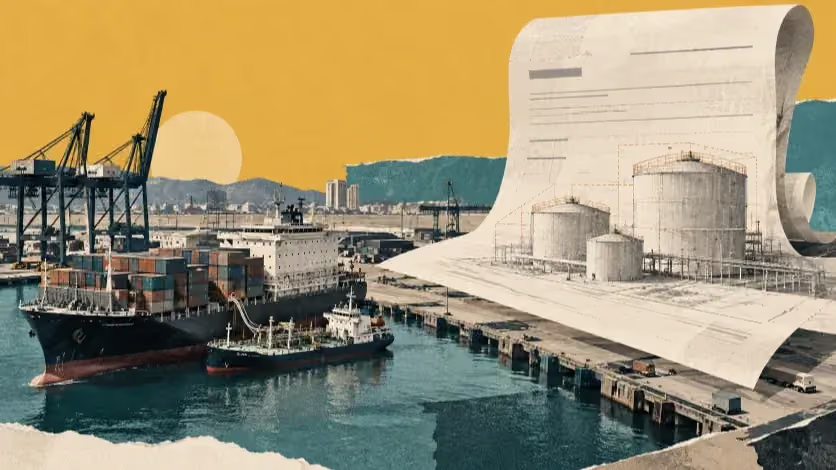
Busan Port’s LNG and Methanol Plan: Who Pays to Keep Fuel Ready?
Busan already supplies ships with LNG and methanol, drawing on regional and i...
 NewsOct 16, 2026
What Is Still Worth Going to See?
Busan’s biennale faces questions of artistic judgment and institutional care....
More from the author
More from this byline
Stay with the same line of reporting through more work from this byline.
 NewsSep 16, 2026
Busan’s Young-Adult Migration Turns Sharply at 25–29
Reader Signal
Community readWhat did this report leave you with?
Choose the signal that best reflects your reading. Select it again to remove it.
One response per article
No response selected
A moderated conversation about the reporting.
One-level replies and newsroom moderation keep the conversation anchored to this article.
Discussion Status
Open
Please sign in to join the discussion.
Newsletter
Weekly reporting and context from Busan and Korea.