Behind Busan’s 15-Minute City Branding
Busan’s 15-minute city branding contrasts with reality: elderly downtowns, empty homes, and car-dependent Eco-Delta leave proximity as a slogan only.

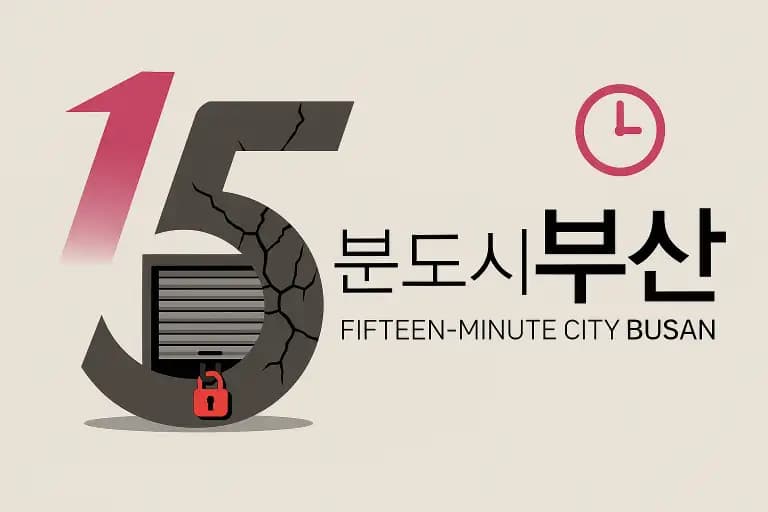
Busan, South Korea — When officials from Busan took the stage at an international forum in Paris this September, they presented South Korea’s second-largest city as a rising model of the “15-minute city.” Slides of new libraries, cultural centers, and pilot walkable neighborhoods were accompanied by confident rhetoric about proximity and sustainability. The presentation drew polite recognition from the audience, and city leaders quickly framed this as “global acclaim,” portraying Busan as an Asian pioneer of the urban concept first popularized in Paris.
Yet, on the ground in Busan, the picture is far less flattering. In the historic districts of Dong, Seo, Jung, and Yeongdo, streets are lined with shuttered shops and rows of vacant homes. The residents who remain are overwhelmingly elderly, with limited purchasing power and few prospects for renewal. A new cultural hall or library may bring symbolic value, but these facilities do little to reverse a cycle of outmigration and decline.
At the same time, Busan’s flagship new town—Eco-Delta City, built on reclaimed wetlands in the west—was marketed as an eco-smart district for the twenty-first century. In practice, its broad arterial roads, car-oriented layout, and long commutes replicate the very problems the 15-minute city promises to solve. Subway extensions meant to link the area to the city center have faced repeated delays, construction accidents, and political disputes. For many residents, “proximity” is measured not by walking distance but by the hours spent in traffic.
The “15-minute city” was coined by Carlos Moreno, a professor in Paris, and championed by Mayor Anne Hidalgo as a cure for the daily grind of urban life: too much traffic, too much pollution, and too little access to essential services. From Barcelona’s “superblocks” to Melbourne’s local living hubs, the idea has spread widely. But it has never landed without controversy. In Oxford, England, low-traffic schemes aimed at reducing car use sparked protests, conspiracy theories about residents being “locked in,” and anger from shopkeepers who saw footfall drop. In parts of the U.K., the phrase itself has become so politically toxic that councils abandoned the wording even as they carried on with similar policies.
Fragmented Geography
Busan’s mountainous terrain and island districts prevent seamless walking or cycling access. The idea of a uniform “15-minute radius” collapses against physical barriers.
Declining Downtowns
In Dong, Seo, Jung, and Yeongdo, vacant houses and shuttered shops dominate. A library or cultural hall cannot revive neighborhoods hollowed out by aging and outmigration.
Car-Centric New Towns
Eco-Delta and western expansions were designed around wide roads and long commutes. Without reliable transit, proximity remains a slogan, not reality.
Demographic Divide
Old quarters are dominated by the elderly; young families relocate to distant new towns. This fractured urban demography undermines the concept of vibrant local consumption.
Busan’s challenge, however, is not the same as Europe’s. European cities typically begin with centuries-old cores—dense, mixed-use streets where proximity already exists, but cars have dominated public space. Busan’s urban form was shaped by rapid postwar growth: steep hills, fragmented districts, and sprawling car-dependent new towns. In much of the city, daily services such as clinics, schools, and small shops are technically within reach. The deeper problem is that the very populations who might use them—young families, middle-aged workers—have left. What remains in many central neighborhoods is an aging, shrinking base of demand. Proximity exists, vitality does not.
For more than a decade, Busan has cycled through grand slogans: “Design City,” “Global Gateway,” and now “15-Minute City.” Each was launched at international events, accompanied by glossy presentations and pilot projects. Such campaigns provide symbolic capital, positioning Busan as a forward-looking metropolis in global urban networks. For local politicians, the international applause signals modernity and competitiveness.
But at home, the cost of governing through branding is the erosion of trust. Residents confronted with stalled subway lines, persistent traffic congestion, and declining local commerce see little connection between promotional slogans and daily life. “Libraries may look impressive in a presentation deck, but they cannot substitute for a missing customer base,” said one local planner. “Without addressing structural decline, the 15-minute label risks becoming theater rather than reform.”
Experts argue that Busan needs to abandon imported formulas and craft an urban strategy rooted in its own geography and demographics. The first priority is revitalizing the old downtown. This requires coordinated housing rehabilitation, incentives for mixed-age settlement, and services tailored to elderly residents. Without restoring population demand, new cultural facilities will remain underused.
Second, the city must strengthen its connective tissue. The long-delayed Sasang–Hadan subway line, weak east–west transit links, and bottlenecks across the Nakdong River have left districts effectively detached. Investment in reliable, cross-city transit infrastructure—bus rapid transit, bridges, and subway completion—is not optional, experts say, but fundamental to any claim of proximity.
Finally, new towns such as Eco-Delta must be rethought. Built on the logic of highways and long commutes, they already reproduce unsustainable patterns. Correcting this requires planning for walkability, density around transit, and integration of workplaces, not just housing. Without these shifts, western Busan will remain disconnected and car-bound.
Busan’s embrace of the “15-minute city” has earned it attention on the global stage. But for many of its own residents—elderly shopkeepers in hollowing districts, commuters stuck in traffic on western boulevards—the applause feels distant. The city’s future credibility will not be determined in Paris conference halls, but in whether its neighborhoods become more livable, connected, and resilient.
Continue this reporting
Reporting on the same issue
Related coverage selected from the article's desk, topics and newsroom relationships.
 NewsOct 22, 2026
Busan Port’s LNG and Methanol Plan: Who Pays to Keep Fuel Ready?
Busan already supplies ships with LNG and methanol, drawing on regional and i...
 NewsOct 16, 2026
What Is Still Worth Going to See?
Busan’s biennale faces questions of artistic judgment and institutional care....
 NewsOct 14, 2026
What Became of Busan’s University Streets?
From 2015 to 2023, registered businesses grew near Pusan National University...
More from the author
More from this byline
Stay with the same line of reporting through more work from this byline.
- NewsOct 22, 2026
Busan Port’s LNG and Methanol Plan: Who Pays to Keep Fuel Ready?
 NewsOct 12, 2026
Bukangi, the Shark That Stayed in Busan’s North Port
Reader Signal
Community readWhat did this report leave you with?
Choose the signal that best reflects your reading. Select it again to remove it.
One response per article
No response selected
A moderated conversation about the reporting.
One-level replies and newsroom moderation keep the conversation anchored to this article.
Discussion Status
Open
Please sign in to join the discussion.
Newsletter
Weekly reporting and context from Busan and Korea.