Autonomous Buses Begin Night Service in Busan
Busan has launched a pilot program for Level 3 autonomous buses along a 10.4 km BRT corridor, limited to night hours and supervised operation.

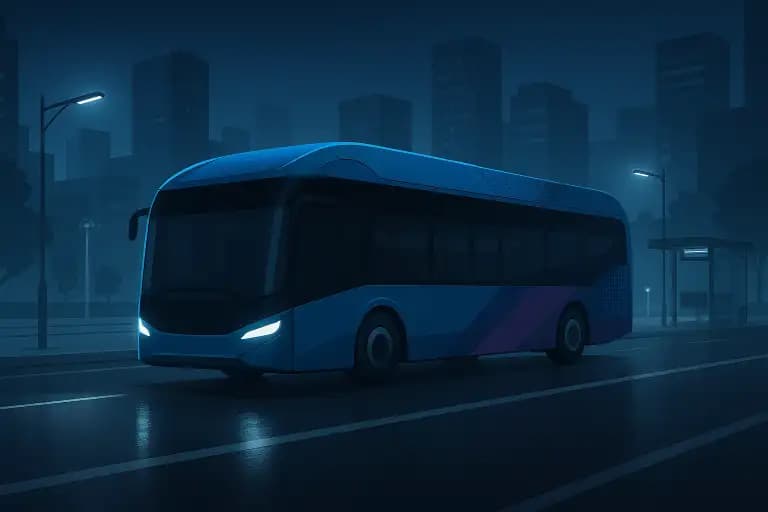
Busan, South Korea — Driverless buses are set to operate on a 10.4-kilometer section of Busan’s Bus Rapid Transit (BRT) corridor between Naeseong Intersection in Dongnae-gu and Haeundae-gu district. The service will run during late-night hours, three times a week, with each vehicle staffed by a safety operator. The system is classified as Level 3 autonomy, requiring human intervention in certain conditions.
The corridor uses dedicated bus lanes, allowing for controlled testing conditions. The vehicles are equipped with sensors and systems that control acceleration, braking, and steering. However, manual control is required in certain areas, including underpasses and intersections with restricted visibility.
The project was designated as part of a national autonomous driving trial zone. Initial testing is scheduled for late 2025, followed by public service in 2026. A separate pilot in the Osiria Tourism Complex will offer shorter trial routes for public experience.
The program targets service hours that are typically underserved by existing transit operations. City officials cite labor shortages and operational gaps as background factors in the planning process. Vehicle capacity is limited to 15 passengers, and routes are fixed. No expansion timeline has been announced. Additional evaluation will follow the trial period.
The vehicles used in the Busan pilot are categorized as Level 3 autonomous systems according to the standards set by the Society of Automotive Engineers (SAE). These handle essential driving tasks, including steering, acceleration, and braking, but require a human operator to intervene when necessary.
Autonomous functions are limited to predefined conditions. These include fixed routes, low-traffic hours, and specific environmental settings. The vehicle cannot initiate or complete a trip outside its designated corridor. Intervention is mandatory in tunnels, underpasses, and during signal failures.
The vehicle platform includes LiDAR, radar, and optical cameras. These systems process surrounding traffic, lane markings, and obstacles in real time. Data is not shared externally beyond system diagnostics.
Each bus carries a maximum of 15 passengers. Seat belts are provided. Standing is not permitted during operation. All routes are supervised remotely and supported by on-board safety staff trained to override the system manually.
No over-the-air updates or route adjustments are applied during active runs. All route and system configurations are pre-programmed before dispatch.
The Busan pilot was developed in response to persistent service gaps in late-night public transit. Fixed-route buses operated by the city do not run past midnight on most lines. Operating costs and labor availability have made expansion during off-peak hours difficult to sustain.
City officials selected the BRT corridor for its existing infrastructure and minimal interaction with mixed traffic. The route includes no unprotected intersections and maintains consistent signaling. These conditions reduce variability in vehicle behavior and allow for system evaluation within manageable limits.
Labor shortages in the public transit sector have remained a long-term issue, particularly in night and early-morning shifts. Entry rates for new drivers have declined, while the average age of active drivers continues to rise. The city’s transportation department has cited these trends in formal documentation accompanying the project.
The pilot is not intended to replace existing services but to supplement them. Test runs are scheduled during hours when no other public buses operate on the same corridor. No reduction in current bus staffing levels has been announced. No changes to fare systems or ticketing methods have been proposed during the trial period.
Public access to the autonomous service will follow a limited release model. Early users will board at selected BRT platforms, under observation by city staff and the operating agency. Feedback from these initial operations will be recorded as part of the evaluation process.
The Busan autonomous bus project remains in its pre-deployment phase. Initial test runs are scheduled to begin in November 2025. These tests will be conducted without passengers and monitored by both technical staff and city officials.
The first phase of public access is planned for early 2026. Vehicles will operate along the 10.4-kilometer BRT route between Naeseong Intersection and Haeundae District. Service will be limited to three nights per week, between 11:00 p.m. and 2:00 a.m.
An additional trial will take place in the Osiria Tourism Complex. This route is shorter and located in a less trafficked area. The purpose of this second route is to provide controlled exposure of the system to general users.
No dates have been confirmed for service expansion. No decisions have been announced regarding integration with the broader city bus network. Current regulations restrict autonomous operation to designated zones under approved conditions.
Data from the initial operations will be collected and submitted to the Ministry of Land, Infrastructure and Transport. It remains unclear whether the service will extend past the pilot phase, and the budget for 2026 is currently under evaluation by the city.
Continue this reporting
Reporting on the same issue
Related coverage selected from the article's desk, topics and newsroom relationships.
 NewsOct 22, 2026
Busan Port’s LNG and Methanol Plan: Who Pays to Keep Fuel Ready?
Busan already supplies ships with LNG and methanol, drawing on regional and i...
 NewsOct 16, 2026
What Is Still Worth Going to See?
Busan’s biennale faces questions of artistic judgment and institutional care....
 NewsOct 14, 2026
What Became of Busan’s University Streets?
From 2015 to 2023, registered businesses grew near Pusan National University...
More from the author
More from this byline
Stay with the same line of reporting through more work from this byline.
- NewsOct 22, 2026
Busan Port’s LNG and Methanol Plan: Who Pays to Keep Fuel Ready?
 NewsOct 12, 2026
Bukangi, the Shark That Stayed in Busan’s North Port
Reader Signal
Community readWhat did this report leave you with?
Choose the signal that best reflects your reading. Select it again to remove it.
One response per article
No response selected
A moderated conversation about the reporting.
One-level replies and newsroom moderation keep the conversation anchored to this article.
Discussion Status
Open
Please sign in to join the discussion.
Newsletter
Weekly reporting and context from Busan and Korea.