How Media Fuels Korea’s Real Estate Frenzy
From click-driven panic to political blame games, Korean real estate journalism plays an active role in fueling the very bubbles it laments.

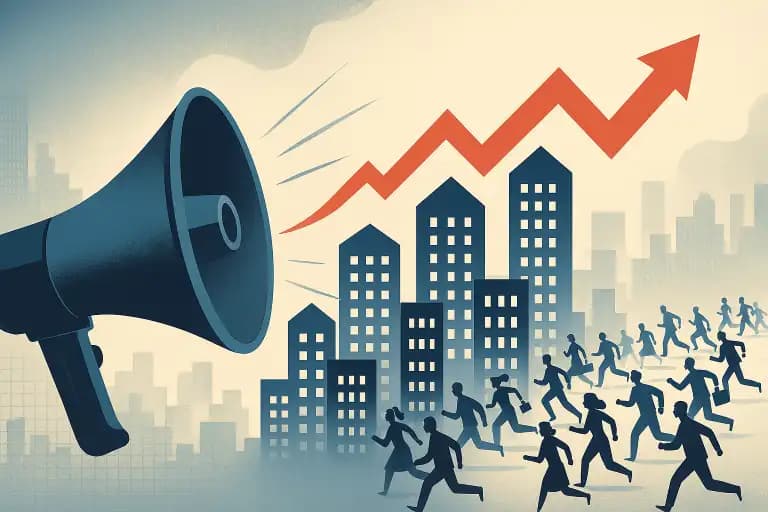
In recent months, Korean real estate headlines have followed a familiar rhythm: sudden surges in apartment prices, anecdotal panic-buying among young professionals, and warnings of a “last train” before stricter loan regulations take effect. At first glance, such articles appear to perform their journalistic duty—reporting current events, reflecting market sentiment, and informing public awareness. But beneath this surface lies a deeper, more consequential pattern: the media itself is not merely a messenger of market shifts but an active participant in the escalation of property speculation.
The language of urgency saturates the coverage. Phrases like “불장” (a burning market), “영끌” (scraping together every last resource), and “막차” (the last chance) are no longer fringe internet slang but normalized media vocabulary. These terms do more than describe—they prescribe, reinforcing a narrative of scarcity and inevitability. They frame housing not as a social right or economic necessity but as a vanishing investment opportunity, fueling fear-driven demand and amplifying volatility.
Housing prices are not the main focus of this report. Instead, it examines how and why the media frames the housing story in certain ways—and the consequences that arise when journalism loses its critical perspective and begins to mirror the very forces it is supposed to scrutinize. The objective here is to analyze the structures, incentives, and linguistic strategies through which major Korean media outlets—particularly economic dailies—contribute to housing market turbulence, all while distancing themselves from the fallout of their coverage.
By unpacking the emotional framing, data manipulation, political bias, and revenue interests embedded in mainstream real estate coverage, this report examines the media’s complicity in shaping one of Korea’s most pressing socioeconomic crises: the commodification of shelter and the manufacture of urgency. In a market where owning a home is increasingly out of reach for the majority, understanding the media's role is not just an academic exercise—it is a civic necessity.
Fear Sells: The Language of Scarcity and Urgency
In the ecosystem of Korean property journalism, words are not neutral. They are carefully selected instruments that shape public sentiment, alter behavior, and ultimately influence the market. Emotional language—especially fear-based metaphors—has become the dominant lens through which the media frames real estate. This shift did not happen by accident. It is a reflection of the symbiotic relationship between media institutions, financial interests, and a speculative housing culture.
Terms like “영끌” (short for “scraping together one’s soul to buy property”) and “패닉바잉” (“panic buying”) have moved from internet subcultures to the headlines of Korea’s most powerful newspapers. These words are not mere descriptions of extreme behavior; they are performative. They normalize desperation. They make irrational risk seem like a rational response to a collapsing window of opportunity. A young couple borrowing beyond their means is no longer a financial risk—it becomes a social norm, a rite of passage.
This emotional scripting is often reinforced through selective anecdotalism. Articles begin with individuals who “missed the last chance” or “rushed into deals out of fear,” and then generalize these stories into broader market trends. The result is a self-fulfilling narrative: by repeatedly portraying homeownership as a high-stakes game, the media intensifies the very anxiety it reports.
What’s missing from these narratives is equally telling. Rarely do these articles contextualize price surges within global economic trends, low interest rate regimes, or structural supply constraints. Instead, the frame remains narrow and urgent—centered on the individual’s emotional response rather than systemic forces. It is a form of storytelling that privatizes risk and absolves institutions, particularly the media itself, from responsibility.
The cumulative effect is subtle but powerful. Over time, readers are conditioned to view housing not through the lens of social utility or fairness, but as a zero-sum investment race. The language tells them that the train is leaving the station—and only the bold will board in time. It is a narrative architecture designed not just to inform, but to compel.
How Numbers Are Bent to Fit the Narrative
Numbers lend legitimacy. In an era dominated by dashboards, indices, and real-time graphs, data seems objective—scientific, even immutable. Yet in Korean real estate journalism, data is not always a tool for clarity. It is often a device of persuasion, carefully curated and contextually stripped to support a predetermined narrative: that the housing market is on fire, and time is running out.
Take, for example, the recurring emphasis on 호가—the asking price set by sellers. In headline after headline, we are told that “prices have surged by X million won in just a week,” yet the articles seldom mention that these are not completed transactions but merely listed prices, which may not reflect market consensus or buyer behavior. Actual 실거래가 (official transaction prices), when eventually released, often tell a more tempered story. But by then, the emotional impact of the earlier report has already taken root.
Another common practice is to highlight rate of increase—percentages that appear significant in isolation but are misleading without context. A 0.36% weekly rise in Seoul apartment prices, for example, is reported as the “largest weekly surge in nearly seven years,” while failing to note that the absolute change may be marginal or localized. Moreover, these statistics are often drawn from highly specific samples—certain districts or apartment types—yet presented as general market trends.
What’s missing is analytical proportionality. There is little attempt to triangulate data: to compare official housing transaction reports with mortgage lending rates, demographic shifts, or global real estate trends. Instead, a narrow set of favorable numbers is extracted and repeated, creating an echo chamber where price optimism masquerades as inevitability.
This selective data framing serves a dual function. For media outlets, it keeps traffic high and headlines dramatic. For developers, agents, and investors, it sustains momentum and justifies inflated valuations. And for everyday readers—especially first-time buyers—it erodes rational decision-making, replacing long-term planning with short-term fear.
The result is not merely misinformation. It is market choreography.
News or Native Ad? When Profit Blurs the Line
Beneath the flood of property headlines, beneath the fear-laced language and carefully curated data, lies a structural truth that few newspapers are willing to disclose: the Korean media’s financial dependence on the very industry it reports on. This is not a conspiracy—it is a business model
Real estate is one of the most profitable advertising sectors for major news outlets. From full-page spreads for new apartment launches to native ads disguised as news reports, the line between editorial and commercial content is often blurred to the point of erasure. A banner ad for a new luxury complex sits directly above a “news” story warning of dwindling housing supply. A glowing article on a redevelopment project appears side by side with a glossy photo spread of its showrooms. These are not editorial accidents; they are carefully engineered pairings.
The influence runs deeper than visuals. Media companies maintain close relationships with developers and construction conglomerates—some of whom are among their largest clients. Advertising departments coordinate with editorial teams to ensure coverage aligns with commercial interests. In some cases, real estate sections of newspapers are operated almost as branded verticals, functioning less like journalism and more like public relations channels for the property industry.
This financial entanglement creates an environment where market optimism is not just preferred—it is incentivized. Skeptical or critical reporting on price bubbles, oversupply, or speculative risk is rare, particularly in the business sections of mainstream outlets. Instead, the prevailing tone is boosterish, designed to sustain investor confidence and consumer urgency.
What’s more troubling is how this revenue dependence intersects with public trust. The average reader often cannot distinguish between promotional content and independent journalism—especially when the language and format of both are nearly identical. This erosion of editorial transparency turns the media into an amplifier of speculation, rather than a check on it.
In this arrangement, everyone wins—except the public. Developers secure momentum, media outlets secure revenue, and policymakers are shielded by the illusion that the “free market” is simply doing its work. But the broader social cost—escalating inequality, financial overreach, and the commodification of basic shelter—remains uncounted and unspoken.
The Ideological Uses of Housing Prices
Korean real estate journalism does not unfold in a political vacuum. It operates within—and actively reinforces—a deeply polarized narrative in which government policy is either scapegoated or sidelined, depending on the ideological leanings of the outlet. Nowhere is this more visible than in how housing price movements are linked, almost ritualistically, to the political party in power.
When prices rise under a progressive government, headlines scream of “policy failure,” “market distrust,” and “regulation-induced chaos.” Conversely, when prices spike under a conservative administration, coverage tends to highlight “market normalization,” “investor confidence,” or “global macroeconomic forces.” These double standards are not simply coincidental; they reflect a political calculus embedded within media ownership, editorial ideology, and the paper’s relationship with its audience and advertisers.
The phrase “progressive governments make housing more expensive” has become a kind of folk wisdom in Korean politics. But this simplistic correlation rarely withstands empirical scrutiny. Price surges under the Roh Moo-hyun and Moon Jae-in administrations coincided with global property booms and ultralow interest rates. In contrast, housing prices also rose steadily during the Park Geun-hye and Yoon Suk-yeol administrations, despite deregulation. Yet media coverage tends to magnify progressive-era price hikes as systemic collapse, while explaining conservative-era spikes as external inevitabilities.
This rhetorical asymmetry serves a dual purpose. It channels public frustration toward elected officials—particularly those with redistributive agendas—while shielding market actors, including developers and speculators, from accountability. The media becomes not just an observer but an ideological broker, deciding where blame should lie and how it should be distributed.
But what remains obscured in this blame game is the role of the media itself. Rarely do outlets reflect on how their own reporting patterns—emotive language, uncontextualized data, and speculative optimism—may have contributed to the very crises they decry. Instead, the press positions itself as a neutral commentator, conveniently ignoring its complicity in fueling the frenzy.
In doing so, journalism abdicates its most fundamental role: to hold power accountable, not only in government, but also in markets—and in itself.
When Journalism Drives Inequality
In theory, journalism is meant to inform markets—not move them. But in the Korean housing sector, the distinction between description and intervention has all but collapsed. Media coverage doesn’t just reflect market sentiment; it manufactures it.
Each cycle begins predictably: a few reports noting rising demand, followed by anecdotal evidence of buyers “lining up” to close deals. Prices inch upward, and the headlines become more frequent, more urgent, more emotional. Suddenly, the story is no longer just about the market—it is the market. Buyers rush in to avoid being “left behind,” sellers raise their expectations, and agents capitalize on the momentum. Then, with little more than another round of optimistic coverage, the cycle repeats, this time with even greater fervor.
This feedback loop has real consequences. First-time buyers, especially younger generations, are drawn into a speculative frenzy under the illusion of market inevitability. Emotionally charged headlines frame prudent financial planning as cowardice and glorify over-leveraged purchases as bold strategy. The result is not merely poor decision-making but structural financial risk—households burdened with unsustainable debt, rising default threats, and the normalization of precarity as a housing strategy.
More insidiously, this market manipulation reinforces housing inequality. Those with existing assets benefit from price surges and media-fueled urgency, while those without—especially renters—are left chasing a ballooning horizon. Wealth gaps widen, not because of natural market forces, but because of an orchestrated informational environment that privileges certain narratives, players, and outcomes.
The systemic impact extends beyond economics. Housing insecurity breeds social anxiety. Families postpone childbirth or marriage; workers cling to jobs they dislike for fear of losing rent stability. Young people emigrate not just for opportunity, but for affordability. And while all of this unfolds, the media remains largely unaccountable, cloaked in the defense of “just reporting the news.”
But when the reporting becomes the catalyst, journalism must ask itself a harder question: what exactly is it building, and for whom?
Rewriting the Script
If journalism is, at its core, a public service, then its greatest betrayal lies not in what it misreports, but in what it refuses to question. The Korean media’s complicity in fueling real estate speculation has become one of the most urgent, yet least acknowledged, drivers of social inequality. It has shaped not only how housing is discussed but also how it is imagined: not as shelter, but as stock; not as stability, but as risk.
But this trajectory is not inevitable. The media can—and must—reclaim its civic role in the housing debate. Doing so begins with editorial transparency. Articles that cite price increases must clarify the nature of their sources: are they based on transaction data or speculative listings? Are the statistics representative or exceptional? Do they reflect long-term trends or short-term noise?
Second, media outlets should revisit their relationship with advertisers. Real estate pages cannot remain indistinguishable from property brochures. Walls must be re-erected between commercial interests and editorial independence—especially in industries where coverage can directly affect market behavior.
Third, the emotional tone of reporting must be recalibrated. Language matters. When journalists describe panic as normal, risk as strategy, and speculation as necessity, they are not informing the public—they are nudging it. Words like “막차,” “영끌,” or “패닉바잉” must be seen for what they are: instruments of market acceleration, not neutral reportage.
Finally, the responsibility is not the media’s alone. Audiences, too, must grow more critical. Media literacy—especially economic media literacy—must become a civic competency. Readers should question who benefits from the headlines they consume, and what logics they unconsciously internalize as a result.
Responsible property journalism is not about suppressing news. It is about contextualizing it. It is about reporting the housing market not as a casino of winners and losers, but as a terrain where policy, equity, and human need intersect. In a time when the price of a home can determine the shape of a life, the stakes are too high for journalism to be anything less than public-minded.
The question now is not just what the media reports next—but what it chooses to become.
The Weekly Breeze
Keep pace with Busan's deep narratives.
Delivered every Monday morning.