Expanding the Definition of Family: A Call for Same-Sex Equality in South Korea
As we step into the month of May, a keyword that resonates across South Korea is "family". May, often referred to as the "Month of Family," is replete with commemorations celebrating family ties, including Children's Day, Parents' Day, and Couples' Day. Notably, May 15th is recognized globally as the International Day of Families. However, May also holds significant meaning for the LGBTQ+ community in South Korea and around the world. May 17th marks the International Day Against Homophobia, Tra

As we step into the month of May, a keyword that resonates across South Korea is "family". May, often referred to as the "Month of Family," is replete with commemorations celebrating family ties, including Children's Day, Parents' Day, and Couples' Day. Notably, May 15th is recognized globally as the International Day of Families.
However, May also holds significant meaning for the LGBTQ+ community in South Korea and around the world. May 17th marks the International Day Against Homophobia, Transphobia, and Biphobia, a global celebration established in memory of the World Health Organization's decision to remove homosexuality from its International Classification of Diseases in 1990. This followed the American Psychiatric Association's earlier move in 1973 to declassify homosexuality as a mental disorder, asserting, "Homosexuality per se implies no impairment in judgment, stability, reliability, or general social and vocational capabilities."
Fast forward to February 2023, almost 50 years since the APA's landmark decision, a similar message was echoed by the Seoul High Court. In a historic ruling, the court overturned the National Health Insurance Corporation's decision not to recognize a same-sex partner as a dependent, stating, "In the realm of public law, which includes social security systems, discrimination based on sexual orientation should no longer be tolerated."
This principle, that discrimination based on sexual orientation is unjustifiable under any circumstances, is a globally established norm that has been upheld for decades. Yet, numerous areas in South Korean society still harbor systemic prejudice against sexual minorities. One of the most glaring areas is the family institution itself. In a society where only heterosexual marriages are recognized and familial relationships are legally protected based solely on marriage and blood ties, same-sex couples are denied any rights as a family.
This discrimination extends beyond the tangible lack of social benefits, such as health insurance, housing, and pension rights. The very fact that a loving relationship is not recognized as a family and is essentially dismissed as irrelevant strikes a blow to the dignity of these individuals. This lack of recognition was evident in the Seoul High Court ruling. Although the court acknowledged the right of same-sex partners to be recognized as dependents, it refrained from using the terms "same-sex marriage" or "spouse," opting instead for "same-sex union" and "union partner."
Despite this, political discourse in South Korea often contends that "while discrimination against homosexuals is opposed, same-sex marriage requires consensus." Such arguments fail to acknowledge that the absence of legal recognition of same-sex marriage, the exclusion of some people from the institution of marriage based on gender and sexual orientation, is itself discrimination. Discrimination, an infringement on the dignity of the individual, can never be rationalized as reasonable. Issues of human rights and equality are not subjects for consensus but matters that politics and society are obliged to address and resolve.
Fortunately, change is brewing. The groundbreaking court ruling affirming the legal status of same-sex partners and the recent introduction of the "Life Companion Act" in the National Assembly herald a shift in societal norms. These movements challenge the limited definition of family restricted to heterosexual marriage and blood relations and pave the way for broader inclusivity. We hope this momentum continues, ultimately leading to reform in the institution of marriage itself. Achieving marriage equality is not a matter to be postponed and consensually agreed upon. It is an imperative duty that the state must fulfill to ensure equality for all its citizens. As we celebrate the Month of Family, it's time we acknowledge and respect all kinds of families.
Continue this reporting
Reporting on the same issue
Related coverage selected from the article's desk, topics and newsroom relationships.
 NewsOct 9, 2026
Why “Busan Is Good” Falls Short as a City Brand
“Busan Is Good” now reaches public transport, city institutions and local bus...
 NewsSep 18, 2026
The Other AI Race Is for the Freedom to Change Course
Korea’s HBM strength gives it unusual leverage inside the AI stack. The harde...
 NewsAug 27, 2026
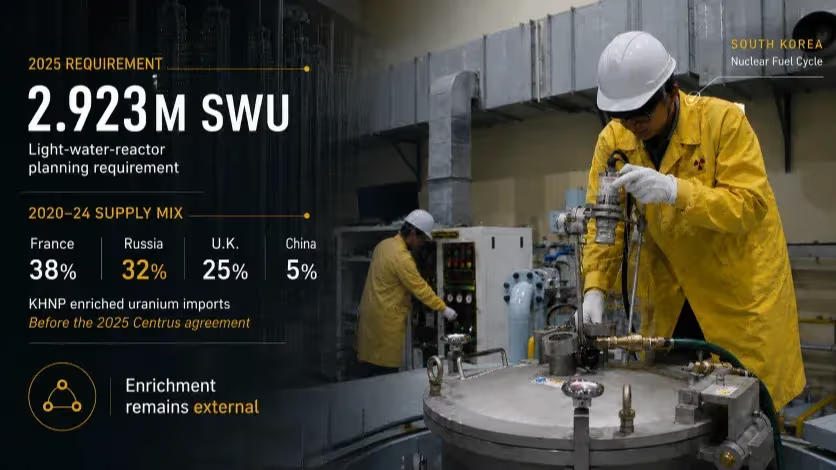
South Korea Has Outgrown Washington’s Nuclear Rules
The U.S. once constrained South Korea’s nuclear fuel cycle over real prolifer...
More from the author
More from this byline
Stay with the same line of reporting through more work from this byline.
- NewsOct 9, 2026
Why “Busan Is Good” Falls Short as a City Brand
- NewsSep 18, 2026
The Other AI Race Is for the Freedom to Change Course
Reader Signal
Community readWhat did this report leave you with?
Choose the signal that best reflects your reading. Select it again to remove it.
One response per article
No response selected
A moderated conversation about the reporting.
One-level replies and newsroom moderation keep the conversation anchored to this article.
Discussion Status
Open
Please sign in to join the discussion.
Newsletter
Weekly reporting and context from Busan and Korea.