South Korean Public Officials' Average Property Increases as Real Estate Prices Surge
Seoul, South Korea - A recent report by the Government Ethics Committee revealed that the average property of 2,037 South Korean public officials increased by KRW 29.81 million (approximately USD 24,500) this year. The disclosure comes amid a surge in real estate prices in the country, significantly impacting the wealth of public officials and raising concerns about transparency and potential conflicts of interest. According to the report, the average property value for public officials subject


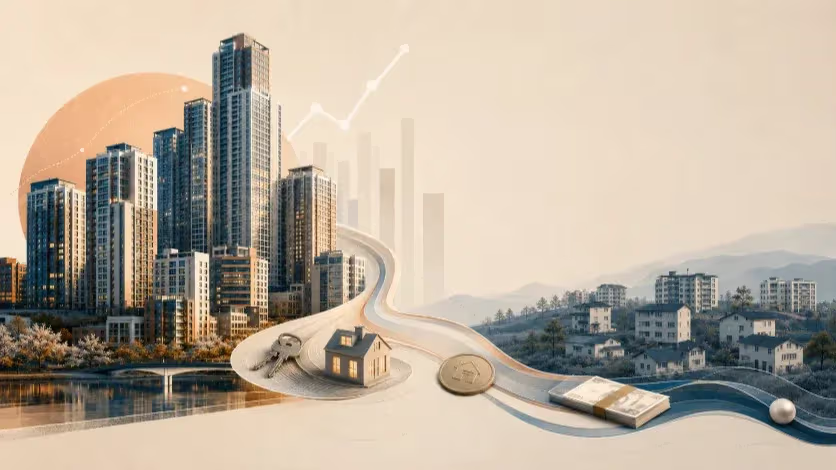
Seoul, South Korea - A recent report by the Government Ethics Committee revealed that the average property of 2,037 South Korean public officials increased by KRW 29.81 million (approximately USD 24,500) this year. The disclosure comes amid a surge in real estate prices in the country, significantly impacting the wealth of public officials and raising concerns about transparency and potential conflicts of interest.
According to the report, the average property value for public officials subject to property disclosure now stands at KRW 1.946 billion (approximately USD 1.6 million) per person. The increase has been attributed to the rise in public real estate prices, which surged by KRW 30.03 million (approximately USD 24,700) on average.
Among those disclosing their property, President Yoon Suk-yeol declared KRW 7.7 billion (approximately USD 6.34 million) in assets. This figure was primarily composed of real estate holdings and deposits under the name of First Lady Kim Geon-hee, as well as the presidential couple's private residence in Seocho-dong, Seoul.
The report also highlighted the property of other high-ranking officials, such as Busan Mayor Park Heong-joon, who declared KRW 5.73 billion (approximately USD 4.71 million) in assets. The top three wealthiest metropolitan local government heads were Governor Kim Young-hwan of Chungbuk, Mayor Oh Se-hoon of Seoul, and Busan Mayor Park, with assets ranging from KRW 6.65 billion to KRW 5.73 billion (approximately USD 5.47 million to USD 4.71 million).
The Government Ethics Committee plans to review all disclosed property changes by public officials by the end of June. In cases where excessive asset fluctuations are detected, the committee will conduct an in-depth investigation into the property formation process. This will include examining whether real estate acquisitions were made using confidential information obtained during official duties or through corporate name trusts.
If any legal violations are discovered during the review, public officials may face penalties such as warnings, corrective measures, fines, dismissal, or disciplinary action requests.
As the South Korean government grapples with surging real estate prices and increasing wealth inequality, the property disclosure report serves as a reminder of the challenges faced by policymakers in ensuring transparency and addressing potential conflicts of interest among public officials.
Editorial Context
"Independent journalism relies on radical transparency. View our full log of editorial notes, corrections, and project dispatches in the Newsroom Transparency Log."
Reader Pulse
The report's impact signal
Be the first to provide a reading pulse. These collective signals help our newsroom understand the impact of our reporting.
Join the discussion
A more thoughtful conversation, anchored to the story
Atlantic-style discussion for this article. One-level replies, editor prompts, and moderation-first participation are now powered directly by Prisma.
Discussion Status
Open
Please sign in to join the discussion.
The Weekly Breeze
Independent reporting and analysis on Busan,
Korea, and the broader regional economy.