South Korea to Implement 97 New Laws in April, Including Support for Student Parents and Digital Crime Crackdown
South Korea will enact 97 new laws in April, including expanded parental leave rights for students, tougher penalties for deepfake sex crimes involving minors, and new low-emission zones in cities.

South Korea will implement a series of legislative reforms in April aimed at strengthening support for student parents, intensifying penalties for digital sex crimes involving minors, and improving urban air quality through new emission regulations. A total of 97 statutes are set to take effect, reflecting the government’s attempt to respond to evolving social, technological, and environmental challenges.
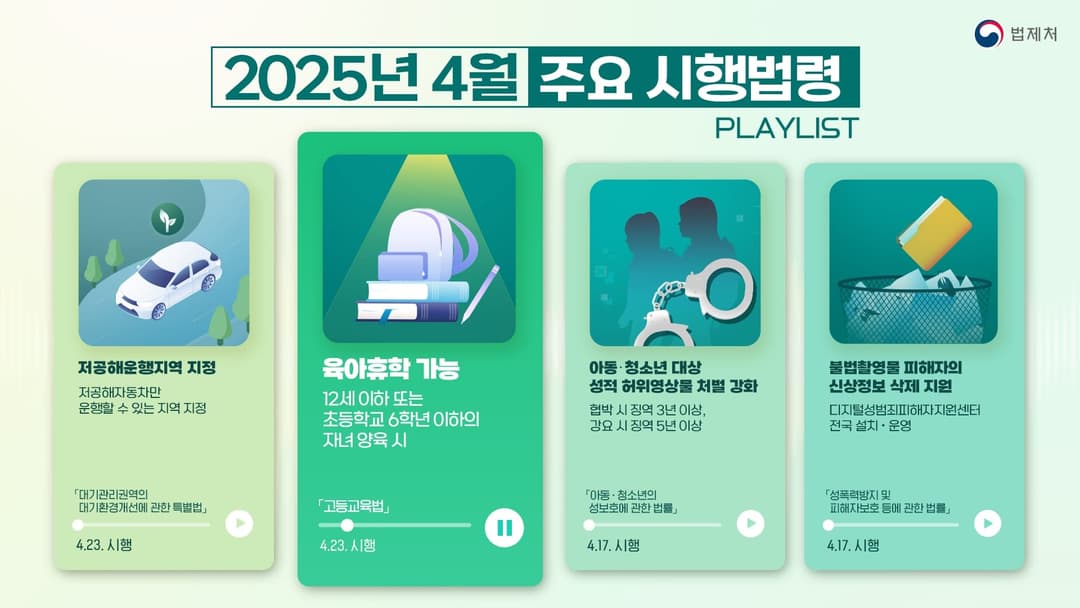
Under the revised Higher Education Act, students raising children will be eligible for parental leave if their child is under 12 years of age or enrolled in sixth grade or below. Previously, the age limit was eight years old or the second grade of elementary school. The change, effective April 23, aims to provide more flexible support for students navigating both education and parenting responsibilities.
For students whose children require long-term care due to physical or mental disabilities, the eligibility threshold has also been raised to 16 years of age or below the first grade of high school. The reform is part of the government’s broader effort to address family policy gaps within academic institutions and reduce dropout rates among student-parents.
Those already on leave when the law takes effect will be allowed to extend their absence under the new criteria.
On April 17, major amendments to the Act on the Protection of Children and Youth Against Sex Offenses will go into force, targeting the growing threat of deepfake technology in online exploitation.
Under the new law, using sexual exploitation materials to intimidate minors will result in a minimum sentence of three years in prison. In cases of coercion, the minimum sentence rises to five years. This marks a substantial increase from existing penalties and reflects growing concern over the proliferation of AI-generated sexual content involving children and youth.
To improve investigative responsiveness, judicial police officers will now be allowed to conduct urgent undercover operations in digital sex crime cases without prior approval. Additionally, officers will be required to immediately request that the Korea Communications Standards Commission delete or block illegal content involving minors when discovered online.
The Sexual Violence Prevention and Victims Protection Act will also be updated on April 17 to provide stronger support for victims of digital sexual abuse.
A new national body, the Advocacy Center for Online Sexual Abuse Victims (A.C.O.S.A.V.), will be launched to provide emergency counseling and handle reports of illegal video and photo circulation. The government will also decentralize responsibility for content deletion, granting local governments the authority to intervene directly in such cases.
In addition to removing explicit materials, authorities will also be empowered to delete personal identifying information — such as names, addresses, photos, or details that could lead to further harm for victims.
Meanwhile, in a move to tackle air pollution and promote sustainable transportation, the Special Act on the Improvement of Air Quality in Air Control Zones will be revised to allow provincial and municipal leaders to designate low-emission vehicle-only areas.
From April 23, only electric, hybrid, hydrogen, and other low-emission vehicles that meet local environmental standards will be permitted to operate in these zones. Violators could face fines of up to 100,000 won.
Emergency vehicles and those transporting persons with disabilities will be exempt from the restrictions, according to the enforcement decree.
The Ministry of Government Legislation emphasized that the raft of new laws reflects the state’s shifting priorities in an age shaped by digital technology, environmental urgency, and more diverse family structures.
Editorial Context
"Independent journalism relies on radical transparency. View our full log of editorial notes, corrections, and project dispatches in the Newsroom Transparency Log."
Reader Pulse
The report's impact signal
Be the first to provide a reading pulse. These collective signals help our newsroom understand the impact of our reporting.
Join the discussion
A more thoughtful conversation, anchored to the story
Atlantic-style discussion for this article. One-level replies, editor prompts, and moderation-first participation are now powered directly by Prisma.
Discussion Status
Open
Please sign in to join the discussion.
The Weekly Breeze
Independent reporting and analysis on Busan,
Korea, and the broader regional economy.