South Korea announces new policy to support single-parent families
The South Korea's Ministry of Gender Equality and Family has announced the approval of the first basic plan for policies aimed at supporting single-parent families. The first basic plan for policies supporting single-parent families has been developed to fulfill the national goal of building a society where no one is left behind, and everyone participates together. The plan includes strategies and objectives to actively respond to the difficult realities and changing social environments faced b

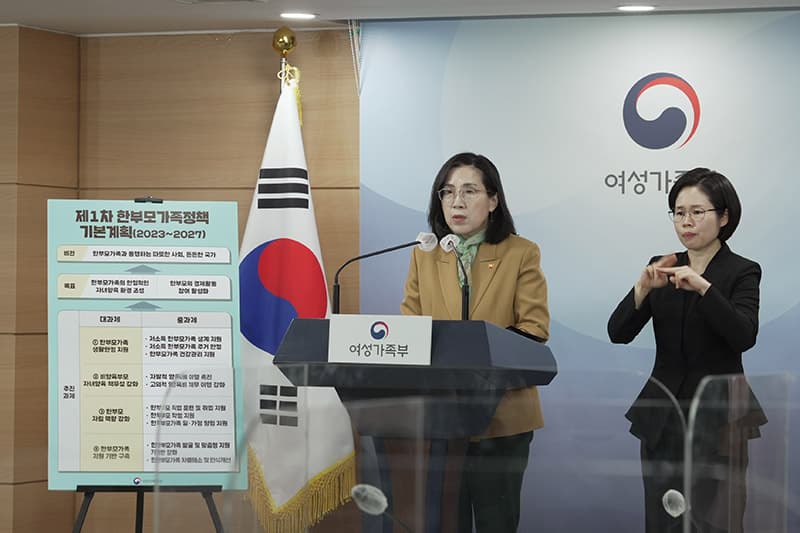
The South Korea's Ministry of Gender Equality and Family has announced the approval of the first basic plan for policies aimed at supporting single-parent families.
The first basic plan for policies supporting single-parent families has been developed to fulfill the national goal of building a society where no one is left behind, and everyone participates together. The plan includes strategies and objectives to actively respond to the difficult realities and changing social environments faced by single-parent families.
Despite the various services provided by the government to relieve the financial burden of low-income single-parent families, many continue to face difficulties in achieving a stable livelihood. Additionally, since the introduction of sanctions against non-custodial parents who do not pay child support in 2021, there has been an increasing demand to improve the effectiveness of the sanctions process, which is often hindered by complicated legal procedures.
The plan outlines four major objectives, including providing stable support for the livelihood of single-parent families, strengthening the obligation of non-custodial parents to pay child support, enhancing the self-reliance of single-parent families, and establishing a support system for single-parent families.
To achieve these objectives, the Ministry plans to expand the age range for providing financial assistance to low-income single-parent families for child-rearing from below 18 years of age to high school graduation. They will also raise the income standards for eligible single-parent families and review the adequacy of the current financial support system.
Moreover, the Ministry plans to establish reasonable criteria for providing living expenses and review the income conversion standard of a car property when calculating income for child support. Additionally, they plan to expand the issuance criteria for certificates verifying the status of single-parent families to allow for increased support, such as a reduction in utility bills.
The plan also includes expanding the basic admission period for single-parent welfare facilities from three to five years and relaxing the criteria for the extension. The government will also prioritize the supply of affordable rental housing to low-income single-parent families and raise the income standards for eligibility.
Furthermore, the Ministry will promote the continuation of a medical insurance program for single-parent families and strengthen public relations to reach more households. The government will also increase the number of family centers offering support for child support payments and expand interview negotiation services for non-custodial parents.
To speed up the identification of the payment ability of child support debtors and shorten the litigation period, the Ministry plans to revise the law to allow the investigation of the debtor's income and assets without their consent. Additionally, they plan to enhance sanctions against non-custodial parents who intentionally refuse to pay child support and consider introducing criminal punishment for non-payment.
In addition, the government plans to increase vocational training and employment support for single parents. They will provide tailored job training to women participating in employment centers and priority selection of single-parent families for national scholarships and work scholarships. The Ministry also plans to continue operating customized re-education courses for lifelong learning.
Overall, the first basic plan for policies supporting single-parent families aims to create a society where single-parent families can live with stability and dignity. The implementation of these policies will provide various forms of support for those in need, such as financial assistance, counseling services, and job training programs.
Editorial Context
"Independent journalism relies on radical transparency. View our full log of editorial notes, corrections, and project dispatches in the Newsroom Transparency Log."
Reader Pulse
The report's impact signal
Be the first to provide a reading pulse. These collective signals help our newsroom understand the impact of our reporting.
Join the discussion
A more thoughtful conversation, anchored to the story
Atlantic-style discussion for this article. One-level replies, editor prompts, and moderation-first participation are now powered directly by Prisma.
Discussion Status
Open
Please sign in to join the discussion.
The Weekly Breeze
Independent reporting and analysis on Busan,
Korea, and the broader regional economy.