Hydrogen-Powered Trains to Revolutionize Busan's Transportation Ahead of 2030 World Expo
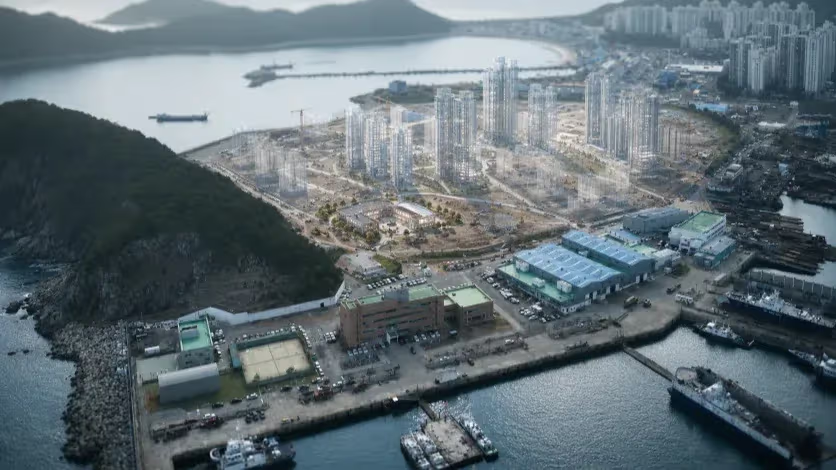
Busan-type Express Railroad (BuTX) project set to connect Gadeokdo New Airport with downtown Busan With the 2030 Busan World Expo on the horizon, the South Korean government is accelerating plans to open Gadeokdo New Airport in December 2029. A significant component of this development is the Busan-type Express Railroad (BuTX) project, an express railroad aimed at connecting the new airport with downtown Busan. The city is working to establish a commercialization strategy for BuTX by the end of


Busan-type Express Railroad (BuTX) project set to connect Gadeokdo New Airport with downtown Busan
With the 2030 Busan World Expo on the horizon, the South Korean government is accelerating plans to open Gadeokdo New Airport in December 2029. A significant component of this development is the Busan-type Express Railroad (BuTX) project, an express railroad aimed at connecting the new airport with downtown Busan. The city is working to establish a commercialization strategy for BuTX by the end of this month, with the goal of transforming Busan's transportation landscape.
Busan City officials carefully evaluated three potential next-generation transportation trains – hyper tube capsule trains, high-speed electric trains, and hydrogen-powered trains – before ultimately selecting hydrogen-fuel cell trains as the most suitable option for the project. These fuel cell trains, developed by the Korea Institute of Railroad Technology and Woojin Industrial System in December 2021, utilize hydrogen as their primary energy source.
Passenger trains powered by hydrogen fuel cells represent a clean and efficient transportation solution. These trains produce electricity through a chemical reaction between hydrogen and oxygen within the fuel cell, resulting in water as the only byproduct. This technology offers an eco-friendly alternative to traditional diesel-powered trains, reducing greenhouse gas emissions and air pollution.
Spanning 47.9 kilometers, the BuTX route will extend from Gadeokdo New Airport to Myeongji-dong, Gangseo-gu, Hadan-dong, Saha-gu, Busan Port North Port (Busan Station), Centum City, Haeundae-gu, and the Osiria Tourism Complex. The hydrogen-powered trains will reach top speeds of 198 kilometers per hour and maintain cruising speeds of 180 kilometers per hour as they navigate a deep tunnel more than 40 meters underground. Travel times between Gadeokdo New Airport and Busan Port North Port, as well as the Osiria Tourist Complex, are estimated at 15 and 25 minutes, respectively.
With an estimated project cost of 2 trillion won ($258.6 billion), construction of the BuTX is scheduled to commence in 2026, with completion targeted before the 2030 Busan World Expo. Funding options under consideration include a 60% national and 40% municipal expense split or the attraction of private capital. In light of the accelerated opening of Gadeokdo New Airport from June 2035 to December 2029, Busan City officials have expressed their commitment to expedite the BuTX construction project, ensuring its completion ahead of the 2030 Busan World Expo.
Editorial Context
"Independent journalism relies on radical transparency. View our full log of editorial notes, corrections, and project dispatches in the Newsroom Transparency Log."
Reader Pulse
The report's impact signal
Be the first to provide a reading pulse. These collective signals help our newsroom understand the impact of our reporting.
Join the discussion
A more thoughtful conversation, anchored to the story
Atlantic-style discussion for this article. One-level replies, editor prompts, and moderation-first participation are now powered directly by Prisma.
Discussion Status
Open
Please sign in to join the discussion.
The Weekly Breeze
Independent reporting and analysis on Busan,
Korea, and the broader regional economy.