Gadeokdo New Airport to Open Sooner with Innovative Landfill Construction Method
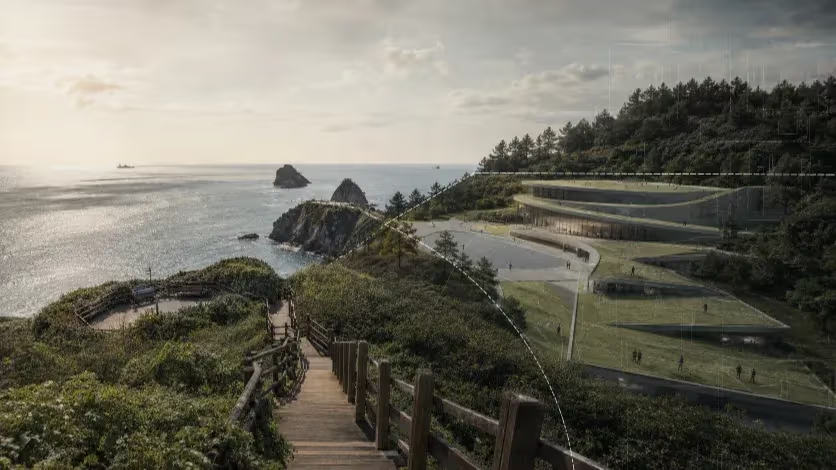
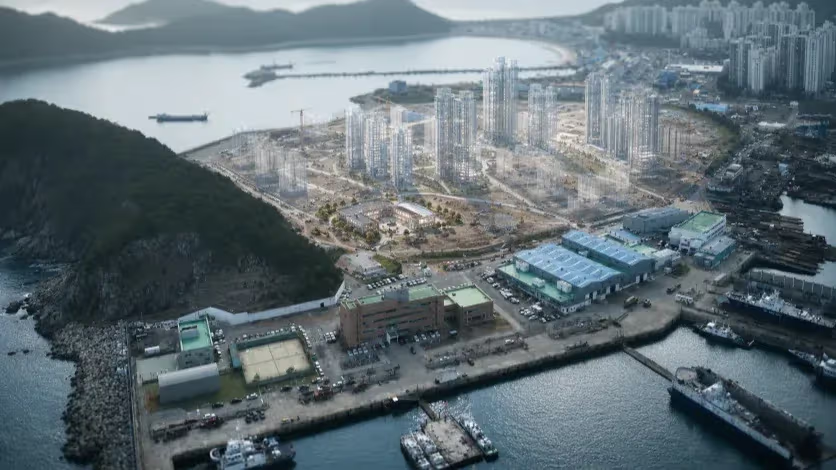
The Ministry of Land, Infrastructure, and Transport (MOLIT) is reportedly considering a new construction method for Gadeokdo New Airport that involves building the terminal and part of the runway on the island and constructing the airport in a landfill style that spans land and sea. The proposed method is expected to greatly reduce the amount of landfill required for the project compared to the existing maritime airport and could allow for the airport to open before 2030. The city of Busan has


The Ministry of Land, Infrastructure, and Transport (MOLIT) is reportedly considering a new construction method for Gadeokdo New Airport that involves building the terminal and part of the runway on the island and constructing the airport in a landfill style that spans land and sea. The proposed method is expected to greatly reduce the amount of landfill required for the project compared to the existing maritime airport and could allow for the airport to open before 2030.
The city of Busan has announced that MOLIT will examine various ways to open Gadeokdo New Airport before 2030, including this method, and will announce the final plan around the middle of next month. Given that the construction law announcement is imminent and the project needs to go through a strategic environmental impact assessment and basic plan notification within this year to start construction next year, industry analysts anticipate that the landfill construction method over land and sea is the most feasible option.
The proposed construction method, which spans land and sea, is expected to reduce the amount of landfill needed to 30% or less compared to the existing method, allowing for the airport to open within five to six years from the start of construction. Moreover, the construction cost, which is currently estimated at 13.76 trillion won, is expected to decrease significantly.
Other artificial island airports built in landfill construction in Asia include Hong Kong International Airport, which was built on the island of Chek Lap Kok, and Japan's Kansai International Airport, which was built on an artificial island in Osaka Bay. These airports have proven to be successful and cost-effective solutions for expanding air transportation infrastructure in densely populated areas, and Gadeokdo New Airport may follow in their footsteps.
Last year's pre-feasibility study suggested that the most optimal option would be to build the entire 3,500-meter runway by reclaiming the sea. However, this would require filling in the sea with a maximum depth of 30 meters and a soft ground of 45 meters, and it would not be possible to open the airport until 2035. By contrast, the landfill method that spans land and sea is expected to have shortened construction period by reclaiming the offshore area of Gadeokdo Island, which has a relatively shallow water depth.
In January, the city of Busan proposed a hybrid method to MOLIT that involved land-filling the terminal of Gadeokdo New Airport and having the runway float on the sea. However, there are uncertainties surrounding this floating runway method, as it has never been attempted before.
The landfill construction method that spans land and sea, which is currently under review, is the Gadeokdo New Airport construction method initially proposed by Busan City. However, there are concerns that if a very large container ship with a height of more than 70 meters passes through Gadeokdo Waterway, which is a 3.3 km wide maritime route through which container ships of Busan New Port pass, it may interfere with aircraft and cause unequal subsidence problems on land and sea. Despite these concerns, MOLIT reportedly believes that such large container ships pass through Gadeokdo waterway only 2.4 times a month, which can be avoided, and that unequal subsidence can be overcome with domestic construction technology.
Editorial Context
"Independent journalism relies on radical transparency. View our full log of editorial notes, corrections, and project dispatches in the Newsroom Transparency Log."
Reader Pulse
The report's impact signal
Be the first to provide a reading pulse. These collective signals help our newsroom understand the impact of our reporting.
Join the discussion
A more thoughtful conversation, anchored to the story
Atlantic-style discussion for this article. One-level replies, editor prompts, and moderation-first participation are now powered directly by Prisma.
Discussion Status
Open
Please sign in to join the discussion.
The Weekly Breeze
Independent reporting and analysis on Busan,
Korea, and the broader regional economy.