Construction Firms Shift Focus to Government Projects in Busan
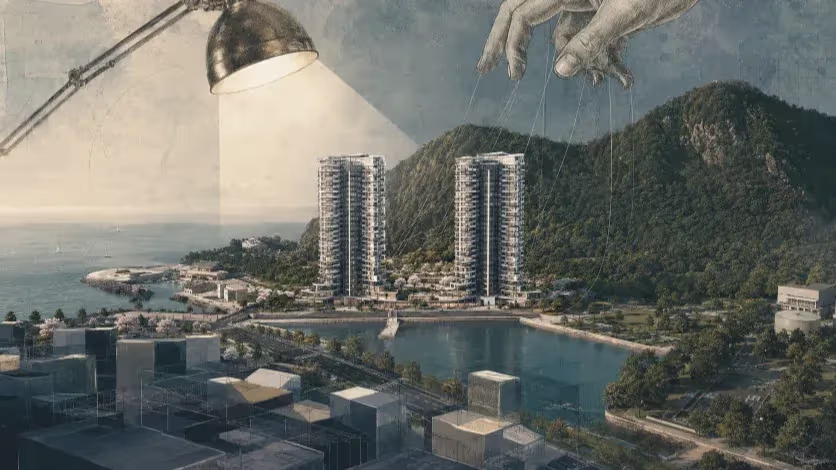
The sluggish sales market in Busan has resulted in construction companies shifting their focus toward government projects, in search of stable construction costs and reduced risks. As a result, the latest offering by the Busan Metropolitan Corporation for private operators has garnered significant attention from at least six companies, including Hyundai Engineering & Construction, Taeyoung E&C, and Kumho E&C, all of which are expected to participate in the upcoming competition. The project will


The sluggish sales market in Busan has resulted in construction companies shifting their focus toward government projects, in search of stable construction costs and reduced risks. As a result, the latest offering by the Busan Metropolitan Corporation for private operators has garnered significant attention from at least six companies, including Hyundai Engineering & Construction, Taeyoung E&C, and Kumho E&C, all of which are expected to participate in the upcoming competition.
The project will see the construction of 3,791 housing units with a total investment of 1.68 trillion won on a site of 201,124 square meters, with Block 11, 12, and 24 having 1,437, 1,290, and 1,065 units, respectively. This year's public offering is anticipated to be more competitive than the previous one for Blocks 18-20 in 2020.
In the current economic climate, construction companies are seeking to reduce their risks by carrying out stable and straightforward construction, making government works an attractive alternative to traditional construction projects. With government projects offering stable construction costs, construction companies are less concerned with sales rates, even if it is linked to Eco Delta City. The pricing of approximately 14 million won per 3.3 square meters is relatively cheaper than the surrounding market price, providing some reassurance for construction companies.
While this trend toward government projects is a recent one, it is not unique to Busan. Construction companies across the globe have been shifting towards government projects as a means of reducing risks and securing stable construction costs. In some cases, this shift has been prompted by economic downturns, as construction companies seek to maintain their organizations and avoid reducing their workforce.
In the current climate, it is likely that this trend toward government projects will continue. Government projects offering stable construction costs and reduced risks are a viable alternative to traditional construction projects, particularly in the face of economic uncertainty. As such, it is expected that construction companies in Busan and beyond will continue to seek out government projects as a means of maintaining their organizations and reducing risks.
Editorial Context
"Independent journalism relies on radical transparency. View our full log of editorial notes, corrections, and project dispatches in the Newsroom Transparency Log."
Reader Pulse
The report's impact signal
Be the first to provide a reading pulse. These collective signals help our newsroom understand the impact of our reporting.
Join the discussion
A more thoughtful conversation, anchored to the story
Atlantic-style discussion for this article. One-level replies, editor prompts, and moderation-first participation are now powered directly by Prisma.
Discussion Status
Open
Please sign in to join the discussion.
The Weekly Breeze
Independent reporting and analysis on Busan,
Korea, and the broader regional economy.