Busan to Train SMEs on ESG Compliance as Global Rules Tighten
Busan will hold its second ESG capacity-building program for small and medium-sized enterprises on September 24, bringing together experts to address EU carbon rules, U.S. disclosure uncertainty, and workplace safety standards.

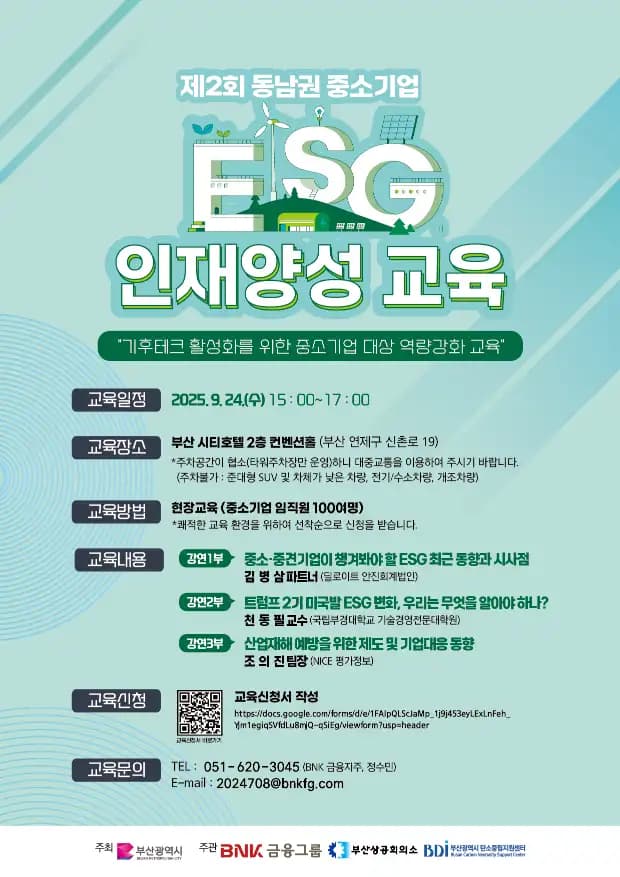
Busan, South Korea — Busan will host the second Southeastern Korea SME ESG Capacity-Building Program on September 24. The event is designed to help small and medium-sized firms in the region respond to tightening global sustainability rules that affect trade and investment. It will take place at the Busan City Hotel and is organized by the city government with BNK Financial Group, the Busan Chamber of Commerce and Industry, and the Busan Carbon Neutrality Support Center.
The program comes at a time when Busan’s industrial base faces mounting pressure from abroad. The city is home to more than 35,000 manufacturers, nearly all of them SMEs. These firms form the backbone of local employment but often lack the systems or expertise to comply with complex environmental and governance standards now demanded by major markets.
The European Union’s Carbon Border Adjustment Mechanism is already in a transitional reporting stage and will take full effect in 2026. Exporters that cannot calculate and verify their embedded emissions face the risk of exclusion from global supply chains. Deloitte Korea partner Byung-Sam Kim will address how these rules are expanding in scope and why firms must treat compliance as a central business issue.
In the United States, the direction of policy has grown less predictable. The Securities and Exchange Commission’s climate disclosure rule, adopted in 2024, is now suspended as litigation continues and political resistance strengthens under the Trump administration. By contrast, the European Union is pressing ahead with stricter disclosure mandates. Dong-phil Chun, professor at Pukyong National University, will examine how this divergence creates uncertainty for Korean exporters, who must prepare for more than one regulatory framework at once.
Attention is also turning to workplace safety and governance practices. NICE Information Service team leader Jo Uijin will speak on how industrial accident prevention is becoming part of ESG evaluations. Safety, once treated mainly as a legal matter, is now measured by rating agencies and investors. For smaller firms in Busan, where resources are often stretched, the ability to collect reliable safety data and introduce prevention programs could determine access to contracts and financing.
Despite rising interest, Busan’s overall ESG performance remains weak. According to the Korea ESG Standards Institute, only nine of the city’s 39 listed companies achieved grades of B+ or higher in 2023. Roughly three quarters remained at C or below. A few, such as DRB Dong-il, managed notable improvements, showing that progress is possible when resources are committed.
The city has launched support measures including ESG vouchers that subsidize consulting and technology upgrades, while local agencies promote frameworks covering environmental management, labor, and safety. Still, the reach of these initiatives is limited, and many smaller firms remain outside the system.
The September program will place these challenges in front of business leaders. It aims to provide not general slogans but practical information on regulation, disclosure, and compliance. The question is whether awareness will translate into change. Without credible reporting, stronger safety systems and more transparent governance, SMEs in Busan risk losing ground in supply chains that now weigh ESG standards heavily. The city can provide education and financing, but the outcome will depend on how firms adapt these tools inside their own operations.
Continue this reporting
Reporting on the same issue
Related coverage selected from the article's desk, topics and newsroom relationships.
 NewsSep 28, 2026
Why Some Commercial Space in Busan Is Hard to Reuse
Two empty commercial spaces exposed to the same broader economy can have very...
 NewsSep 20, 2026
What It Takes for U.S. Navy Repair Work to Become a Busan Industry
HJ Shipbuilding has brought U.S. Navy maintenance work to Yeongdo. Whether it...
 NewsSep 17, 2026
Busan’s Finished Homes, Unfinished Projects
Busan’s unsold homes sit in one monthly total, but they belong to very differ...
More from the author
More from this byline
Stay with the same line of reporting through more work from this byline.
 NewsApr 23, 2026
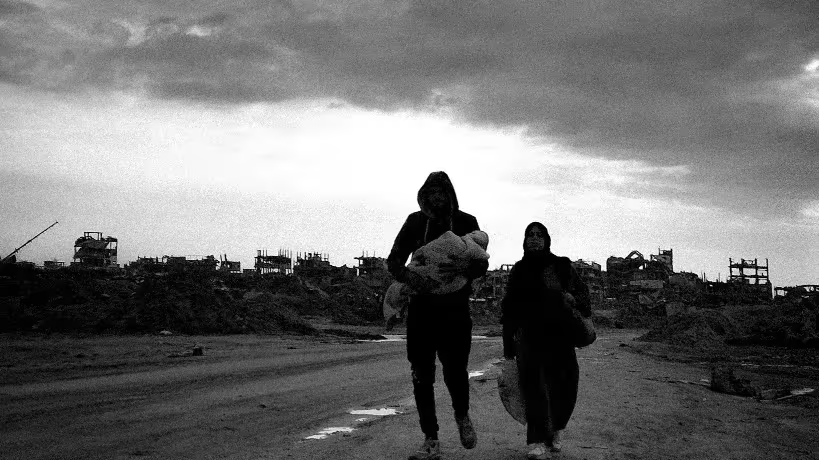
Gaza photo exhibition opens at Busan’s Arise Art Space
 NewsNov 10, 2025
Busan Fireworks Festival Marks 20 Years With Expanded Show
Reader Signal
Community readWhat did this report leave you with?
Choose the signal that best reflects your reading. Select it again to remove it.
One response per article
No response selected
A moderated conversation about the reporting.
One-level replies and newsroom moderation keep the conversation anchored to this article.
Discussion Status
Open
Please sign in to join the discussion.
Newsletter
Weekly reporting and context from Busan and Korea.