Busan Strengthens Climate Education with National Marine Youth Event
As climate impacts accelerate, Busan invests in next-gen marine stewardship with a national youth forum on ocean sustainability.

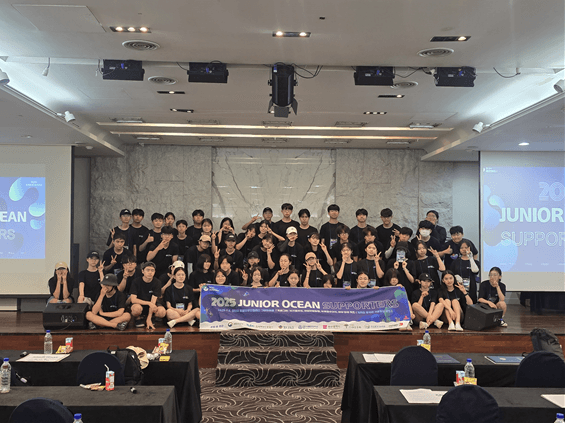
Busan, South Korea — This Saturday, Korea Maritime & Ocean University will open its main auditorium to hundreds of students, educators, and environmental organizers for the 5th Junior Ocean Conference, the country’s only national marine forum designed specifically for youth. The event, now in its fifth year, arrives at a critical juncture in both regional maritime strategy and global climate policy.
Organized by Busan Metropolitan City in cooperation with the Ministry of Oceans and Fisheries, the Korea Coast Guard, and a range of educational and scientific institutions, the Junior Ocean Conference serves a dual role: it educates students on the marine crisis while integrating them into the fabric of civic environmental action. Unlike traditional conferences that place young people in the audience, this one positions them at the podium.
This year’s program includes thematic presentations by student participants and an invited international youth climate activist, a keynote session by a professional Korean ocean explorer, and a marine knowledge competition known as the “Junior Ocean Golden Bell.” A youth performance and visual showcase of environmental media produced by students will complete the half-day program. No pre-registration is required for attendance, ensuring broad accessibility.
The conference builds on a month-long series of preparatory initiatives. On July 5, 58 students participated in a cleanup and plogging campaign along Gwangalli Beach as part of the city’s “Junior Ocean Supporters” program. In parallel, the “Ocean Placard Challenge” encouraged participants to design hand-drawn messages and explanatory videos addressing ocean degradation, microplastics, and coastal erosion. Selected submissions will be recognized during the conference's award ceremony.
Busan’s commitment to environmental education is not isolated. The city has been steadily cultivating its international maritime profile, most recently by hosting the 10th Our Ocean Conference (OOC) in April. That event brought over 2,600 stakeholders from 60 countries and saw announcements of 380 new ocean-related commitments globally. Busan used the opportunity to position itself as a future host for larger ocean governance platforms, while promoting a youth leadership summit in parallel.
The city’s strategic focus is underpinned by institutional infrastructure. Busan is home to the Korea Institute of Ocean Science and Technology (KIOST), the Korea Maritime Institute, and the Korea Ocean Business Corporation. Together, these organizations anchor Korea’s blue economy research, policy planning, and commercial development. The Junior Ocean Conference, while educational, functions as an early channel into this broader ecosystem.
The urgency behind these efforts is reinforced by global oceanographic trends. From 2023 through 2025, Earth has experienced one of the most extensive coral bleaching events in recorded history, affecting more than 84 percent of surveyed reef regions. Ocean heat content has reached new highs, with 2024 marking the warmest year for global sea surface temperatures. Acidification has continued at pace, with atmospheric CO₂ dissolving into seawater at rates that jeopardize marine calcifiers—key to both food chains and coastal protection.
In this context, marine literacy has emerged as a central pillar of sustainability education. The concept, increasingly adopted by UNESCO and ocean-focused NGOs, advocates for a clear public understanding of how ocean systems function, how they are impacted by human behavior, and what policies are needed to preserve them. South Korea has begun integrating this framework into public outreach and schooling, with Busan often at the forefront.
The Junior Ocean Conference directly aligns with these principles. It doesn’t merely teach environmental facts—it cultivates analytical thinking, scientific communication, and civic responsibility. For a port city reliant on shipping, fisheries, and coastal development, the stakes are both ecological and economic. Failing to invest in a marine-aware citizenry would weaken the city’s long-term competitiveness in an era of rising seas and tightening environmental regulation.
Saturday’s conference also serves as a signal. It underscores that youth education is not a peripheral part of ocean governance—it is essential infrastructure. As international climate negotiations increasingly call for inclusivity and intergenerational equity, cities like Busan are laying the groundwork where it matters: in classrooms, on coastlines, and within the minds of young residents.
Continue this reporting
Reporting on the same issue
Related coverage selected from the article's desk, topics and newsroom relationships.
 NewsSep 28, 2026
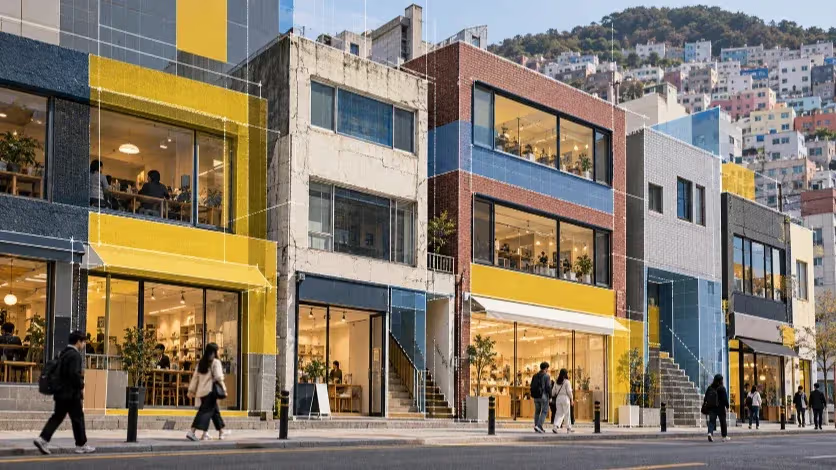
Why Some Commercial Space in Busan Is Hard to Reuse
Two empty commercial spaces exposed to the same broader economy can have very...
 NewsSep 20, 2026
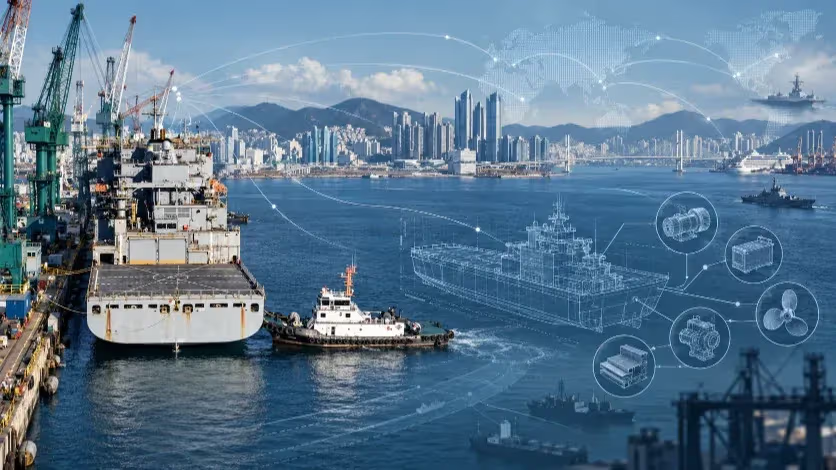
What It Takes for U.S. Navy Repair Work to Become a Busan Industry
HJ Shipbuilding has brought U.S. Navy maintenance work to Yeongdo. Whether it...
 NewsSep 17, 2026
Busan’s Finished Homes, Unfinished Projects
Busan’s unsold homes sit in one monthly total, but they belong to very differ...
More from the author
More from this byline
Stay with the same line of reporting through more work from this byline.
 NewsApr 23, 2026
Gaza photo exhibition opens at Busan’s Arise Art Space
 NewsNov 10, 2025
Busan Fireworks Festival Marks 20 Years With Expanded Show
Reader Signal
Community readWhat did this report leave you with?
Choose the signal that best reflects your reading. Select it again to remove it.
One response per article
No response selected
A moderated conversation about the reporting.
One-level replies and newsroom moderation keep the conversation anchored to this article.
Discussion Status
Open
Please sign in to join the discussion.
Newsletter
Weekly reporting and context from Busan and Korea.