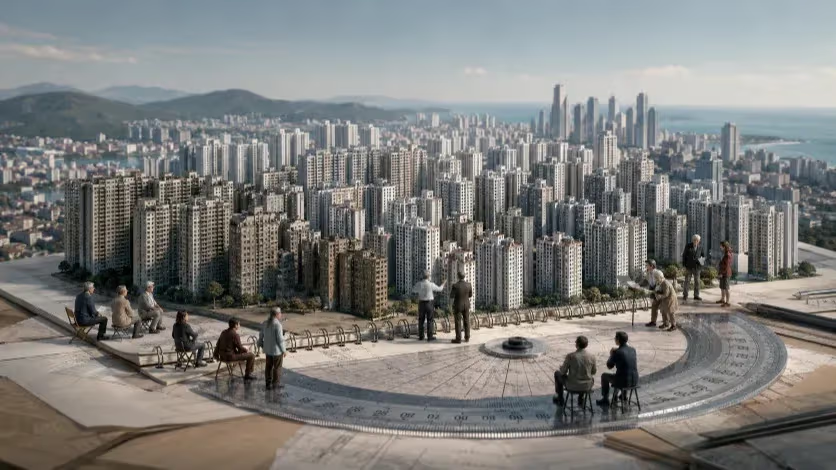
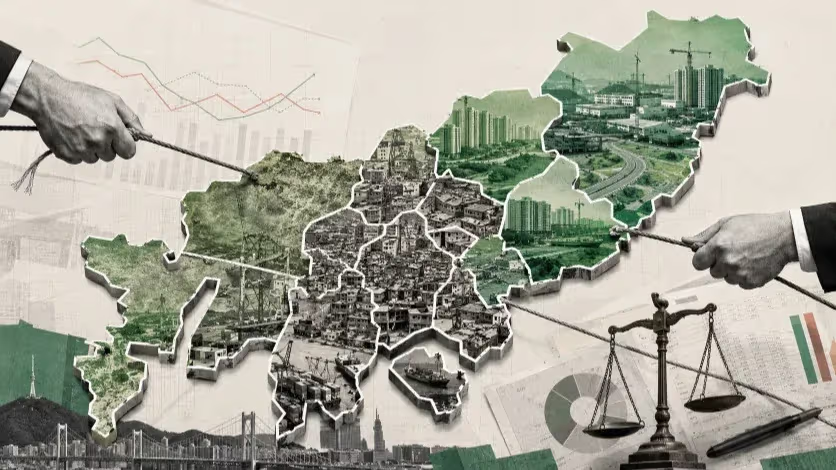
Aging South Korean Workers Struggle With Economic Challenges and Limited Job Opportunities
A recent report indicates a growing trend of aging workers, particularly those in the 50-60 age bracket, enduring financial difficulties in retirement. Despite a desire to remain employed, the majority of jobs available to this age group are non-regular such as temporary or day labor jobs, which are lacking in job security and benefits. Experts argue that there is a pressing need to create high-quality job opportunities where this demographic can utilize their professional skills. According to


A recent report indicates a growing trend of aging workers, particularly those in the 50-60 age bracket, enduring financial difficulties in retirement. Despite a desire to remain employed, the majority of jobs available to this age group are non-regular such as temporary or day labor jobs, which are lacking in job security and benefits. Experts argue that there is a pressing need to create high-quality job opportunities where this demographic can utilize their professional skills.
According to data from the city of Busan, the proportion of elderly people aged 65 and above receiving basic living benefits has steadily increased over the last five years. The percentage of elderly within this bracket was 26.4% in 2017, and by 2019, it had risen to 32%. By 2021, they accounted for one-third or 33.3% of all recipients of basic living benefits. While this trend is noticeable nationwide, it's particularly severe in Busan, where the rate of elderly poverty surpasses the national average.
The number of older workers (aged 55 and above) who wish to continue working post-retirement to support their living is increasing. However, they often find themselves in precarious employment conditions, as the rate of temporary or daily work is significantly higher for them compared to other age groups. While the ratio of temporary and daily laborers among the 15-54 age group is 17.4%, this jumps to 27.8% for those aged 55 and above.
The percentage of non-wage workers such as those working in family-run businesses is over double for those aged 55 and above at 37.1%, compared to the 15-54 age group at 17.1%. As the first city in the country to enter a super-aged society (where over 20% of the population is over 65), Busan anticipates that by 2050, elderly people will make up 43.6% of its population. The pressing issue of elderly poverty is thus on the rise.
Unfortunately, most of the available job opportunities for the 50-60 age group are still public-sector jobs driven by government initiatives. The government has classified those between 50-69 as the "new middle-aged" and is pushing policies to support job opportunities for retirees.
However, there are challenges. In Busan, the 'Support Center for Elderly Employment' is operational, but the number of program participants is quite low due to budget constraints. For programs utilizing the skills and expertise of the elderly, participation averages only between 90 to 120 individuals annually. Moreover, the lack of coordination with private businesses results in many participants failing to find regular employment after program completion.
Experts suggest that while the baby-boomer generation has a strong desire to work, demographic factors such as mass retirement make re-employment challenging. They recommend not only securing more public-sector jobs but also proactively promoting job projects connected with private organizations.
The Korea Institute for Health and Social Affairs(KIHASA) highlighted this issue in a report published in March, stating that 'policies supporting economic activities for the elderly tend to focus on professionals or skilled workers'. It urged for expanded support for vulnerable groups lacking in skills or career experience. The experts also recommended a more detailed classification of job fields and intensive case management for older workers, as well as the operation of a re-employment platform in cooperation with private companies to quickly connect workers with the jobs that companies need.
Editorial Context
"Independent journalism relies on radical transparency. View our full log of editorial notes, corrections, and project dispatches in the Newsroom Transparency Log."
Reader Pulse
The report's impact signal
Be the first to provide a reading pulse. These collective signals help our newsroom understand the impact of our reporting.
Join the discussion
A more thoughtful conversation, anchored to the story
Atlantic-style discussion for this article. One-level replies, editor prompts, and moderation-first participation are now powered directly by Prisma.
Discussion Status
Open
Please sign in to join the discussion.
The Weekly Breeze
Independent reporting and analysis on Busan,
Korea, and the broader regional economy.