South Korea’s ‘Cruel Finance’ Debate Puts the Price of Trust Under Scrutiny
South Korea’s push to reform credit scoring and mid-rate lending has opened a deeper debate over whether banks are fairly pricing risk — or turning financial exclusion into profit.

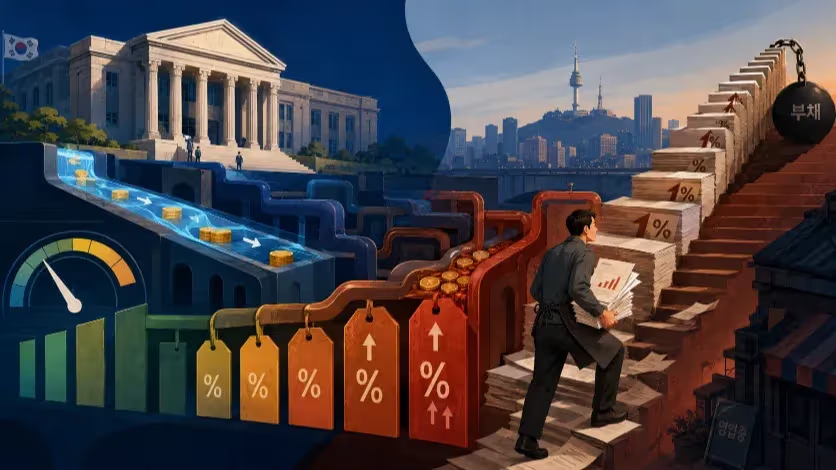
SEOUL — Finance has always converted trust into a price. In banking, that price is interest. Borrowers with assets, stable income and long credit histories receive cheaper money; those without them pay more, wait longer, or are pushed toward costlier forms of credit outside the banking mainstream.
That basic logic is now at the center of South Korea’s most politically charged financial debate. President Lee Jae-myung’s administration has described the current system as “cruel finance,” a phrase meant to capture a familiar but often underexamined reality: the people most desperate for credit are frequently the ones who face the highest cost of money.
Banks have pushed back, at least implicitly, against the moral framing. Credit, they argue, cannot be priced by sympathy. Interest rates reflect default risk, funding costs, capital requirements and expected losses. If the government turns financial inclusion into political pressure on lending, they warn, the result could be weaker underwriting, rising delinquencies and costs passed on to the wider financial system.
That warning is not without merit. No banking system can ignore credit risk. But it is also incomplete. Banks are not ordinary private firms operating in a purely private market. They lend under public licenses, draw confidence from deposit protection, move money through payment systems, and operate with the knowledge that central banks and regulators exist to preserve financial stability when the system comes under stress. A bank loan may be a private contract, but banking itself is public infrastructure.
This is where South Korea’s debate becomes larger than a dispute over interest rates. The question is not whether low-credit borrowers should be shielded from risk-based pricing altogether. They cannot be. The question is whether the financial system is measuring risk fairly — or whether thin credit files, unstable work, lack of collateral and limited bargaining power are being translated too easily into exclusion and high-cost debt.
The Machinery Behind Credit
The first target of the administration’s push is not the posted interest rate at a bank branch. It is the machinery that determines who gets through the door.
For decades, modern credit systems have rewarded those who already have a visible financial life: salaried workers with stable payroll records, homeowners with collateral, borrowers with long histories of card payments and loan repayments. These are not irrational criteria. They are the raw material of risk assessment. But they also create a circular problem. To be judged creditworthy, a borrower often needs a history of having already been trusted by the financial system.
That leaves a growing group of borrowers in a weaker position. Young workers, self-employed shop owners, platform workers, small franchisees, homemakers returning to economic activity and older borrowers with thin formal credit records may not be reckless or incapable of repayment. They may simply be difficult for the existing system to read. In banking, what cannot be read is often treated as risk. What is treated as risk becomes more expensive. What becomes expensive can eventually become exclusion.
This is the logic South Korean policymakers are now trying to challenge. The government’s review of credit assessment is expected to look beyond conventional repayment histories and consider whether alternative data — tax records, utility payments, telecom bills, business cash flow, sales records and other non-bank information — can help lenders distinguish between genuinely risky borrowers and borrowers who have merely been invisible to traditional scoring models.
That distinction is crucial. A more inclusive credit system does not mean lending to everyone at the same price. It means reducing the number of people misclassified as unworthy because the system has too little information about them, or the wrong kind of information. The aim, at least in principle, is not to replace risk-based pricing with political judgment, but to make risk assessment less blunt.
Mid-rate lending sits at the center of that effort. The government’s complaint is that South Korea’s credit market has developed a hollow middle. At the top, prime borrowers can access low-cost loans from major banks. At the bottom, weaker borrowers often face high-cost credit from non-bank lenders or are pushed into informal channels. In between lies the borrower the current system struggles to serve: not safe enough for the cheapest bank credit, but not so risky that high-cost debt should be the only option.
That missing middle is where the phrase “cruel finance” gains policy meaning. The cruelty is not simply that weaker borrowers pay more. Finance will always charge more for higher risk. The cruelty begins when the system has no credible middle price — when uncertainty is priced as failure, and when a borrower who might be viable at a moderate rate is pushed into a debt structure that makes failure more likely.
Internet-only banks were supposed to help fill that gap. With lower operating costs and data-driven underwriting, they entered the market under the promise that technology could reach borrowers traditional banks overlooked. The government’s renewed scrutiny asks whether that promise has been kept. If digital banks use technology mainly to compete for low-risk customers, the innovation becomes cosmetic. If they can use data to evaluate thin-file and middle-credit borrowers more precisely, they could become part of the solution.
The same question applies to savings banks, mutual finance institutions and other lenders historically associated with ordinary households, small merchants and local communities. Their role is not merely institutional nostalgia. In a credit system dominated by large commercial banks, smaller and community-oriented lenders are supposed to carry information that national scoring models may miss: local business conditions, relationship histories, seasonal cash flow, and the difference between temporary stress and structural insolvency.
But this is also where the reform agenda becomes difficult. Better data can expand access, but it can also deepen surveillance. Alternative credit assessment may help a platform worker prove income stability; it may also turn every payment, purchase and delay into a signal against them. A small merchant’s sales data may show resilience; it may also expose volatility that conventional models would never have seen. The more deeply finance enters daily life, the more carefully the state must ask who controls the data, who interprets it, and how a borrower can challenge the result.
Why the Banks’ Defense Is Both Right and Incomplete
Banks have a simple answer to much of this criticism: risk has a price.
They are not wrong. A lender that cannot distinguish between borrowers will not remain a lender for long. Credit is not a social promise written in moral language; it is a contract built around probability. Some borrowers are more likely to repay than others. Some loans require more capital to hold, more monitoring to manage, and more reserves to absorb losses if they fail. A bank that ignores those differences does not become fairer. It becomes weaker.
This is why the industry’s concern about the government’s language deserves to be taken seriously. If “inclusive finance” becomes a political instruction to lend more to weaker borrowers without regard to repayment capacity, it will not help the people it claims to protect. It may trap them in debt they cannot service. It may push banks to loosen underwriting in order to satisfy public pressure. It may raise losses that are later recovered through higher prices elsewhere in the system. In the worst case, it could turn a policy meant to correct exclusion into another form of financial instability.
That is the strongest version of the banks’ argument. It is also where the argument often stops.
What it leaves out is that banks do not price risk from a position of pure market innocence. They operate in a system built and protected by the state. They are licensed to take deposits. Their deposit base rests partly on public confidence. Their payments infrastructure is woven into the monetary system. Their liquidity depends, in periods of stress, on central banks and regulators whose task is not to let the system collapse. Their failures are rarely treated as ordinary corporate failures, because banking failures do not remain private for long.
A public backstop does not make banks charities. But it does make their claim to pure market logic incomplete.
The modern bank is a private institution with public consequences. Its loan book is not only a collection of contracts; it is a map of who receives purchasing power, who can start a business, who can survive a temporary cash-flow shock, who can refinance old debt before it becomes ruinous, and who is left to pay more because the formal system has decided they are too difficult to read. When banks say that interest rates merely reflect risk, they are describing part of the mechanism. They are not describing the social architecture in which that mechanism operates.
That distinction matters in South Korea, where household credit, small-business debt and property-linked lending have long shaped the boundaries of economic opportunity. Cheap credit has not been distributed randomly. It has tended to follow collateral, payroll stability, home ownership and institutional familiarity. Those who already sit comfortably inside the formal financial system are easier to assess and cheaper to serve. Those outside it are more expensive not only because they may be riskier, but because the system has invested less in understanding them.
This is the point at which risk-based pricing can become circular. A borrower pays more because they are considered risky. They are considered risky because they lack the records, collateral or income profile the system prefers. The higher price then weakens their ability to repay, narrowing their options and reinforcing the very risk the lender claimed merely to observe. What began as a measurement of risk can become a producer of risk.
The issue is not whether banks should become welfare agencies. It is whether publicly protected financial institutions can continue to treat exclusion as if it were a natural fact, rather than an outcome shaped by the design of credit models, regulatory incentives, collateral preferences and business strategy. There is a difference between refusing a loan that cannot be repaid and refusing to build the tools needed to evaluate borrowers who do not fit the safest template.
When Public Money Becomes Expensive Debt
The debate might have remained abstract — a clash of language between a government invoking fairness and banks invoking risk — if not for the franchise lending scandal that gave it a more concrete shape.
The Myungryundang case does not fit neatly into the usual argument over credit scores. It is not simply a story of weaker borrowers paying higher rates because they were more likely to default. It is a story about the route money takes: how low-cost funding, supported by public financial institutions, can move through a private business structure and reappear as expensive debt for those with the least bargaining power inside that structure.
That route is what makes the case politically potent. According to authorities and Korean media reports, the company had access to low-interest funding from state-backed institutions, while related lending entities extended higher-cost loans to franchisees. The franchisees were not ordinary consumers walking into a market of competing lenders. They were small business operators tied to a franchising system, often dependent on the franchisor for opening costs, interior work, supplies, operational rules and revenue flows.
In such a setting, the price of credit cannot be analyzed as if it emerged from a clean marketplace. A borrower who is free to compare lenders, reject terms and walk away occupies one position. A franchisee who has already committed capital, signed a contract, accepted a business model and become dependent on the franchisor’s network occupies another. The second borrower may formally consent to a loan. But consent inside dependency is not the same as consent inside competition.
This is why the scandal cuts deeper than the headline figure of the interest rate. High interest is not automatically abusive. If a loan is unsecured, costly to monitor and likely to default, a higher rate may reflect real risk. But when the lender sits inside, beside or behind a business relationship that already gives one party structural power over the other, the question changes. The issue is not only how risky the borrower was. It is whether the borrower had any meaningful alternative to the credit being offered.
The policy-fund dimension makes the case even more troubling. Publicly supported credit is not ordinary capital. It is supplied on preferential terms because the state wants to lower financing costs for firms, support employment, sustain small businesses or correct a market failure. When that cheap funding is captured by an intermediary and converted into high-cost lending to weaker parties, the public purpose is inverted. The state lowers the cost of money at one end of the chain; the vulnerable borrower encounters a higher cost at the other.
That is not merely inefficient. It is a failure of transmission.
The logic of policy finance depends on the benefit reaching the intended economic actor. A guarantee, subsidized loan or low-cost credit line is justified because it is supposed to expand access where private markets would otherwise be too expensive or too cautious. If the benefit is absorbed by a franchisor, platform, intermediary or related lender before reaching the small business owner, the policy has not simply failed to help. It may have helped strengthen the very structure through which the weaker party is charged more.
This is the point at which “cruel finance” becomes less a slogan than a description of institutional leakage. The cruelty does not lie only in the borrower paying a high rate. It lies in the possibility that public support, intended to soften the terms of credit, can be captured and converted into a private spread. In that form, high-cost finance is not the opposite of public policy. It is parasitic on it.
The Myungryundang case also exposes a regulatory blind spot. Financial supervision often follows institutional categories: banks, savings banks, card companies, lenders, guarantors. Fair trade supervision follows market conduct: franchise contracts, disclosure, unfair tying, abuse of bargaining power. But high-cost credit in the real economy often moves across these boundaries. It can be embedded in supply contracts, equipment financing, interior construction, platform fees, franchise payments or related-party lending. By the time the borrower experiences it as debt, the transaction may no longer look like a conventional bank loan.
That is why a narrow banking response would be insufficient. The problem is not only whether a bank should have lent differently. It is whether policy lenders knew how their funds were being used after disbursement; whether franchise disclosure rules captured the true cost of financing; whether related-party lenders avoided stricter supervision by fragmenting their balance sheets; whether franchisees understood the repayment structure; and whether the state had the tools to see the entire chain before the harm became visible.
The scandal does not prove that all high-interest lending is abusive. Nor does it prove that banks should be forced to lend cheaply to every borrower whom the market rejects. What it proves is more specific, and more useful: risk-based pricing becomes suspect when public support, market power and borrower dependency converge.
In that convergence, interest ceases to be a neutral price. It becomes a record of power.
Inclusion Without Political Lending
Other countries have struggled with the same tension, though they rarely use language as blunt as “cruel finance.” The problem is familiar: how to preserve the discipline of credit while preventing banks and lenders from excluding borrowers whose risks are harder to measure, whose histories are thinner, or whose bargaining power is weak.
The answer, in most advanced financial systems, has not been to abolish risk-based pricing. It has been to surround it with obligations, safeguards and public channels that limit the damage when markets leave certain borrowers behind.
The United States offers one version of that compromise. Its fair-lending framework prohibits discrimination in credit, while the Community Reinvestment Act asks banks to serve the credit needs of the communities in which they operate, including low- and moderate-income areas. But the principle is not unlimited lending. The phrase that matters is safe and sound banking. Financial inclusion is expected to occur within the boundaries of prudential discipline.
That distinction is important for South Korea. A government can demand that banks look harder at excluded borrowers. It can ask whether credit models are too narrow, whether digital screening has reduced access, whether lenders have neglected communities that are less profitable to serve. But it cannot simply replace underwriting with political intention. A loan that cannot be repaid is not inclusion. It is a delayed failure.
Europe has approached the issue from a different starting point: access. The European debate has often focused less on whether every borrower can obtain credit and more on whether every person can enter the financial system at all. Basic payment accounts, transparent fees and protections against unjustified exclusion are treated as foundations of participation in modern economic life. The premise is straightforward. Before a person can be evaluated for credit, they must be allowed to exist inside the financial system.
The United Kingdom has moved the conversation toward consumer outcomes. Its regulatory emphasis on vulnerable customers and fair value asks whether financial firms are designing products that customers can understand, afford and use without being pushed into foreseeable harm. The logic is not that vulnerable borrowers should never pay more. It is that firms should not profit from complexity, distress or inertia when customers have little practical ability to protect themselves.
This is where the international lesson becomes useful for Korea. The strongest systems do not pretend that risk disappears. They ask whether risk is being measured honestly, whether the borrower can understand the terms, whether the product is suitable, whether distress is handled fairly, and whether the lender’s profit depends on repeat failure.
High-cost credit is most dangerous when repayment difficulty is not an accident but part of the business model. Payday lending became controversial not only because the rates were high, but because many borrowers rolled loans over repeatedly, turning short-term liquidity into a long-term trap. The policy concern was not simply price. It was the structure of dependency: fees, renewals, penalties and refinancing patterns that made exit difficult.
That lesson applies directly to Korea’s current debate. A high interest rate may be defensible if it reflects a measurable risk on a loan that the borrower can realistically repay. It is much harder to defend when the loan is embedded in a relationship where the borrower has limited alternatives, poor information, repeated refinancing pressure or no clear path out of debt. The question becomes not just how much the borrower pays, but how the borrower remains attached to the debt.
Interest-rate caps illustrate the danger of simple answers. Caps can protect borrowers from predatory pricing and prevent lenders from charging rates that no social system should tolerate. But if caps are set without regard to funding costs, default risk and operating costs, lenders may withdraw from the market, leaving the riskiest borrowers with fewer legal options and more exposure to informal or illegal credit. A ceiling that looks protective can become exclusionary if it closes the only regulated door available.
This does not mean rate caps are useless. It means they are incomplete. They must be paired with public guarantees, targeted subsidies, debt restructuring, enforcement against illegal lenders, and better credit assessment. Otherwise, the state merely changes the visible price while leaving the underlying risk and desperation untouched.
From Slogan to Architecture
If South Korea’s reform is to move beyond the politics of “cruel finance,” it must become less rhetorical and more architectural.
The country does not lack financial institutions. It has major commercial banks, internet-only banks, savings banks, mutual finance institutions, policy lenders, public guarantees, credit bureaus, fintech firms and state-backed programs for small businesses and vulnerable borrowers. The problem is not the absence of machinery. It is that the machinery does not always connect. Cheap credit exists, but not always where it is needed. Public guarantees exist, but not always with enough precision. Credit data exist, but not always in forms that make irregular borrowers legible. Regulation exists, but often along institutional lines that do not match how high-cost credit is experienced in the real economy.
A serious reform must therefore begin with visibility. The state cannot fix what it does not measure, and banks cannot defend what they do not disclose. If risk-based pricing is to retain public legitimacy, the system needs clearer evidence of how risk is priced: default rates by credit band, interest margins by borrower type, rejection rates, refinancing outcomes, rollover patterns, recovery rates, guarantee coverage and the treatment of borrowers after distress begins.
Without that evidence, both sides are tempted by slogans. Government can say the system is cruel. Banks can say the system is prudent. Neither claim is enough.
The first requirement is loan-level transparency, not necessarily public disclosure of every borrower’s data, but enough supervisory visibility to distinguish justified risk premiums from institutional convenience. A high rate may be defensible if it reflects measurable default probability and expected loss. It is harder to defend if borrowers with similar repayment outcomes face sharply different prices because one group lacks collateral, bargaining power or access to competing lenders. It is harder still if a public guarantee reduces the lender’s downside while the borrower continues to pay as if the full risk remains private.
The second requirement is a credible middle market. South Korea’s debate will remain abstract unless borrowers between prime and distressed credit can actually find usable loans at sustainable prices. That means mid-rate lending cannot be treated as a public-relations category. It must be built around real underwriting, partial risk sharing and product design that reduces the chance of failure.
A middle market cannot be created by naming it. It must be priced, guaranteed, monitored and adjusted.
The third requirement is to separate credit from relief. Some borrowers need better access to loans. Others need fewer loans. A household already trapped in repeat high-cost borrowing may not be helped by a new product unless old debt is restructured. A self-employed borrower with collapsing revenue may need temporary forbearance or income support, not another refinancing channel. A borrower facing illegal lending needs enforcement and protection before they need credit scoring reform.
This distinction is politically difficult because credit is often presented as opportunity. But credit can also be a way of postponing failure while increasing its cost. A reform that expands lending without building stronger restructuring paths may simply move borrowers from one layer of distress to another. The point of inclusive finance is not to keep every borrower in debt. It is to give viable borrowers a path forward and nonviable borrowers a path out.
The fourth requirement is to regulate total cost, not only headline interest. High-cost finance often hides in fees, penalties, required purchases, refinancing charges, insurance products, settlement delays or business-linked obligations. A loan can look tolerable by its nominal rate and still become destructive through its structure. Conversely, a higher nominal rate may be less harmful if it is transparent, short-term, non-revolving and paired with realistic repayment.
The fifth requirement is accountability for alternative data. The government is right to question whether old credit models exclude too many people whose financial lives do not fit the payroll-and-collateral template. But the answer cannot be a reckless expansion of data extraction. Tax records, telecom bills, utility payments, sales data and platform income can improve assessment. They can also create new forms of exclusion if volatility, late payments or consumption patterns are interpreted without context.
The question is not whether finance should see more. It is whether seeing more leads to fairer judgment.
Between Political Credit and Market Evasion
The danger for South Korea is that the debate hardens into two familiar positions before the real work begins.
On one side is the temptation of political credit: the belief that a system can become fairer if the state pushes banks to lend more, lend cheaper and lend faster to those who have been excluded. On the other side is the temptation of market evasion: the claim that every existing pattern of exclusion is simply the neutral result of risk-based finance.
Both positions are easier than reform. Both are incomplete.
Political credit has a long history in countries where banks are treated as instruments of national policy. It can build industries, rescue firms and expand access when private markets are too cautious. But it can also misallocate capital, disguise insolvency, reward political proximity and leave losses to be socialized later. When lending is driven by targets rather than repayment capacity, the borrower may initially receive relief, but the system receives risk that has not been priced honestly.
That risk does not disappear. It moves.
It moves into bank balance sheets through delinquencies and provisions. It moves into public guarantees when losses are absorbed by the state. It moves into other borrowers’ interest rates if institutions recover costs elsewhere. It moves into households when borrowers are encouraged to take debt they cannot sustain. The moral language of inclusion can obscure the arithmetic of loss.
But the opposite danger is just as real. Banks can invoke risk in a way that makes the present system appear more natural than it is. They can describe their lending patterns as if they were produced only by mathematics, when they are also produced by business strategy, regulatory incentives, historical data, collateral preferences and institutional habit. They can insist that higher prices merely reflect higher risk without showing how much of the price is expected loss, how much is uncertainty, how much is operating cost, and how much is margin extracted from lack of alternatives.
That is market evasion. It turns a principle into a shield.
Risk-based pricing is essential. But risk is not self-defining. It is measured through models built from past data. It is shaped by what lenders choose to collect, what regulators reward, what borrowers can prove, and what kinds of income the system treats as legitimate. If a model is better at recognizing salaried employment than self-employment, property than cash flow, collateral than resilience, then the resulting price is not only a reflection of risk. It is a reflection of what the system has been designed to see.
Banks may not create inequality, but they often certify it.
They certify it when assets become cheaper credit. They certify it when stable employment becomes lower risk, while equally real but irregular income is discounted. They certify it when a borrower with no formal record is treated as more dangerous than a borrower with a long record of being trusted by institutions. They certify it when the price of uncertainty is charged almost entirely to the person least able to contest it.
This is not a call to lend blindly. It is a call to make the logic of refusal more accountable.
The Price of Trust
At the center of the debate is a deceptively simple question: who deserves trust?
Every credit system answers that question, even when it claims only to measure risk. It answers through scores, collateral rules, income verification, loan limits, guarantees, interest rates and rejections. It answers through what it counts, what it ignores and what it treats as proof. It answers differently for a salaried worker and a platform driver, for a homeowner and a tenant, for a franchisee and a large franchisor, for a borrower with a long bank record and one whose financial life has taken place at the margins.
The answer is never purely technical. It is institutional.
That is why South Korea’s argument over “cruel finance” has become larger than the phrase itself. The words are political, and at times imprecise. But they have opened a debate that had often remained buried beneath the language of credit management: whether the formal financial system has become too good at identifying safe borrowers and not good enough at recognizing recoverable ones.
A safe borrower is easy to price. A recoverable borrower is harder. The first already has proof: assets, payroll, collateral, history. The second may have cash flow but not collateral, resilience but not stable income, discipline but not a thick credit file, a viable business but not the kind of record that fits comfortably inside a model. A banking system that serves only the first can remain profitable and prudent. It can also become socially narrow.
This is where public responsibility enters. Not because banks should lend by sympathy, and not because every denied borrower has been wronged. Public responsibility enters because banking is the institution through which trust becomes purchasing power. When trust is distributed too narrowly, opportunity narrows with it.
The state cannot simply order trust into existence. It cannot declare a weak borrower strong, a failing business viable, or an unaffordable loan responsible. But it can ask whether the institutions that allocate trust are using the best available evidence, whether their refusals are accountable, whether public guarantees reach the intended borrower, and whether the price charged for uncertainty is proportionate to the risk or inflated by the borrower’s lack of alternatives.
That is the line between risk pricing and exclusion pricing.
Risk pricing asks: what is the probability of loss, and what price is needed to cover it?
Exclusion pricing asks a different, quieter question: how much can be charged because the borrower has nowhere else to go?
The two can look similar in the market. Both appear as interest. Both can be defended with the vocabulary of risk. Both can be embedded in contracts the borrower formally signs. But they are not the same. One compensates for danger. The other monetizes dependency.
That is why Korea’s next step should not be a campaign against interest rates in general. It should be a campaign for intelligible credit. Credit that can explain why it says yes, why it says no, why it charges what it charges, who benefits from public support, and what happens to borrowers when the formal system turns them away.
Such a system would not be simple. It would require banks to disclose more to supervisors about how pricing differs by borrower type and outcome. It would require policy lenders to trace whether subsidized funds lower final borrowing costs. It would require regulators to look across financial supervision, fair trade law and small-business policy. It would require alternative scoring systems to be audited for bias and usefulness, not merely celebrated as innovation. It would require debt restructuring to be treated as part of inclusion, not as a failure of it.
Most of all, it would require South Korea to stop treating credit access and credit safety as opposing values. They are in tension, but they are not opposites. Better information can widen access while reducing losses. Better guarantees can make moderate-risk loans viable without pretending they are risk-free. Better conduct rules can prevent captive borrowers from being charged as if they had chosen freely. Better restructuring can reduce the need for desperate refinancing.
The point is not to make finance softer. It is to make it more exact.
That exactness matters because the cost of imprecision is not distributed evenly. When banks misread a prime borrower, the loss is often manageable. When the system misreads a marginal borrower, the consequence can be exclusion, higher-cost debt, damaged credit records and a narrower path back. The borrower pays not only for risk, but for the system’s uncertainty about them.
This is the price of being illegible.
A mature financial system should try to reduce that price. Not eliminate it entirely, because uncertainty will always carry cost. But reduce it where better data, better products, public guarantees or conduct rules can turn uncertainty into manageable risk rather than permanent penalty.
The Test Ahead
South Korea’s banking system does not have to choose between compassion and discipline. It has to prove that its discipline is worthy of public trust.
That proof will not come from declarations. It will come from the borrowers the system learns to distinguish: the over-indebted borrower who needs relief rather than another loan; the thin-file borrower who can repay but lacks conventional proof; the small merchant whose cash flow is viable but irregular; the franchisee whose debt is shaped by dependency; the borrower whose high rate reflects real expected loss; and the borrower whose high rate reflects nothing more noble than lack of alternatives.
The government’s risk is turning inclusion into political lending. The banks’ risk is using risk-based pricing as a shield against their public obligations. The harder task lies between those positions: to preserve the discipline of credit while preventing publicly supported finance from turning vulnerability into profit.
That task will not be achieved by attacking banks, nor by accepting every bank price as the neutral verdict of the market. It will require a more demanding form of finance — one that can say no when repayment is impossible, say yes when risk is manageable, restructure when distress is recoverable, and intervene when public support or market power is being used to trap the weaker party.
South Korea does not need a banking system that lends by sympathy. It needs one that can price risk without turning exclusion into profit.
Only then will the price of trust become something more defensible than the price of power.
Continue this reporting
Reporting on the same issue
Related coverage selected from the article's desk, topics and newsroom relationships.
 NewsSep 26, 2026
South Korea’s 490 Regional Doctor Seats Begin a Longer Route to Care
South Korea’s first 490 regional-doctor seats tie medical-school admission to...
 NewsAug 30, 2026
The Hidden Economics of South Korea’s Public Transport
Busan’s latest transport review exposes a wider national problem: South Korea...
 NewsAug 11, 2026
Korea’s Innovation Cities Did Not Grow the Same Way
Nearly two decades after South Korea began relocating public institutions, th...
More from the author
More from this byline
Stay with the same line of reporting through more work from this byline.
 NewsOct 4, 2026
Zelensky, South Korea and the Limits of Wartime Pressure

Reader Signal
Community readWhat did this report leave you with?
Choose the signal that best reflects your reading. Select it again to remove it.
One response per article
No response selected
A moderated conversation about the reporting.
One-level replies and newsroom moderation keep the conversation anchored to this article.
Discussion Status
Open
Please sign in to join the discussion.
Newsletter
Weekly reporting and context from Busan and Korea.