South Korea announces new policy to support single-parent families
The South Korea's Ministry of Gender Equality and Family has announced the approval of the first basic plan for policies aimed at supporting single-parent families. The first basic plan for policies supporting single-parent families has been developed to fulfill the national goal of building a society where no one is left behind, and everyone participates together. The plan includes strategies and objectives to actively respond to the difficult realities and changing social environments faced b

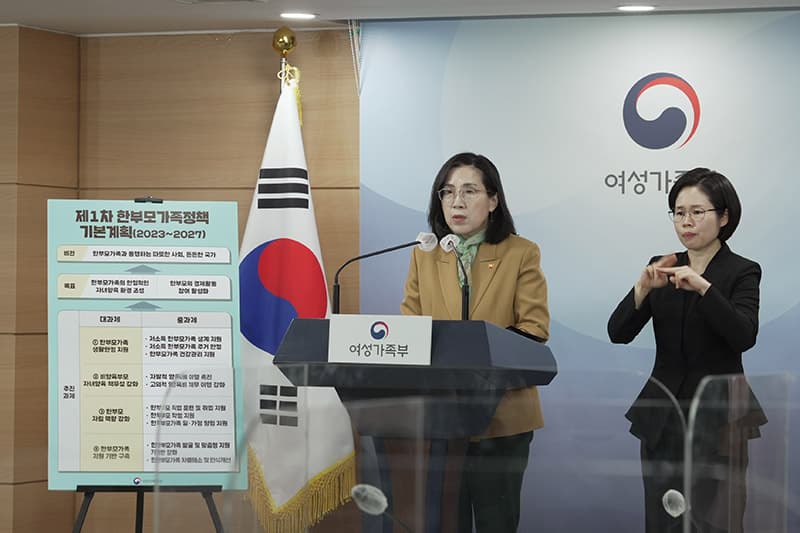
The South Korea's Ministry of Gender Equality and Family has announced the approval of the first basic plan for policies aimed at supporting single-parent families.
The first basic plan for policies supporting single-parent families has been developed to fulfill the national goal of building a society where no one is left behind, and everyone participates together. The plan includes strategies and objectives to actively respond to the difficult realities and changing social environments faced by single-parent families.
Despite the various services provided by the government to relieve the financial burden of low-income single-parent families, many continue to face difficulties in achieving a stable livelihood. Additionally, since the introduction of sanctions against non-custodial parents who do not pay child support in 2021, there has been an increasing demand to improve the effectiveness of the sanctions process, which is often hindered by complicated legal procedures.
The plan outlines four major objectives, including providing stable support for the livelihood of single-parent families, strengthening the obligation of non-custodial parents to pay child support, enhancing the self-reliance of single-parent families, and establishing a support system for single-parent families.
To achieve these objectives, the Ministry plans to expand the age range for providing financial assistance to low-income single-parent families for child-rearing from below 18 years of age to high school graduation. They will also raise the income standards for eligible single-parent families and review the adequacy of the current financial support system.
Moreover, the Ministry plans to establish reasonable criteria for providing living expenses and review the income conversion standard of a car property when calculating income for child support. Additionally, they plan to expand the issuance criteria for certificates verifying the status of single-parent families to allow for increased support, such as a reduction in utility bills.
The plan also includes expanding the basic admission period for single-parent welfare facilities from three to five years and relaxing the criteria for the extension. The government will also prioritize the supply of affordable rental housing to low-income single-parent families and raise the income standards for eligibility.
Furthermore, the Ministry will promote the continuation of a medical insurance program for single-parent families and strengthen public relations to reach more households. The government will also increase the number of family centers offering support for child support payments and expand interview negotiation services for non-custodial parents.
To speed up the identification of the payment ability of child support debtors and shorten the litigation period, the Ministry plans to revise the law to allow the investigation of the debtor's income and assets without their consent. Additionally, they plan to enhance sanctions against non-custodial parents who intentionally refuse to pay child support and consider introducing criminal punishment for non-payment.
In addition, the government plans to increase vocational training and employment support for single parents. They will provide tailored job training to women participating in employment centers and priority selection of single-parent families for national scholarships and work scholarships. The Ministry also plans to continue operating customized re-education courses for lifelong learning.
Overall, the first basic plan for policies supporting single-parent families aims to create a society where single-parent families can live with stability and dignity. The implementation of these policies will provide various forms of support for those in need, such as financial assistance, counseling services, and job training programs.
Continue this reporting
Reporting on the same issue
Related coverage selected from the article's desk, topics and newsroom relationships.
 NewsSep 26, 2026
South Korea’s 490 Regional Doctor Seats Begin a Longer Route to Care
South Korea’s first 490 regional-doctor seats tie medical-school admission to...
 NewsAug 30, 2026
The Hidden Economics of South Korea’s Public Transport
Busan’s latest transport review exposes a wider national problem: South Korea...
 NewsAug 11, 2026
Korea’s Innovation Cities Did Not Grow the Same Way
Nearly two decades after South Korea began relocating public institutions, th...
More from the author
More from this byline
Stay with the same line of reporting through more work from this byline.
 NewsOct 9, 2026
Why “Busan Is Good” Falls Short as a City Brand
 NewsSep 18, 2026
The Other AI Race Is for the Freedom to Change Course
Reader Signal
Community readWhat did this report leave you with?
Choose the signal that best reflects your reading. Select it again to remove it.
One response per article
No response selected
A moderated conversation about the reporting.
One-level replies and newsroom moderation keep the conversation anchored to this article.
Discussion Status
Open
Please sign in to join the discussion.
Newsletter
Weekly reporting and context from Busan and Korea.