Korean Independence Fighter Hwang Ki-hwan Laid to Rest After Century-Long Wait
Korean independence fighter Hwang Ki-hwan, who inspired the hit South Korean TV series "Mr. Sunshine," has finally returned to his homeland after a century-long wait. Hwang, who died alone in New York in 1923, had been buried at Mount Olivet Cemetery, and his remains were repatriated to South Korea after a 15-hour flight. Honor guards carried Hwang’s casket, draped with the South Korean national flag, during the repatriation ceremony at Incheon Airport. The patriot was interred in the national c

Korean independence fighter Hwang Ki-hwan, who inspired the hit South Korean TV series "Mr. Sunshine," has finally returned to his homeland after a century-long wait. Hwang, who died alone in New York in 1923, had been buried at Mount Olivet Cemetery, and his remains were repatriated to South Korea after a 15-hour flight. Honor guards carried Hwang’s casket, draped with the South Korean national flag, during the repatriation ceremony at Incheon Airport. The patriot was interred in the national cemetery in Daejeon on Monday afternoon, and South Korean nationality was conferred upon him before the burial ceremony.
Hwang Ki-hwan was born in 1886 in Sunchon, South Pyongan Province, which is now in North Korea. In 1904, he moved to the United States to study and later volunteered to fight for the US in World War I in 1918, where he served as a medic and rescued wounded soldiers on the front lines in Europe.
After the war, Hwang moved to France in 1919 and engaged in the Korean independence movement. He supported Kim Kyu-sik, then-foreign minister of the Korean Provisional Government in exile in Shanghai, who stayed in France to attend the Paris Peace Conference convened in January 1919 at Versailles, just outside Paris, to lobby for Korean independence. Hwang played a crucial role in promoting the cause of Korean independence in the international community, where he gave interviews to international press, including the New York Herald and the Chicago Tribune, claiming the legitimacy of Korean independence.
Hwang published a monthly magazine, La Coree Libre, in French, which he distributed to news organizations, government officials, and scholars. The magazine provided news and analysis of the Korean independence movement and presented the case for Korean sovereignty. Hwang also organized rallies and protests in France to garner support for the Korean independence movement.
Hwang later moved to the UK to continue his efforts in promoting Korean independence. Along with Frederick Arthur McKenzie, he led efforts to establish the League of Friends of Korea in London in support of Korean independence in late October 1920. McKenzie was a journalist whose reporting and writing during the early 20th century helped expose Koreans' suffering under the rule of Imperial Japan.
Hwang returned to the United States in the early 1920s to attend the Washington Conference and continue his fight for Korean independence and protect the rights of overseas Koreans. Hwang died of a heart attack in New York in 1923, leaving no direct descendants in South Korea.
Hwang's contributions to the Korean independence movement were posthumously recognized by the South Korean government. He was awarded the Order of Merit of National Foundation and Patriotism Award for his dedication and sacrifice in the pursuit of Korean independence.
Hwang's life came to wider attention thanks to "Mr. Sunshine," a historical drama that aired in 2018. In the series, Hwang was depicted as Eugene Choi, a Korean-born US military officer, played by Korean actor Lee Byung-hun. Choi, a former slave who returned home during the Japanese rule of the Korean peninsula, joins a band of independence fighters with Go Ae-shin, a nobleman's daughter played by Kim Tae-ri.
The repatriation of Hwang's remains to South Korea after a century-long wait is a significant event for the country, and his interment in the national cemetery in Daejeon serves as a reminder of the sacrifices made by those who fought for Korean independence.
Continue this reporting
Reporting on the same issue
Related coverage selected from the article's desk, topics and newsroom relationships.
 NewsSep 26, 2026
South Korea’s 490 Regional Doctor Seats Begin a Longer Route to Care
South Korea’s first 490 regional-doctor seats tie medical-school admission to...
 NewsAug 30, 2026
The Hidden Economics of South Korea’s Public Transport
Busan’s latest transport review exposes a wider national problem: South Korea...
 NewsAug 11, 2026
Korea’s Innovation Cities Did Not Grow the Same Way
Nearly two decades after South Korea began relocating public institutions, th...
More from the author
More from this byline
Stay with the same line of reporting through more work from this byline.
 NewsOct 9, 2026
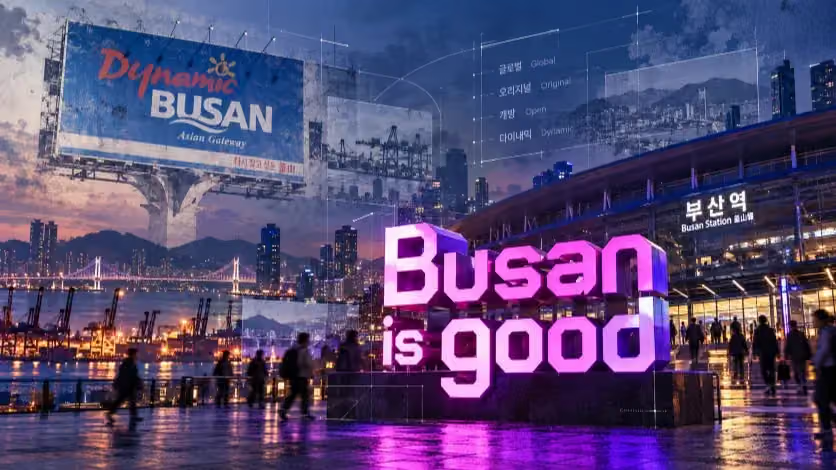
Why “Busan Is Good” Falls Short as a City Brand
 NewsSep 18, 2026
The Other AI Race Is for the Freedom to Change Course
Reader Signal
Community readWhat did this report leave you with?
Choose the signal that best reflects your reading. Select it again to remove it.
One response per article
No response selected
A moderated conversation about the reporting.
One-level replies and newsroom moderation keep the conversation anchored to this article.
Discussion Status
Open
Please sign in to join the discussion.
Newsletter
Weekly reporting and context from Busan and Korea.