Korean Education Is Producing Elites—But Not Democratic Citizens
Beneath Korea’s academic success lies a quieter crisis: classrooms that prioritize competition over citizenship, conformity over critical thought. As inequality deepens and public trust erodes, we must ask: Are we educating for democracy—or against it?
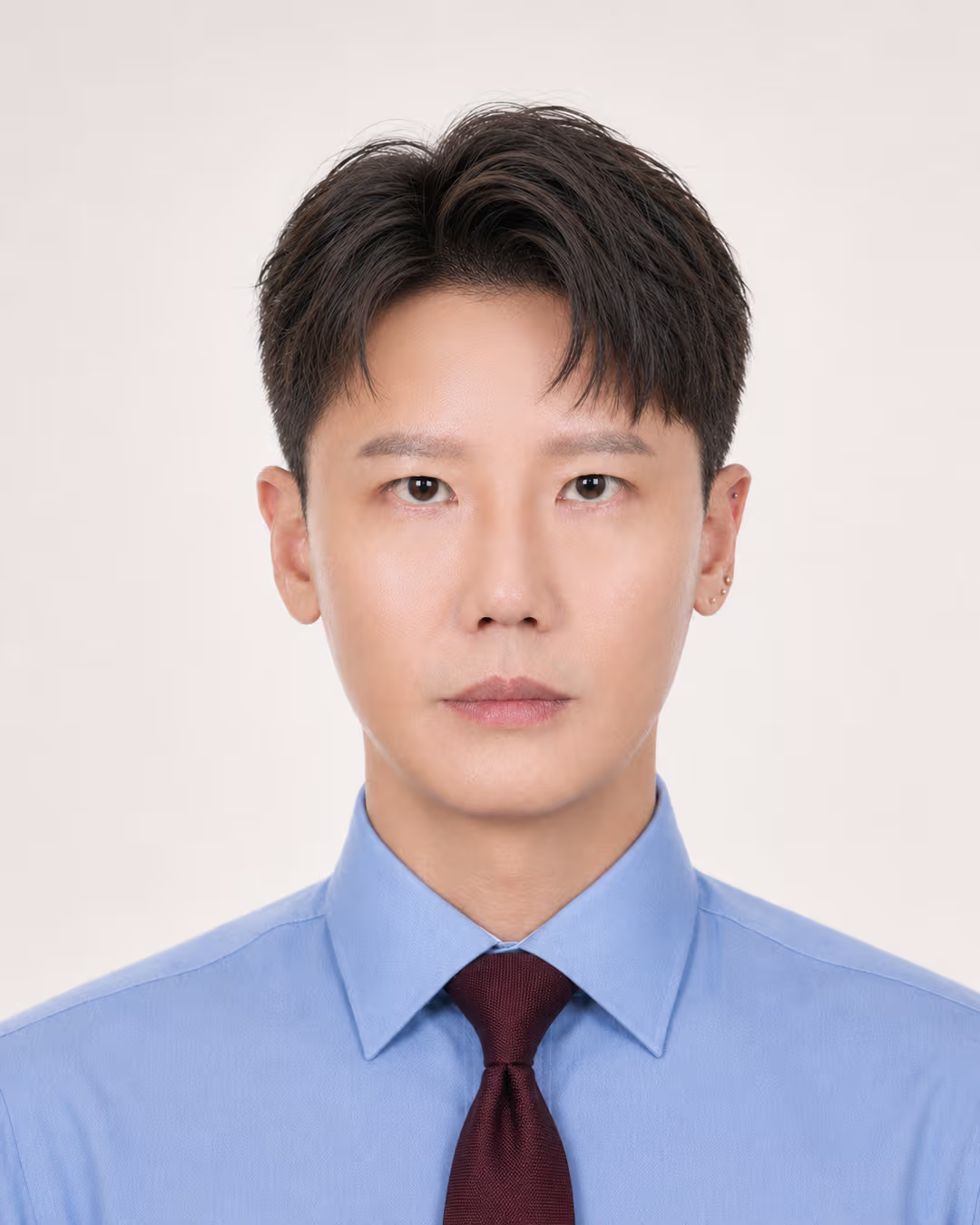

In South Korea’s most prestigious universities, some of the brightest students are walking away—not because they’ve failed, but because they’ve succeeded too well in the wrong race. Top-ranked students at Seoul National University and other elite institutions are increasingly dropping out to reapply for medical school, not out of passion for healing, but in pursuit of prestige, security, and guaranteed social mobility. In a country where success is tightly linked to status, this phenomenon reflects more than academic ambition—it signals a deeper societal dysfunction.
South Korea’s education system is globally praised for its academic excellence. But beneath the surface lies a troubling paradox: while the country has embraced democracy in form, its education system remains structured around values that are deeply authoritarian. Hierarchy, blind competition, conformity, and the fear of failure continue to shape the minds of future generations. In the process, we are producing high-performing elites—but not democratic citizens.
Korean students are introduced to competition from their earliest years. Academic success is determined not by personal growth or passion, but by relative rank and percentile. The system is designed to sort, not to nurture. From standardized testing and school rankings to entrance exams and university branding, the pathway to success is a narrow, rigid ladder—one that most climb in fear, not in joy.
Private academies, or hagwons, have become a near-obligatory extension of formal schooling, driving families into financial strain while reinforcing inequality. The race does not end with admission to a top university. Increasingly, even these students are abandoning their programs to chase the most prized credential: a seat in medical school. This “medical school syndrome” illustrates how narrowly success is defined—and how desperately young people cling to it, often at the expense of their mental health, creativity, and individuality.
Beneath the surface, a darker cost emerges: students are not taught to think together, but to outpace each other. School becomes a battleground of silent rivals. Trust becomes conditional. Collaboration, empathy, and curiosity—qualities essential to a democratic society—are quietly starved.
The problem runs far deeper than mere academic stress. It lies in the moral architecture of the system itself.
As political philosopher Michael Sandel of Harvard University observes in his seminal work The Tyranny of Merit, modern meritocratic societies increasingly conflate academic performance—particularly test-based success—with moral deservingness. In these systems, those who reach the top are not merely seen as talented or hardworking—they are believed to have earned their place through superior virtue. Conversely, those who fall behind are too often perceived, and perceive themselves, as deficient in worth.
This logic quietly transforms education from a space of human development into a mechanism for sorting human value. Classrooms become proving grounds, not for citizenship or ethical growth, but for self-justification and status competition.
In South Korea, this dynamic plays out with unsettling intensity. From early childhood, students are ranked, quantified, and judged. Success becomes not just an outcome—but a marker of identity. As Sandel warns, such systems foster entitlement among the “winners” and humiliation among the “losers.” The social fabric begins to fray as resentment builds beneath the surface, and trust in shared institutions erodes.
This is not a minor cultural quirk. It is a democratic vulnerability.
When young people are taught to measure themselves and others by test scores, school names, and eventual job titles, they are less likely to see one another as fellow citizens. The result is a society of brilliant performers—yet one increasingly lacking in solidarity, empathy, or civic imagination.
South Korea’s education system, for all its academic rigor, is not immune to this crisis. In fact, it may be one of its most acute examples. Unless addressed, the country risks producing generations of successful individuals who struggle to build a sustainable democratic society.
South Korea’s hyper-meritocratic culture has undoubtedly delivered impressive results—economic development, technological innovation, and international prestige. But beneath these achievements lies a series of social costs that are becoming increasingly difficult to ignore. The same system that elevated national performance has quietly eroded the foundations of social cohesion.
Students, from an early age, are conditioned to measure their worth against that of their peers. Academic rankings, standardized testing, and university admissions function as constant barometers of value. Over time, this conditioning breeds social alienation. Friendships and learning become transactional, and young people internalize shame for “falling behind”—even when they’ve done nothing wrong. They begin to believe their value is only as good as their latest score.
This emotional pressure takes a toll. Mental health challenges among Korean youth are among the most severe in the developed world. Depression, anxiety, and suicide—especially among teenagers—are not isolated issues but systemic symptoms of an educational culture that equates performance with personhood. The cost of success is not merely individual exhaustion; it is collective suffering.
At the same time, public trust in institutions begins to erode. When the road to success appears reserved for those with resources—private tutors, elite networks, or insider knowledge—the sense of fairness evaporates. Meritocracy, once held up as a just alternative to privilege, begins to look suspiciously like a new form of it. Citizens stop believing in the system and start looking out only for themselves.
Perhaps most concerning of all is the quiet erosion of civic engagement. The system produces skilled, disciplined individuals—but few who feel empowered to speak out, challenge authority, or take responsibility beyond personal advancement. A society filled with achievers may still lack citizens. This is the paradox of modern Korea: individual brilliance coexisting with collective fragmentation.
Yet the path forward is not uncharted. In the wake of World War II, Germany faced its own reckoning with authoritarianism. Recognizing that its schools had been complicit in indoctrinating obedience, not democratic thought, Germany radically overhauled its educational model. Rankings were abolished. Nationalist rituals were removed. Most importantly, civic education became a core tenet—not as a subject, but as a practice embedded in everyday schooling. The goal was not simply to prevent the return of fascism, but to cultivate citizens capable of resisting it.
South Korea, by contrast, successfully democratized its political institutions in the post-dictatorship era, but left its classrooms largely untouched. The culture of hierarchy, obedience, and competition persisted—even as the society outside evolved. Today, Koreans vote in democratic elections, but many grow up without ever having experienced democratic values in school. The result is a society governed by democratic rules, yet lacking the lived experience of democracy itself.
To remain globally competitive and socially resilient in the 21st century, Korea must redefine what constitutes national strength. In an era marked by polarization, climate disruption, and technological upheaval, a nation’s true power will be measured not by how well it ranks, but by how well its people cooperate, deliberate, and act in solidarity. Economic success alone is no longer enough.
What Korea needs now is not more elites, but more citizens—people who value dignity over dominance, collaboration over conquest, and responsibility over obedience. And this transformation begins, quite simply, in the classroom.
It is time to fundamentally rethink what education is for. Schools must shift away from reinforcing conformity and performance, and toward cultivating autonomy, critical thinking, and dialogue. Education should not be a race to the top, but a rehearsal for participation in public life.
This reorientation requires structural change. Evaluation systems must be reformed to reward depth over speed and collaboration over competition. Civic education should be expanded—not as rote learning about government, but as lived experience in deliberation and debate. Teachers must be restored as trusted public intellectuals, granted both pedagogical freedom and political rights. Above all, schools must become emotionally safe spaces, where students are supported not just academically, but as whole human beings.
If we fail to do this, we risk building a society that is efficient but brittle, educated but indifferent, accomplished but unequal. The cost of inaction is not abstract. It is visible in the growing disillusionment of our youth, the fragmentation of social trust, and the weakening of our democratic bonds.
Korea’s education system has mastered the art of producing high-performing individuals. But it now faces a greater challenge: cultivating ethical, resilient, and engaged citizens. A society that measures success by how few reach the top cannot be sustained. A democracy built on obedience cannot thrive. And a nation that forgets how to stand together may one day find that it cannot stand at all.
It is time for Korean classrooms to stop replicating the hierarchies of the past—and begin rehearsing the possibilities of a shared and democratic future.
Continue this reporting
Reporting on the same issue
Related coverage selected from the article's desk, topics and newsroom relationships.
 NewsSep 26, 2026
South Korea’s 490 Regional Doctor Seats Begin a Longer Route to Care
South Korea’s first 490 regional-doctor seats tie medical-school admission to...
 NewsAug 30, 2026
The Hidden Economics of South Korea’s Public Transport
Busan’s latest transport review exposes a wider national problem: South Korea...
 NewsAug 11, 2026
Korea’s Innovation Cities Did Not Grow the Same Way
Nearly two decades after South Korea began relocating public institutions, th...
More from the author
More from this byline
Stay with the same line of reporting through more work from this byline.
 NewsSep 18, 2026
The Other AI Race Is for the Freedom to Change Course
 NewsSep 5, 2026
How a Political Appointment Becomes a Judgment of Character
Reader Signal
Community readWhat did this report leave you with?
Choose the signal that best reflects your reading. Select it again to remove it.
One response per article
No response selected
A moderated conversation about the reporting.
One-level replies and newsroom moderation keep the conversation anchored to this article.
Discussion Status
Open
Please sign in to join the discussion.
Newsletter
Weekly reporting and context from Busan and Korea.