How Korea’s Apartments Became a Bet on the Future
South Korea’s apartment crisis is not just about prices or taxes. In Seoul and the capital region, apartments have become a route to opportunity, security and mobility. Breaking the cycle will require more than tax and mortgage rules: it demands a new housing settlement for future cities.

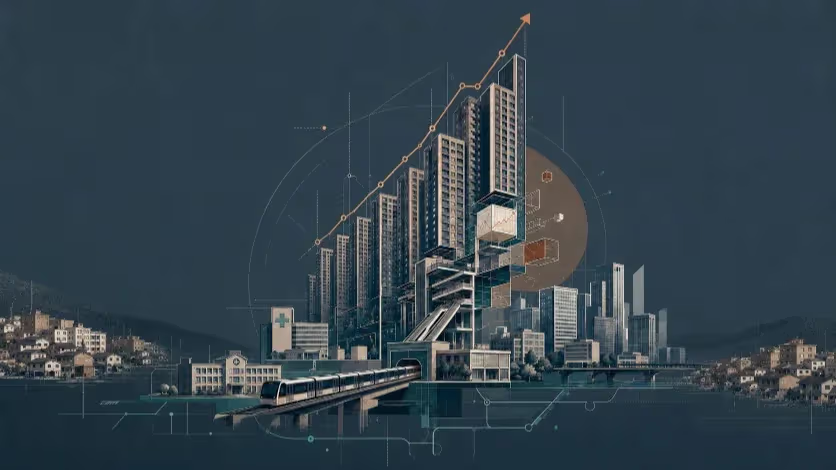
Capital gains tax may cool some speculation, but Korea’s housing crisis runs deeper: apartments have become claims on jobs, schools, hospitals, inheritance and the future of the city itself.
South Korea’s latest real estate debate has returned, predictably, to tax. The temporary relief on capital gains tax for multiple-home owners has expired, reviving steep surcharges on the sale of homes in regulated areas and restoring one of the government’s most visible tools against speculative ownership. On paper, the logic is direct: make it more costly to hold multiple homes in overheated markets, pressure investors to sell, and return more housing to people who intend to live in it. Yet the Korean apartment market has rarely responded to policy in such a linear way.
The reason lies in what an apartment has come to represent. In Seoul and the surrounding capital region, an apartment is seldom priced as shelter alone. It carries the value of a school district, a subway line, a hospital network, a redevelopment possibility, a liquid resale market and a family’s expectation that property will remain the safest store of wealth. A unit may be made of concrete, pipes and elevators, but its price contains something less visible and far more powerful: access to the institutions and opportunities that shape life chances in Korea.
A capital gains surcharge can change the timing of a sale. It can pull transactions forward before a deadline, punish speculative profit and send a political signal that multiple-home ownership is no longer a neutral private choice in strained urban markets. But because the tax is paid only when a home is sold, it can also make owners wait. If holding costs remain bearable while the cost of selling rises sharply, a rational owner may rent the property, transfer it within the family, wait for another policy shift or simply keep the unit off the market. The home remains physically occupied, but economically it may vanish from circulation.
That paradox exposes the limits of treating Korea’s housing crisis as a tax problem. Policymakers want homes to move from investors to residents, yet some of the strongest instruments used against speculation can make movement itself more expensive. The deeper issue is not only whether a multiple-home owner should pay more tax on capital gains. The deeper issue is why so many households came to believe that owning the right apartment in the right district was the safest way to secure education, mobility, retirement, inheritance and social standing.
Seoul apartments became investment vehicles because Seoul became the place where too much of Korea’s future was concentrated. High-paying jobs, elite universities, major hospitals, cultural infrastructure, corporate networks and transport systems gathered in a narrow geography, while the apartment became the housing form most capable of converting that concentration into private wealth. To buy into a desirable apartment complex was therefore not merely to purchase a home. It was to purchase a position inside Korea’s hierarchy of access.
The same spatial order has produced the opposite result outside the capital region. Where employment, education and medical services concentrate, housing behaves like an appreciating asset; where those functions weaken, homes become harder to sell, harder to maintain and less able to serve as family wealth. Seoul’s apartment inflation and regional decline are not separate stories moving in opposite directions. They are the same story told from two ends of the country’s urban structure.
Seen this way, Korea’s apartment problem is not simply that homes cost too much. It is that too much of Korean life has been priced into them. Work, schooling, care, mobility, inheritance and status have been compressed into a market that was supposed to provide shelter. Breaking that cycle will require more than a tougher capital gains tax, more than another mortgage rule and more than another headline supply target. It will require a policy that treats housing not as an isolated asset class, but as the physical expression of how Korea distributes opportunity across cities, regions and generations.
The Tax Paradox
A capital gains tax surcharge carries an obvious moral appeal in a country where housing wealth has become so unevenly distributed. When multiple-home owners profit from price increases in overheated districts, it seems reasonable that the state should reclaim a larger share of those gains and discourage further accumulation. In political terms, the policy is easy to understand. It tells the public that homes in strained urban markets should not be treated simply as tradable assets. It also tells investors that holding multiple apartments in Seoul or other regulated areas will no longer be costless.
But the market effect is less simple than the political message. A capital gains tax is not a tax on ownership. It is a tax on exit. The owner pays it only when the asset is sold, which means the tax changes not only the profit from a sale but the decision to sell at all. When the surcharge is expected to begin or return, some owners rush to complete transactions before the deadline. That can create a temporary wave of listings, discounted deals and family transfers. Once the deadline passes, the same tax can produce the opposite behavior. The owner who missed the window may decide that selling no longer makes sense.
This is why the effect of a capital gains surcharge should not be measured only by whether prices fall in the weeks around implementation. Its first effect is usually on timing. It pulls some sales forward, compresses decisions and gives the market a short burst of movement. Its second effect is on circulation. After the tax becomes binding, the market may lose precisely the kind of supply policymakers hoped to release. A home can remain occupied, rented out or held within a family, but it no longer functions as available inventory for buyers. It stays in the housing stock, while leaving the market.
That distinction matters in Seoul, where price is often less flexible than volume. Owners of prime apartments do not behave like sellers of ordinary consumer goods. Many can wait. They may have rental income, accumulated equity, family wealth or a belief that the long-term value of the location will recover from any policy shock. A higher tax bill does not necessarily make them accept a lower price. It may make them raise the price they need in order to sell, or remove the property from the market entirely. The result is not always cheaper housing. It can be fewer transactions, wider gaps between asking prices and actual deals, and a market increasingly divided between forced sellers and cash-rich buyers.
Korea’s tax structure makes this risk sharper. The country has long imposed heavy costs at the moment of transaction while keeping the annual cost of holding valuable property relatively modest by international standards. Acquisition taxes, capital gains taxes and special surcharges make movement expensive; lower recurring holding costs make waiting possible. In such a system, the rational strategy is often not to trade frequently but to hold a scarce asset in a scarce location. The apartment becomes less like a home moving through a market and more like a position kept on a family balance sheet.
The policy paradox is therefore clear. If the state wants to reduce speculative demand, a capital gains surcharge can send a necessary warning. If the state wants homes to move from investors to residents, the same surcharge can become a barrier. Punishing profit at the point of sale may be justified, especially for short-term or highly leveraged speculation, but relying too heavily on exit taxes risks rewarding the very behavior the government wants to discourage: waiting, withholding and betting on future scarcity.
A more durable housing policy would put more weight on the cost of holding underused or non-resident property, while lowering unnecessary friction for transactions that serve a social purpose. A multiple-home owner who keeps valuable homes out of resident use should face a rising annual cost. A household that moves for work, downsizes in old age or sells a former investment property to an actual resident should not face a system that treats every transaction as suspect. The goal should not be to make movement impossible. It should be to make speculative holding unattractive.
Korea does not need to abandon capital gains taxation. It needs to stop asking capital gains taxation to do the work of an entire housing system. Exit taxes can punish excess profits after they are realized. They cannot, by themselves, change the urban geography that made those profits likely in the first place. As long as the annual cost of holding prime apartments remains manageable, and as long as the best opportunities remain concentrated in a narrow set of places, many owners will continue to treat the tax not as a reason to sell, but as a reason to wait.
The Apartment as Urban Access
The durability of Korea’s apartment market cannot be explained by tax policy alone. Taxes may alter the cost of buying, selling or holding, but they do not explain why so many households continue to believe that a Seoul apartment is worth defending through every policy cycle. That belief comes from the city itself. The apartment became a powerful asset because it absorbed the value of things that the wider urban system failed to distribute evenly.
A desirable apartment in Seoul contains far more than private living space. Its price carries the value of a school district, a transit line, a hospital network, a safer street environment, a shorter commute, a stronger rental market and the expectation that future buyers will compete for the same advantages. The building may age, but the location often becomes more valuable as the city around it accumulates infrastructure, services and institutional prestige. What is traded, then, is not only a housing unit. It is a share in the city’s most concentrated advantages.
This is why apartment prices in Seoul are so resistant to ordinary explanations of supply and demand. New supply matters, and Korea needs more housing in the places where people actually want to live. But the demand for a prime apartment is not demand for shelter in the abstract. It is demand for a position inside a hierarchy of access. Families are not only asking where they can sleep. They are asking where their children can attend school, where they can reach work without losing hours each day, where hospitals are close, where elderly parents can be cared for, where the property will remain liquid, and where the next buyer is likely to see the same value.
The apartment complex has become the Korean form through which these advantages are bundled. It offers standardized construction, management, parking, security, community facilities, financing, resale liquidity and social recognition. In a dense and unequal urban system, that bundle matters. It gives households not only a home but a sense of order, predictability and status. For many buyers, especially those who have watched land and housing values rise over decades, the apartment is not a speculative object separate from daily life. It is the financial expression of a life plan.
That helps explain why policy often struggles to break expectations. A government may raise taxes, tighten loans or announce new supply, but households still look at the geography of opportunity and draw a familiar conclusion. If the best jobs remain in the capital region, if elite education remains spatially concentrated, if major hospitals and cultural institutions cluster in a few districts, and if non-apartment housing continues to carry lower status and weaker resale confidence, then the apartment in the right location remains rationally desirable. The expectation of appreciation is not merely psychological. It is produced by the way the country has organized opportunity.
This also explains why the Korean apartment market is not just a market of greed. It is a market of fear. The fear is not only that prices will rise further, but that failing to enter the right market will push a household out of the channels through which security is accumulated. Parents buy because they worry about schools and inheritance. Young households stretch because they fear permanent exclusion. Older households hold because the apartment has become their pension. Investors buy because the state, the city and the financial system have repeatedly signaled that scarce urban access will remain valuable.
When housing performs so many functions, policy aimed at only one function tends to disappoint. A tax can discourage profit-taking, but it cannot replace a school system. A mortgage rule can reduce leverage, but it cannot shorten a commute. A supply target can add units, but it cannot automatically create the hospitals, universities, jobs and cultural infrastructure that make a district valuable. The apartment became overburdened because other systems failed to carry their share of social security.
The result is a housing market that looks private but is built on public concentration. The value of a Seoul apartment depends heavily on infrastructure, zoning decisions, transport investment, school reputations, hospital access and the clustering of firms and institutions. Yet much of that publicly produced value is captured privately through ownership. The owner of the right apartment benefits not only from personal investment, but from the accumulated decisions of the state and the city. In this sense, apartment wealth is never purely private wealth. It is private wealth attached to public geography.
Breaking the investment logic of apartments therefore requires more than asking owners to behave differently. It requires changing the conditions that made the behavior rational. If good education, reliable transport, quality health care, cultural life and stable employment remain overwhelmingly concentrated in a narrow set of places, people will continue to pay for proximity to those places. If apartments remain the most trusted way to hold that proximity, they will continue to trade as claims on the future.
A Wealth System Built on Housing
The power of the Korean apartment market also comes from the way housing sits inside the household balance sheet. For many families, real estate is not one investment among several. It is the central asset around which retirement, inheritance, borrowing capacity and social confidence are organized. A stock portfolio can fall without changing where a child goes to school. A pension account can disappoint without forcing a family to move. A home, especially an apartment in a desirable urban district, carries financial value and social location at the same time. That combination makes it far harder to cool than an ordinary asset market.
This is why every attempt to lower housing expectations meets resistance from more than professional investors. The apartment owner is often not only seeking profit. He is protecting the largest asset his family owns, the collateral that supports loans, the inheritance he expects to leave, and the security he believes the public pension system may not fully provide. In a society where old-age anxiety is real and household wealth is heavily tied to property, the apartment becomes a private welfare system. It is asked to perform tasks that pensions, regional employment, rental security and public services have not carried strongly enough.
The result is a market in which price decline is politically harder than price control sounds. For younger households and renters, lower prices promise access. For incumbent owners, lower prices threaten the foundation of family wealth. For parents, an apartment may represent the only asset large enough to help children enter the same market later. For retirees, it may be the store of value that compensates for inadequate income. Housing policy therefore works on two conflicting publics at once: those locked out by high prices, and those whose financial security has been built on those prices not falling too far.
This conflict helps explain Korea’s repeated policy reversals. Governments announce tougher rules when prices rise too quickly, then soften them when transactions freeze, construction weakens, or owner anxiety becomes politically costly. Each reversal teaches the market a lesson. It tells owners that waiting can pay, that policy may bend, and that the state itself is reluctant to let housing wealth fall sharply. Over time, that expectation becomes part of the asset. Buyers do not merely bet on location. They bet on the political difficulty of allowing prime apartment prices to collapse.
Debt reinforces the pattern. When households borrow heavily to enter the apartment market, the price of housing becomes tied to the stability of the financial system. A rapid fall in prices would not only hurt speculative owners; it could weaken household balance sheets, depress consumption, and unsettle banks exposed to mortgages and property-related credit. That makes the state cautious. It wants to restrain speculative demand, but it also fears the consequences of a disorderly correction. The market understands this caution. It is one reason apartments in prime locations retain an aura of state-protected importance, even when policymakers deny any intention to support prices.
The inheritance channel deepens the divide. In a high-price market, income alone no longer determines who can buy. Family assets increasingly decide who enters early, who borrows safely, who waits, and who remains a renter despite stable employment. Housing wealth then reproduces itself across generations. The apartment bought decades ago with one generation’s income becomes the down payment, collateral or direct transfer that allows the next generation to compete. Those outside the chain face a different market, one in which wages must chase an asset whose price has already absorbed years of family accumulation.
That is why Korea’s apartment economy is not simply a story of owners against renters, or investors against residents. It is a story of how the boundary between housing and wealth has blurred. A household that owns a valuable apartment is not only better housed; it is better positioned in credit markets, marriage markets, education decisions and retirement planning. A household without one is not only paying rent; it is often falling behind in the main channel through which wealth has been accumulated. The apartment has become a sorting device, assigning families to different futures even before they make their next housing decision.
A serious housing policy must therefore distinguish between shelter, wealth storage and speculation. These functions have been fused inside the apartment market, but they do not deserve the same treatment. A household’s need for stable residence should be protected. The use of scarce urban housing as a lightly held financial option should not be. Long-term resident owners, elderly households with limited income, leveraged short-term investors, multiple-home landlords and families transferring wealth across generations all occupy different positions in the same market. Treating them as one category produces blunt policy and predictable backlash.
The deeper task is to reduce the amount of private security that must be purchased through housing. Stronger pensions, more credible long-term rental options, better regional employment, safer non-apartment housing and more reliable public services would all weaken the pressure to treat an apartment as the only dependable asset. Without those supports, households will continue to load too many hopes onto housing. They will buy not only because they expect prices to rise, but because they fear what happens if they do not own the asset everyone else is using to secure the future.
Seoul and the Regions Are One Story
The apartment economy that rewards ownership in Seoul also explains why housing has begun to lose its force in many regional cities. These are not separate stories, one about overheating and the other about decline. They are two outcomes of the same spatial order. Where jobs, universities, hospitals, transport investment and cultural attention concentrate, housing becomes a claim on future opportunity. Where those functions weaken or leave, housing becomes harder to sell, harder to finance and harder to treat as family wealth. The same national structure that turns a Seoul apartment into an appreciating asset can turn a regional home into a stranded one.
For decades, Korea treated regional imbalance as a matter of population distribution, infrastructure spending or local development. Those categories still matter, but they do not fully capture what has happened to housing. A home does not hold value only because it is well built. It holds value because the city around it continues to produce reasons to stay. A university that attracts young people, a hospital that anchors care, a labor market that offers careers, a station that connects daily life to wider opportunity, a cultural scene that gives a city identity — these are not amenities separate from housing value. They are the conditions that allow housing to function as a durable asset.
This is why the gap between Seoul and the regions cannot be corrected simply by building more apartments outside the capital. In a shrinking or aging city, new housing supply can become another burden if it is not tied to a credible urban function. Empty units, weak resale demand, declining school enrollment and rising maintenance costs can turn development into a form of denial. The problem is not that regional residents do not need better housing. They do. The problem is that housing policy detached from jobs, transport, education, health care and demographic reality can produce buildings without a future market.
Busan shows the complexity of the issue. It remains Korea’s second city, with a major port, universities, hospitals, cultural assets and a distinct urban identity. Yet it competes against a capital region that absorbs young workers, corporate headquarters, investment flows and national attention with relentless efficiency. For Busan, as for other regional metropolitan areas, the housing question is not only how many units should be supplied or how apartment prices compare with Seoul. The harder question is what functions can make the city worth staying in, returning to and investing in over a lifetime.
A regional apartment cannot become a stable asset merely by imitating the form of a Seoul apartment. It needs a city around it that offers work, care, mobility and belonging. Without those functions, the apartment becomes a physical structure without the same economic promise. This is why regional housing policy must begin with urban purpose rather than construction volume. A port city, an industrial city, a university city, a medical hub, a tourism city and a shrinking agricultural town cannot be governed by the same apartment logic. Each needs a different answer to the same question: what makes living here viable, not only affordable?
The national debate often misses this because it treats Seoul housing as the urgent problem and regional housing as the secondary problem. In reality, the two reinforce each other. As more opportunity concentrates in the capital region, more households conclude that paying a premium for Seoul access is rational. As more young people leave regional cities, the housing markets they leave behind lose liquidity, confidence and future demand. Seoul becomes more expensive because it is expected to win; regional housing becomes weaker because too many people expect their cities to lose. Once those expectations harden, prices begin to reflect not only current conditions but anticipated decline.
This spatial imbalance also reshapes inequality. A household that owns property in a rising district of the capital region accumulates wealth even while living an ordinary life. A household that owns a home in a weakening regional market may have shelter but not the same asset trajectory. Both may be homeowners, but they do not own the same kind of future. The old division between owners and renters no longer explains enough. In Korea, it increasingly matters where ownership is located, what kind of city surrounds it, and whether that city is gaining or losing function.
The policy implications are uncomfortable. Not every region can or should pursue the same growth model. Some cities need to be strengthened as metropolitan anchors, with universities, hospitals, advanced industries, logistics, culture and international functions tied to housing and transport. Some medium-sized cities need compact service zones that concentrate care, education, mobility and public administration around livable centers. Some depopulating areas need managed adaptation rather than speculative development: fewer empty buildings, better care access, safer homes, flexible mobility and land-use policies that accept demographic change instead of pretending it can be reversed by another construction cycle.
The lesson for the national housing debate is clear. Seoul apartment prices cannot be separated from the weakening of alternative urban futures. As long as the capital region remains the safest place to pursue education, work, care and asset growth, households will continue to treat access to it as something worth buying at extraordinary cost. As long as regional cities struggle to retain the functions that make housing valuable, their real estate markets will remain vulnerable to decline even when homes are physically adequate and prices are lower. Korea’s housing crisis is therefore not only a shortage of affordable units in the capital. It is a shortage of credible urban futures outside it.
The Quality Divide
Korea’s housing divide is often described through ownership, income or location, but another boundary has become just as decisive: the divide between apartments and almost everything else. In many countries, housing inequality is visible in the gap between central and peripheral districts, between homeowners and renters, or between market-rate and subsidized housing. Korea has those divisions too. Yet its housing hierarchy is unusually concentrated around a single form. The apartment complex has become the default image of secure middle-class life, while many villas, multiplex houses, aging low-rise buildings, semi-basement units and small rental rooms are treated as lesser forms of urban residence even when they provide shelter in the same city.
That hierarchy is not merely cultural. Apartments offer a bundle of advantages that the rest of the housing system has struggled to match. They are easier for banks to value, easier for buyers to compare, easier for brokers to trade and easier for households to trust. They come with professional management, parking, elevators, security systems, maintenance funds, clearer ownership records and a resale market deep enough to make the asset feel liquid. A buyer may not know the future, but he can usually believe that someone else will understand the value of the same apartment later. That confidence is itself part of the price.
Non-apartment housing often lacks this infrastructure of trust. A villa may be well located and livable, but the buyer must worry about construction quality, maintenance responsibility, resale liquidity, parking, neighborhood management, hidden defects, unclear price benchmarks and, in recent years, the memory of rental fraud. A low-rise home may offer more human scale than a tower complex, but it may not offer the same financial recognition from lenders or the same confidence from future buyers. Once a housing type is seen as harder to finance, harder to sell and harder to protect legally, households do not merely prefer apartments; they flee toward them.
This flight is one of the least discussed engines of apartment inflation. Demand for apartments is not created only by status seeking or speculative greed. It is also created by the weakness of alternatives. When non-apartment housing carries greater perceived risk, the apartment becomes the safer asset even for households that do not need every amenity it offers. Families pay more not only for square meters, but for certainty. They pay for the knowledge that the building will be managed, that the market will recognize the product, that lenders will accept it, that relatives will understand the purchase, and that the next buyer will not treat it as an inferior asset.
The result is a housing market in which quality and liquidity reinforce each other. Apartments attract demand because they are trusted; they are trusted because demand remains deep. Non-apartment housing loses demand because it is viewed as risky; it becomes riskier because fewer households want to buy it. This feedback loop turns housing type into a class marker. Two households may live in the same district and even pay similar monthly costs, but the household inside a recognized apartment complex holds an asset with stronger collateral value, stronger resale confidence and stronger social recognition. The other may have a roof but not the same economic position.
This distinction matters for policy because adding homes does not automatically ease apartment pressure if the homes being added do not command trust. A supply policy that produces units households regard as temporary, risky or financially inferior will not fully compete with apartment demand. Nor will a tax policy aimed at multiple-home owners change the fact that many first-time buyers still see the apartment as the only safe entry into ownership. Korea cannot weaken the speculative force of apartments while leaving other housing types to function as the residual category of the urban system.
Urban design suffers as well. A city that treats apartments as the only credible form of middle-class housing gradually loses the diversity that makes neighborhoods adaptable. Low-rise streets, mixed-use blocks, small rental buildings and older residential areas can support walkable life, local commerce and social continuity. But if they are left with weak maintenance systems, poor financing, fragmented ownership and little public investment, they become symbols of decline rather than alternatives to tower living. The city then faces a false choice between high-rise apartment redevelopment and neglect, when what it needs is a broader grammar of decent housing.
Breaking the apartment investment loop therefore requires rebuilding the credibility of non-apartment housing. That means more than cosmetic renovation. It requires stronger construction oversight, transparent transaction data, better rental guarantees, professional maintenance systems, safer financing, parking and accessibility solutions, and public investment in streets, lighting, drainage, parks and neighborhood services. It also requires legal and financial institutions that do not treat every non-apartment home as a lower-grade asset by default. Until the market believes that a well-built villa, a renovated low-rise home or a long-term rental unit can offer stability, households will continue to crowd into apartments even when they are unaffordable.
Korea’s housing inequality will not be solved by treating apartments as the only serious product and everything else as a temporary compromise. As long as the apartment remains the sole trusted container of shelter, wealth, safety and recognition, demand will continue to concentrate there and policy will keep chasing the symptoms. A healthier housing system would allow households to choose between different forms of decent urban life without feeling that only one of them preserves their future. That, more than any single tax change, is what would begin to loosen the apartment’s grip on the Korean imagination.
The Limits of Demand Control
The current government has not been passive in the face of Korea’s housing pressures. It has tightened mortgage rules, restored heavier taxation on multiple-home owners, expanded regulated zones and announced large supply targets for the capital region. These measures matter. In a market where expectations can move faster than construction and where leverage can turn fear of missing out into a national balance-sheet risk, a government that refuses to act would effectively endorse speculation. The question is not whether the state should intervene. The question is whether the tools now being used are capable of changing the structure that made apartments such powerful investment vehicles in the first place.
The government’s demand-side measures have a clear logic. Higher borrowing hurdles can slow speculative purchases, especially in expensive districts where price expectations depend heavily on leverage. Restrictions on regulated areas can make it harder for investors to use credit, family capital and short-term market timing to accumulate homes. A revived capital gains surcharge can tell multiple-home owners that the state no longer treats speculative holding in overheated markets as an ordinary private investment choice. Together, these policies can cool momentum, reduce some forms of leveraged demand and restore a sense that housing is not exempt from public discipline.
But demand control has an inherent limit. It can restrain buyers; it cannot by itself create alternatives. A mortgage rule may prevent a household from overborrowing, but it does not make non-apartment housing more trustworthy. A capital gains surcharge may punish profit, but it does not build stable rental housing. A regulated-zone designation may slow speculative entry, but it does not move universities, hospitals or high-value jobs out of the capital region. These tools can lean against the cycle, but they do not remove the reasons households continue to see the right apartment as the safest claim on the future.
There is also a distributional risk inside strict demand control. When credit becomes scarce, the market does not necessarily become fairer. It can become more favorable to those who do not need credit. Cash-rich buyers, households with parental support and owners with existing equity can often survive tighter lending rules better than first-time buyers who rely on income rather than inherited wealth. A policy designed to suppress speculation can therefore leave the structure of advantage intact unless it distinguishes carefully between leveraged investment demand and genuine owner-occupier need. In a market already shaped by family wealth, broad credit restraint can cool prices at the surface while preserving the hierarchy beneath it.
Supply policy faces a different problem. Korea needs more homes in the places where people can actually live with dignity, work without punishing commutes and raise families without treating housing as a lottery ticket. Yet supply numbers alone do not answer the harder questions: where the homes will be built, when they will be occupied, at what price, under what tenure, with what transport, schools, care facilities and employment base around them. A headline target can calm a market for a moment, but households do not buy a national supply figure. They buy a location, a commute, a school path, a hospital radius and a judgment about future liquidity.
This is why construction volume cannot be separated from urban function. If new homes arrive far from jobs or without reliable transport, they may add units without reducing the premium on established districts. If redevelopment produces expensive apartments that only reproduce the existing hierarchy, it may increase supply while deepening exclusion. If public housing remains too limited, too residual or too distant from opportunity, it will not become a credible alternative to private apartment ownership. The issue is not whether Korea builds enough in the abstract. It is whether it builds enough of the right housing in the right places, and whether that housing weakens or reinforces the apartment-as-asset model.
The government’s emerging interest in tightening tax preferences for rental business owners also reflects a real tension. Tax benefits given in the name of rental supply can become shelters for multiple-home ownership if they are not tied to clear public obligations. In that sense, reviewing those privileges is legitimate. Yet removing them carelessly could unsettle the rental market, especially if landlords respond by selling, raising rents or shifting units away from stable leases. The policy problem is not whether rental ownership should be subsidized or punished. It is whether private rental supply receives public benefits only when it delivers public value: long leases, transparent contracts, controlled rent increases, insured deposits and real tenant security.
The current policy mix may cool parts of the market, and in the short term that may be necessary. But cooling is not the same as redesign. A lower transaction count is not a healthier housing system. A temporary pause in price growth is not proof that households have stopped treating apartments as claims on urban opportunity. The real test will come later: whether homes move to residents rather than disappear from circulation, whether younger households gain access without unsustainable debt, whether non-apartment housing becomes credible, whether regional cities recover functions worth staying for, and whether the state can hold a consistent line long enough for expectations to change.
Breaking the Apartment Investment Loop
Breaking Korea’s apartment investment loop does not require the state to declare war on ownership. It requires the state to separate ownership for residence from ownership for extraction. A household that buys a home to live near work, raise children, care for parents or age in place should not be treated as the same policy subject as an investor who holds multiple scarce units as claims on future appreciation. The failure of Korean housing policy has often been its inability to draw that line with enough precision. When rules become too broad, they frighten ordinary households; when they become too lenient, they reward those best positioned to accumulate.
The first principle should be to make speculative holding more expensive while making socially useful movement easier. Korea has relied heavily on taxes that bite at the moment of transaction, especially acquisition and capital gains taxes. Those taxes can raise revenue and discourage some speculative trades, but they also make the market less fluid. A system that taxes exit too heavily and holding too lightly invites owners to wait. The better direction is not to remove capital gains taxation, but to reduce the degree to which the entire burden of housing discipline falls on the sale. Homes that are valuable, underused, non-resident-owned or accumulated in multiple holdings should carry a clearer annual cost. Homes that move into resident use should not be trapped behind avoidable friction.
This shift would change the psychology of the market. Under the current logic, an owner can often treat time as an ally. If the property is in the right district and the annual cost of holding is manageable, the owner can absorb policy shocks, rent the unit, wait for political reversal or pass the asset through the family. A stronger recurring cost on high-value non-resident or multiple-home ownership would make waiting less neutral. It would not force a fire sale, and it should not be designed to do so. But it would tell the market that scarce urban housing cannot be held indefinitely as a low-cost option on future public investment.
At the same time, Korea needs cleaner exits. A tax system that wants investors to release homes must give them a path to do so without turning every sale into a punitive event. That does not mean offering another broad amnesty or repeating temporary relief every time the market freezes. Repeated exemptions teach owners to wait for the next window. A better model would be rule-based and predictable: limited relief for sales to genuine resident buyers, clearer treatment for long-held former rental homes, support for elderly downsizing, and lower transaction barriers for households moving for work, family care or life-cycle needs. The policy objective should be circulation, not paralysis.
The same logic applies to credit. Korea cannot allow apartment speculation to feed on cheap leverage, but it should not design mortgage rules that leave only the wealthy untouched. If lending restrictions mainly exclude households without parental support while cash-rich buyers remain active, demand control becomes a filter for inherited advantage. Credit policy must distinguish more sharply between a first resident purchase, a necessary move, a leveraged investment purchase and a gap-investment strategy built on tenants’ deposits. The state should be strict where debt turns housing into a speculative multiplier. It should be more careful where credit is the only bridge between income and ownership for households that are actually trying to live in the home.
Rental policy must also be rebuilt around public value. Private landlords can play a role in supplying housing, but tax privileges and regulatory exemptions should not exist simply to make multiple ownership easier. If rental business owners receive benefits, those benefits should buy something measurable for tenants: longer leases, controlled rent increases, deposit protection, transparent reporting, maintenance standards and real penalties for abuse. Public support should not subsidize ownership status. It should purchase residential stability. Without that discipline, rental incentives become another channel through which the apartment investment loop survives under a different name.
Public and long-term rental housing should be understood in the same way. It is not merely a welfare tool for the poorest households. In a market where ownership has become the main path to security, stable rental housing is a way to reduce the social compulsion to buy. Korea does not need to copy Singapore’s public housing model or Vienna’s social housing system wholesale; its land regime, politics and history are different. But it does need a stronger middle layer between insecure private renting and highly leveraged apartment ownership. Without that layer, households will continue to treat ownership as the only serious protection against exclusion.
Supply must be judged by whether it weakens the investment logic, not simply by whether it increases the count of units. A large number of homes delivered in weak locations, at unaffordable prices or in forms that replicate the existing hierarchy will not change the structure. The right supply is connected to work, schools, care, transit and daily services. It includes rental and ownership options. It improves neighborhoods rather than merely replacing them. It gives households a credible alternative to competing for the same limited set of apartment complexes. A housing unit does not become meaningful supply until it is attached to a livable urban system.
Regional policy belongs inside this housing strategy, not outside it. If Seoul remains the only plausible geography of advancement, every housing measure in the capital will be fighting a national tide. Regional cities need more than subsidies and construction targets. They need functions that can anchor life: universities that retain talent, hospitals that provide confidence, industries that create skilled work, cultural institutions that give identity, transport systems that connect without exhausting residents, and care infrastructure that fits an aging population. Housing in such cities can hold value because the city itself holds value. Without those functions, cheaper housing alone will not persuade people to stay.
The goal is not to suppress apartment ownership as an aspiration. It is to reduce the number of social functions that only apartment ownership can perform. A healthy housing system would allow a family to rent without feeling permanently exposed, buy a non-apartment home without fearing financial inferiority, live in a regional city without sacrificing opportunity, downsize without being punished, and hold one home without needing to treat it as the family’s only pension. Such a system would not eliminate housing markets or price differences. It would make fewer people feel compelled to bet their future on one asset class in one geography.
AI, Mobility and the Next Geography of Housing
The next stage of Korea’s housing debate will not be shaped by tax and supply alone. It will also be shaped by technologies that change how people work, move, receive care and relate to distance. Artificial intelligence, remote services and autonomous mobility will not abolish the importance of place, but they may alter what kinds of places can remain viable. For a country struggling with capital-region concentration, regional decline and an aging population, that possibility matters. The danger is that Korea will treat these technologies as accessories to the existing urban order rather than as tools for redesigning it.
Technology does not automatically decentralize a country. Artificial intelligence may allow more work, health care, education and administration to move across distance, but it may also concentrate talent, capital, data centers and high-value firms even more tightly in the places that already dominate. The same technology that permits remote diagnosis in a regional town can also enrich a metropolitan hospital network. The same systems that allow a small city to manage mobility more efficiently can also make Seoul’s service economy faster, denser and harder to compete with. AI will not save regional cities by existing. It will help only where institutions know how to turn it into urban function.
This distinction is crucial. A declining city does not become attractive because it installs sensors, opens a data platform or brands itself as smart. It becomes attractive when technology helps residents solve problems that shape daily life: reaching a hospital without a car, receiving public services without long travel, connecting older residents to care, matching local firms with skilled workers, supporting remote education, managing empty homes, reducing energy waste, and making transport reliable despite a thinner population. The question is not whether a city uses AI. The question is whether AI strengthens the reasons to live there.
Autonomous mobility raises a similar dilemma. If driverless vehicles are treated mainly as private cars with better software, they may intensify sprawl. Longer commutes become more tolerable when travel time can be used for work or rest, and households may be tempted to move farther from jobs while still depending on the metropolitan core. In that scenario, autonomous vehicles do not repair the city. They stretch it. They make distance feel cheaper for the individual while leaving society with more roads, more energy use, more dispersed services and a weaker logic for compact neighborhoods.
A different outcome is possible if autonomous mobility is designed as part of a shared urban system. Driverless shuttles connected to rail stations, hospitals, universities, markets and residential clusters could make smaller cities and aging districts more livable. Flexible routes could serve areas where fixed bus lines are difficult to maintain. Reduced parking demand could free land now trapped in garages, surface lots and wide roads. Streets could be redesigned for walking, local commerce, trees, care facilities and housing rather than for the storage of private vehicles. In that model, mobility technology would not simply help people travel farther. It would help them live closer to what they need.
The stakes are especially high for regional Korea. Many local governments have pursued development through construction, festivals, industrial parks or branding, but the deeper challenge is service viability. An aging town may not need another apartment complex as much as it needs reliable transport to clinics, coordinated home care, accessible public buildings, energy-efficient housing and digital links to larger hospitals and universities. A regional metropolis may not need to imitate Seoul’s density as much as it needs to build a distinctive network of work, education, culture and mobility that gives younger residents a reason to stay. Technology can support that work, but it cannot substitute for it.
The same applies inside Seoul. AI and mobility systems could make the capital more efficient, but efficiency alone may worsen inequality if the benefits attach mainly to already valuable districts. Better traffic management, predictive maintenance, digital health services and automated logistics can raise the premium on places that already have strong infrastructure. If smart-city investment follows existing property values, it will become another layer of urban advantage priced into apartments. The future city could therefore deepen the very problem Korea is trying to solve: the conversion of public systems into private real estate value.
Housing policy must anticipate this. The arrival of autonomous mobility should force a reconsideration of parking requirements, road space, station-area planning, curb management and the relationship between housing and daily services. AI-enabled care should change how Korea designs homes for older residents, not merely how hospitals process data. Remote work should encourage cities to build shared workspaces, cultural infrastructure and neighborhood services outside Seoul, not just allow metropolitan workers to answer emails from farther away. Energy systems should make housing quality depend less on age and prestige and more on performance, resilience and cost of living.
The future of housing will increasingly depend on the quality of the surrounding service network. A home will be valuable not only because it is near a subway station or inside a famous school district, but because it is connected to health care, mobility, digital work, energy efficiency, public safety and social support. This could loosen the grip of a few apartment districts if Korea deliberately distributes those networks. It could also tighten the grip if the same services cluster where wealth already is. The technology is flexible. The political economy around it is not.
The apartment became Korea’s dominant investment asset because too many forms of security were tied to a limited geography. Future technology will either reinforce that geography or help redistribute the functions that made it so valuable. Nothing in the technology itself guarantees the better outcome. The city will be shaped by zoning, public investment, transport design, data governance, housing standards and the political will to make good urban life available in more than one place.
The City After the Apartment Bet
The hardest part of Korea’s housing problem is that the apartment has performed too many roles too well. It has sheltered families, stored wealth, secured school access, supported borrowing, signaled social status and promised a form of protection against an uncertain future. Its dominance did not emerge by accident. It grew because households learned, over decades, that the safest way to remain inside Korea’s main channels of opportunity was to own a standardized, liquid and widely recognized asset in the right urban location. The apartment became powerful not because Koreans misunderstood housing, but because they understood the country’s spatial economy with painful accuracy.
That is why breaking the apartment bet cannot mean merely scolding households for treating homes as investments. A family that buys an apartment for education, security or retirement is responding to a system that has made private ownership carry public functions. A young couple stretching to buy is not only chasing profit; it is trying to avoid permanent exclusion from the market that everyone else uses to accumulate stability. An older household holding a valuable apartment is not always speculating in the narrow sense; it may be protecting the asset that stands in for pension, inheritance and family security. The moral vocabulary of speculation captures part of the problem, but not the whole of it.
The better question is how Korea can reduce the number of reasons a household feels it must own the right apartment. If good schools, reliable transport, credible rental housing, decent non-apartment homes, accessible hospitals, stable pensions and regional careers were distributed more widely, the apartment would still be valuable, but it would no longer need to carry the entire burden of security. It would become one housing choice among others, not the central instrument through which families buy protection from the future. That is the real meaning of turning housing back into shelter.
Such a shift would require the state to treat housing as an organizing principle of national life, not as a sector to be managed after prices move. Tax policy would have to distinguish more carefully between resident ownership and speculative holding. Credit policy would have to block leveraged accumulation without leaving only cash-rich buyers in control. Rental policy would have to offer stability strong enough that ownership is no longer the only serious form of security. Urban policy would have to rebuild trust in non-apartment neighborhoods. Regional policy would have to strengthen cities around real functions rather than construction targets. Technology policy would have to use AI and mobility to improve access, not simply to raise the efficiency of places already ahead.
The measure of success should also change. A government can slow price growth and still fail if younger households remain locked out, if homes do not circulate, if renters remain insecure, if regional cities lose function, and if non-apartment housing remains the residual category of the market. A housing system is not healthy merely because prices pause. It is healthy when people can move for work without being punished, age without being displaced, rent without feeling exposed, buy without taking reckless debt, and live outside the capital without believing they have abandoned the future.
This is where the debate over capital gains tax finds its proper scale. The tax matters, but it is not the architecture of reform. It can discipline realized profit, signal that multiple-home ownership in strained markets carries social costs, and prevent some speculative gains from escaping public claim. Yet it cannot decide where jobs are located, whether a regional university survives, whether a villa is trusted, whether an elderly tenant can stay, whether a young household needs parental wealth to buy, or whether a city is designed around private cars or shared access. Those are the conditions that make the apartment bet rational in the first place.
Nor can the answer be reduced to building more towers. Korea will need more housing in high-demand areas, but the country does not need a future in which every solution takes the form of another apartment complex carrying the same expectations as the last. It needs housing that supports different household types, different stages of life and different urban futures. It needs neighborhoods where low-rise living does not mean financial inferiority, rental housing where long-term residence does not mean insecurity, regional centers where professional ambition does not require departure, and aging communities where care is embedded in the design of daily life.
This is not an argument against Seoul. A successful country needs a strong capital, and Seoul will remain one of Asia’s great urban economies. The problem is not that Seoul is valuable. The problem is that too many pathways to security pass through Seoul, and within Seoul through too narrow a set of housing forms. A healthier Korea would not weaken the capital for the sake of symbolism. It would build enough strength elsewhere that the capital no longer has to carry the whole country’s hopes, fears and balance sheets.
The next housing settlement will therefore be judged less by whether it defeats speculation in a single policy cycle than by whether it changes what families consider safe. If safety still means owning a Seoul-area apartment, the cycle will return under another name. If safety can also mean a stable rental home, a credible regional career, a well-managed low-rise neighborhood, a reliable pension, a nearby clinic, a workable commute and a city that will not be abandoned by its institutions, then the apartment will lose some of its extraordinary financial charge. It will still be a home, and often a valuable one. It will no longer have to be the country’s main promise of belonging.
Korea’s apartment problem began with price, but price was never the whole story. The deeper story is about access: who can reach opportunity, who can store security, who can remain in the city, who can pass wealth forward, and which places are allowed to have a future. The country will not solve that problem by asking one tax to do the work of an entire urban order. It will solve it only when good urban life is no longer something households must purchase through a single asset in a single geography.
Continue this reporting
Reporting on the same issue
Related coverage selected from the article's desk, topics and newsroom relationships.
 NewsSep 24, 2026
Taiwan’s AI Boom Is Surging, but Wealth Follows a Different Map
Taiwan’s semiconductor boom is lifting output and incomes at extraordinary sp...
 NewsSep 10, 2026
Busan Records 1.3 Percent Unemployment as Male and Female Employment Diverge
Busan’s 1.3 percent unemployment rate reflects real job growth, but not a bro...
 NewsSep 4, 2026
Korea Moves Deeper Into the Global Market for Long-Term Capital
Japanese yields are rising, Korean bonds are entering the WGBI and American p...
More from the author
More from this byline
Stay with the same line of reporting through more work from this byline.
 NewsOct 9, 2026
Why “Busan Is Good” Falls Short as a City Brand
 NewsSep 18, 2026
The Other AI Race Is for the Freedom to Change Course
Reader Signal
Community readWhat did this report leave you with?
Choose the signal that best reflects your reading. Select it again to remove it.
One response per article
No response selected
A moderated conversation about the reporting.
One-level replies and newsroom moderation keep the conversation anchored to this article.
Discussion Status
Open
Please sign in to join the discussion.
Newsletter
Weekly reporting and context from Busan and Korea.