Busan’s Arctic Ambition Meets the Hormuz Reality
Busan’s maritime rise is gaining momentum after the relocation of the oceans ministry and shipping headquarters plans. But the Hormuz crisis shows South Korea’s real challenge is energy resilience, not simply a new Arctic sea lane.

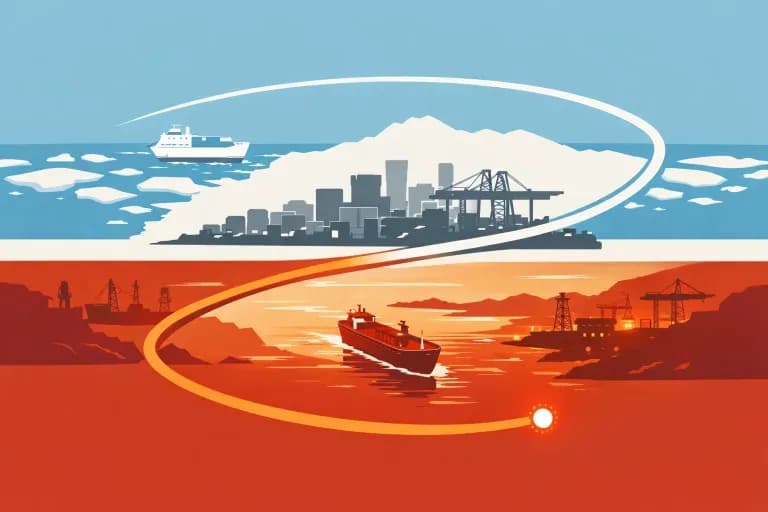
When war returned to the waters around the Strait of Hormuz, the shock reached South Korea with familiar speed. Oil markets moved first. Shipping risk followed. Then came the harder question for Seoul, for refiners, and for a country that still depends heavily on energy moving through one of the world’s most dangerous chokepoints: what, exactly, is the real fallback when the Gulf no longer feels secure. The International Energy Agency and the U.S. Energy Information Administration both underscore how central Hormuz remains to global energy flows, with roughly a fifth of world petroleum liquids consumption moving through the strait and the overwhelming bulk of those exports headed to Asia.
That question matters far beyond fuel prices. It cuts into the larger argument now taking shape in Busan, where the relocation of the Ministry of Oceans and Fisheries, the announced headquarters moves of shipping firms, and the government’s push for an Arctic route have been presented as signs of a new maritime era for South Korea. In that story, Busan is no longer supposed to be only the port city that handles cargo. It is meant to become a place where maritime policy, shipping strategy, finance and industrial planning begin to gather with real force. The ministry completed its relocation to Busan in December 2025, and the government tied that move directly to a broader “Ocean Capital Region” strategy and to preparations for Arctic-route policy experiments.
But the Hormuz crisis strips the rhetoric away. It shows, with uncomfortable clarity, that an Arctic route is not a substitute for the Gulf. It cannot replace the oil and gas that leave the Middle East. It cannot erase South Korea’s exposure to energy insecurity. And it cannot, on its own, solve the structural weakness revealed every time conflict pushes up freight costs, insurance premiums and supply anxiety across Asia. Reuters reported this week that about 61% of South Korea’s crude imports and 54% of its naphtha imports still depend on the Hormuz route.
That does not make Busan’s maritime strategy irrelevant. It makes the stakes clearer. If the city is to become something more than the stage for relocation ceremonies and political slogans, the test is not whether it can attach itself to the language of a new sea lane.
The test is whether it can anchor something larger and harder to build: real corporate functions, durable jobs, stronger university pipelines, maritime finance, legal infrastructure and the kind of industrial depth that can hold when global trade routes turn unstable.
Busan’s Maritime Shift Is No Longer Abstract
What has changed in Busan is no longer theoretical. For years, the city’s claim to maritime centrality rested on geography, cargo volume and institutional memory. Busan had the port, the terminals and the workforce, but not the full weight of state decision-making. That balance began to shift in late 2025, when the Ministry of Oceans and Fisheries completed its move to Busan and opened its new offices in Dong-gu. The relocation mattered less as a symbolic transfer of bureaucrats than as a signal that the government was prepared to place maritime policy closer to the coast, closer to the port and closer to the industries it says it wants to strengthen.
The ministry’s move was followed almost immediately by a development Busan had spent years trying to secure: a private-sector response that could be read as more than ceremonial. On Dec. 5, 2025, SK Shipping and H-Line Shipping announced in Busan that they would relocate their headquarters from Seoul to the city, with procedures to be completed in early 2026. The announcement was important not only because both companies are nationally significant players in bulk and energy transport, but because it suggested that Busan’s maritime reordering might finally be starting to affect where corporate strategy is organized, not just where ships call.
Still, it would be too easy to overstate the meaning of that shift. In Korea, a headquarters relocation can mean very different things. It can mean a real transfer of executive authority, commercial operations, finance and planning. It can also mean little more than a legal address backed by a limited local presence. That distinction matters because Busan’s future will not be changed by paperwork alone. The city gains real weight only if strategic functions follow — the people who make decisions, allocate capital, negotiate contracts, build client relationships and shape long-term corporate direction.
Even so, the political and institutional sequence is difficult to dismiss. The ministry did not move in isolation. It framed the relocation as part of a wider effort to build what it called an “Ocean Capital Region,” tying Busan more closely to maritime policy, logistics planning and the government’s emerging Arctic shipping agenda. In early 2026, the ministry said it would begin pilot Arctic-route sailings between Busan and Rotterdam and accelerate measures designed to strengthen Busan’s position as a maritime hub. That matters because it places the city within a national strategy, not just a regional aspiration.
The effects of that shift are beginning to show up in places that are less visible than a ministry opening ceremony but potentially more revealing. In higher education, Korea Maritime and Ocean University reported a 2026 regular-admission competition rate of 6.73 to 1, the highest in 17 years, while Pukyong National University said its regular-admission competition rate rose to 7.19 to 1, a record high. Those numbers should not be used carelessly; they do not prove that students are moving because a ministry changed cities. But they do suggest that expectations around the maritime sector have changed. A city begins to look different to young people when it no longer appears to be only a place of operations, but a place where careers, policy and industry might converge.
Why the Arctic Route Appeals to Busan
The appeal of the Arctic route to Busan is not hard to understand. For a city that has spent decades handling cargo without fully controlling the strategy around it, the northern route offers something larger than a shorter journey to Europe. It offers a new argument about what Busan could become. If the sea lanes running above Russia become commercially viable even on a limited seasonal basis, Busan would not be selling itself merely as South Korea’s busiest port. It would be positioning itself as the natural departure point for a new strategic corridor linking Northeast Asia to northern Europe. That is the language now taking hold in government policy, and it is one reason the city’s maritime ambitions suddenly sound less provincial and more national in scope.
The policy push has been explicit. Officials tied the ministry’s move directly to the effort to transform Busan into a global maritime center in anticipation of Arctic shipping routes. The government’s 2026 agenda called for pilot Busan-Rotterdam Arctic sailings, the launch of a dedicated Arctic-route promotion body, and a larger package designed to cluster companies, institutions and legal functions around Busan’s maritime economy.
That helps explain why the route carries such political and economic weight even before its commercial reliability has been proven. In Busan’s preferred version of the future, the city does not simply move containers faster. It becomes the place where shipping strategy, logistics planning, maritime finance and related legal and industrial functions begin to cluster more tightly than they have in the past. The route matters because it promises to change Busan’s position in the map of decision-making.
There is also a practical reason the idea resonates. Arctic shipping is attractive to policymakers and shipping planners because it speaks to time, distance and strategic diversification at once. A northern passage between Busan and Europe suggests a possible reduction in sailing distance compared with the traditional Suez-bound route. Just as important, it offers the image of an alternative to the bottlenecks and disruptions that have repeatedly unsettled global shipping, from the Red Sea to other unstable chokepoints. For a port city trying to expand its strategic relevance, that possibility has obvious appeal. It allows Busan to present itself not only as a node in existing trade, but as a city preparing for the next map of trade.
The appeal extends beyond government offices and port planners. It also helps shape expectations in the institutions around them. Korea Maritime and Ocean University and Pukyong National University both posted sharply stronger admissions figures for 2026. Those figures do not prove that the Arctic route itself is driving student demand. But they do suggest that the maritime sector is being seen in a more expansive way — not only as a traditional shipping industry, but as a field that may once again offer upward mobility, institutional attention and future-facing relevance.
What the Hormuz Crisis Revealed
The war around the Strait of Hormuz did more than rattle oil markets. It exposed the exact point at which South Korea remains vulnerable, and in doing so it forced a harder reading of Busan’s maritime ambitions. The country’s problem was not simply that one route had become dangerous. It was that too much of its energy system still depended on a single region and a single chokepoint. That distinction matters, because it separates the appeal of a new sea lane from the reality of energy security. Around 20 million barrels a day of crude oil and oil products moved through Hormuz in 2025, according to the IEA and EIA, and most of that traffic was bound for Asia.
That is why the recent disruption landed so heavily in Seoul. Reuters reported that the government had moved to secure 110 million barrels of alternative crude for April and May from 17 countries, while also trying to protect Korean-flagged vessels delayed near the strait. Refinery operations and naphtha supplies were already under pressure, underlining how quickly a military crisis in the Gulf can spill into South Korea’s industrial system.
This is the point at which the limits of the Arctic-route narrative become clear. A northern route may help Busan imagine a different future in global shipping. It may reduce dependence on southern passages to Europe and offer a partial hedge against disruption in places like the Red Sea or Suez. But it cannot replace Hormuz, because Hormuz is not simply one shipping lane among many. It is the exit point for Gulf energy. A vessel leaving Busan for Rotterdam through Arctic waters solves one kind of logistical problem. It does nothing to move crude oil or LNG out of the Persian Gulf when the Gulf itself is under pressure.
The gap between those two problems is easy to blur in political language and dangerous to blur in policy. Busan’s Arctic strategy speaks to trade geography, port relevance and future maritime positioning. The Hormuz crisis speaks to sourcing, storage, refining flexibility and national emergency response. One is about strategic opportunity. The other is about systemic exposure. They belong in the same article because they shape the same national debate, but they do not answer the same question.
South Korea’s Real Energy-Security Playbook
If the crisis around the Strait of Hormuz has clarified anything for South Korea, it is that resilience will not come from a single dramatic alternative. It will come from a layered response built around supply diversification, limited bypass infrastructure in the Gulf, strategic reserves and a more flexible refining and gas-import system. That may sound less visionary than talk of a new Arctic corridor. It is also far closer to the machinery that actually keeps an energy-importing economy running when a war begins to squeeze the world’s most important oil chokepoint.
The first layer is diversification, and South Korea is already being forced to pursue it in real time. Reuters reported that the government had lined up 110 million barrels of alternative crude for April and May from 17 countries, including the United States, Brazil and Canada, while also relying on a 24-million-barrel supply arrangement with the United Arab Emirates. That is an important emergency adjustment, but it should not be mistaken for a clean break from the Gulf. Refining systems are built around particular crude slates, long-term commercial relationships are hard to rewire overnight, and substitute barrels often arrive with higher freight and processing costs. Diversification, in other words, is not about replacing the Middle East in one stroke. It is about reducing the degree to which one region can destabilize the entire system at once.
The second layer is bypass infrastructure inside the Gulf itself. This is the most direct physical hedge against a Hormuz disruption, but also the one that is easiest to romanticize. The available alternatives are limited. The EIA says the only major operating routes that can bypass the strait are Saudi Arabia’s East-West pipeline to the Red Sea and the Abu Dhabi Crude Oil Pipeline to Fujairah on the Gulf of Oman. Together, those routes provide only a fraction of normal Hormuz throughput. The EIA estimates that available spare bypass capacity is roughly 4.7 million barrels per day, far below normal Hormuz flows. That means these pipelines matter, but only as partial relief valves.
The third layer is strategic stockpiling, which buys time rather than solving the underlying problem. Reuters reported that South Korea holds roughly 100 million barrels in government crude reserves and another 95 million barrels in private-sector inventories, enough in total to cover about 208 days of domestic demand by the government’s estimate. That is a substantial cushion, and it gives Seoul room to manage immediate disruptions without a straight-line slide into shortage. But reserves are not a substitute for supply architecture. They can be drawn down only so fast, they do not erase price shocks, and they do not necessarily match the exact feedstock mix refiners want at any given moment.
The fourth layer is the hardest and the most important because it requires structural change rather than emergency reaction. South Korea’s refining and gas-import system needs greater flexibility if the country wants diversification to be more than an improvisation used during wartime. Reuters reported in March that after Iranian attacks disrupted Qatari LNG capacity, Seoul said it did not expect immediate supply disruption because inventories remained above required levels and alternative LNG procurement was possible. At the same time, the government moved to reduce gas-fired generation, lift caps on coal power and accelerate maintenance schedules for nuclear reactors in order to cut exposure to gas imports. The logic was clear: energy security does not begin at the port. It begins with whether the domestic system is flexible enough to absorb the shock after the cargo lands — or fails to land.
Seen in that light, the practical lesson of the Hormuz crisis is less dramatic than the language of national maritime revival, but far more important. South Korea’s real answer is not one new route on a map. It is a supply structure that can tolerate disruption: more diverse sourcing, partial Gulf bypass options, deeper strategic buffers and a domestic energy system that is less brittle under stress.
What Busan Still Has to Prove
The numbers coming out of Busan are strong enough to suggest that something real has started. They are not yet strong enough to prove that the city has crossed into a new industrial era. That distinction is central to understanding where Busan stands now. The ministry has moved. Shipping companies have announced relocations. Busan Port remains a major global asset. University admissions have risen. Local commercial indicators have improved. Taken together, those signs point to momentum. Taken separately, they still fall short of demonstrating deep structural change.
Start with the easiest metric to verify: the port itself. Busan handled a record 24.88 million TEU in 2025, according to the oceans ministry, confirming that the city’s maritime claims are backed by real throughput rather than branding alone. That matters because any strategy to turn Busan into a higher-order maritime center rests first on whether the port remains indispensable as a logistics platform. On that measure, Busan is entering this next phase from a position of real strength.
There are also early signs of spillover into the local economy, though they should be read with caution. Figures cited in February showed that average weekly sales in Busan’s Dong-gu district rose 8.4% year on year in the ten weeks after the Ministry of Oceans and Fisheries completed its relocation. Restaurant sales rose 9.1% in Sujeong-dong and 7.3% in Choryang-dong, both neighborhoods near the ministry’s new offices. Those are meaningful gains for an urban district that has long searched for a stronger commercial base. But they are still best understood as immediate consumption effects from the arrival of public-sector workers and related traffic, not as proof that Busan has yet built a self-sustaining maritime growth engine.
The same caution applies to business formation. Reports citing the Busan Chamber of Commerce and Industry said new corporate registrations in the city rose in 2025 for the first time in four years. That rebound matters, especially after several years of decline. But even here the data require restraint. The number suggests that the local business climate has improved. It does not, on its own, demonstrate that a maritime headquarters cluster has already taken root.
Higher education tells a similar story: encouraging, but not conclusive. Korea Maritime and Ocean University’s 6.73-to-1 figure and Pukyong National University’s 7.19-to-1 figure suggest that the maritime sector is being viewed with greater optimism by students and families. They may reflect the ministry’s relocation, the Arctic-route narrative and a broader sense that marine industries are regaining policy relevance. But competition rates are a sentiment indicator before they are a capability indicator. A university’s real standing rises when graduates move into strong local career tracks, research funding deepens, and institutions can recruit and retain talent on the strength of a durable industrial ecosystem. Busan is not there yet.
That is why the next set of numbers matters much more than the first. The crucial data are the ones that remain either incomplete or politically contested. How many core functions have actually moved with the announced headquarters relocations? How many executive, finance, commercial, legal and planning jobs are now based in Busan rather than merely registered there? How many of the new jobs being created are high-value professional roles rather than support functions? Public announcements have established direction, but the proof of transformation lies in workforce composition, wage levels, departmental transfers, procurement spending and the density of follow-on firms that begin to cluster around the first movers.
HMM has become the clearest test of that next phase. In late March, its board approved a plan to submit a headquarters-relocation amendment for shareholder approval, underscoring that Busan’s push has moved beyond rhetoric and into one of the country’s most important shipping companies. But the fierce union backlash is just as revealing as the board decision itself. It shows that relocation is not a frictionless administrative act. It is a fight over where power sits, where employees live, and whether “moving to Busan” means merely changing a legal domicile or shifting the real center of corporate gravity.
Busan’s Future Will Be Decided by More Than a Route
In the end, Busan’s maritime future will not be decided by whether the city can attach itself to the idea of the Arctic. It will be decided by whether that idea can be turned into institutions, jobs and staying power. The relocation of the Ministry of Oceans and Fisheries gave Busan something it had long wanted: policy gravity. The port’s 2025 throughput confirms that the city still has the industrial base to make a larger claim on national maritime strategy. And the government’s plan to begin a Busan-Rotterdam Arctic trial voyage this year shows that the northern-route concept has moved from slogan to policy experiment. But none of that, by itself, settles the harder question. A city does not become a command center because a ministry opens an office there or because a new route appears on a map. It becomes one when decision-making, capital, expertise and careers begin to accumulate in ways that endure beyond the political cycle.
That is why the next phase matters more than the first. Busan has already won the argument that maritime concentration belongs on the national agenda. What it has not yet proved is whether the concentration will be substantive. HMM’s relocation fight shows exactly where the real struggle begins: not at the level of rhetoric, but at the level of power, labor and corporate control. The question is no longer whether Busan can attract announcements. It is whether it can draw the functions that matter — executive authority, commercial strategy, finance, legal work, planning and high-value employment — and keep them there.
The Hormuz crisis has made that distinction impossible to ignore. It has shown that South Korea’s first line of defense is not a northern shipping lane but a more resilient energy architecture: broader sourcing, partial Gulf bypass capacity, strategic stockpiles and a more flexible refining system. Busan does not need to solve every part of that problem to matter. But if it is to become more than a symbolic maritime capital, it has to become part of the answer: a place where shipping, policy, finance and industrial capability are concentrated enough to help South Korea manage a less stable world.
So the most honest conclusion is also the most demanding one. Busan’s project is real. The ministry has moved. The port is strong. The Arctic route is now an active state-backed experiment. The pressure created by conflict in the Gulf has, if anything, made the need for a stronger maritime center more obvious. But the same crisis has also stripped away the easy version of the story. A new route will not rescue South Korea from old dependencies. Busan will matter not because it can magically replace Hormuz, but because it may be able to help South Korea build a deeper maritime system around that vulnerability — one with more corporate depth, more professional employment, more institutional density and more strategic flexibility than the country had before. That is a much harder ambition than branding a sea lane. It is also the only one that would really change Busan’s place in the Korean economy.
Continue this reporting
Reporting on the same issue
Related coverage selected from the article's desk, topics and newsroom relationships.
 NewsSep 24, 2026
Taiwan’s AI Boom Is Surging, but Wealth Follows a Different Map
Taiwan’s semiconductor boom is lifting output and incomes at extraordinary sp...
 NewsSep 10, 2026
Busan Records 1.3 Percent Unemployment as Male and Female Employment Diverge
Busan’s 1.3 percent unemployment rate reflects real job growth, but not a bro...
 NewsSep 4, 2026
Korea Moves Deeper Into the Global Market for Long-Term Capital
Japanese yields are rising, Korean bonds are entering the WGBI and American p...
More from the author
More from this byline
Stay with the same line of reporting through more work from this byline.
 NewsOct 21, 2026
What a Small Mackerel Is Worth
Reader Signal
Community readWhat did this report leave you with?
Choose the signal that best reflects your reading. Select it again to remove it.
One response per article
No response selected
A moderated conversation about the reporting.
One-level replies and newsroom moderation keep the conversation anchored to this article.
Discussion Status
Open
Please sign in to join the discussion.
Newsletter
Weekly reporting and context from Busan and Korea.