Beyond the Budget: Inside Korea’s Concentrated Fiscal Power
The Ministry of Economy and Finance dominates South Korea’s budgets, from constitutional clauses limiting parliament to fiscal statistics that shape public debate.

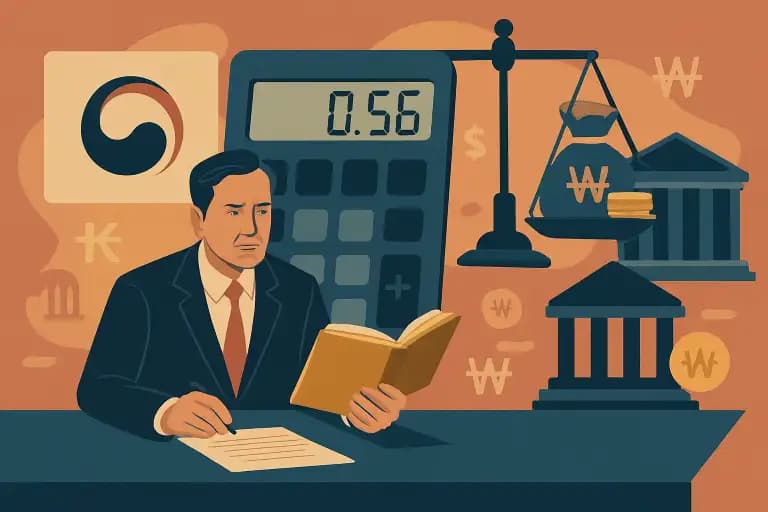
On August 19, during a tense session of the National Assembly’s finance committee, South Korea’s finance minister was asked a simple question about the domestic stock market. He paused briefly before responding, “The KOSPI’s price-to-book ratio… about ten, isn’t it?”
The number stunned lawmakers and observers alike. The KOSPI’s PBR has hovered around one for years, often falling below that mark—a signal many analysts cite when calling Korean equities chronically undervalued. A ratio of ten belongs to a different universe altogether, more fantasy than finance.
The minister later clarified he had confused PBR with the price-to-earnings ratio, yet the slip lingered. For critics, it revealed more than a momentary lapse. It symbolized a ministry often accused of seeing the economy primarily through the narrow lens of fiscal spreadsheets, detached from market realities and broader economic currents.
Beneath that moment lies a deeper unease. Over decades, the Ministry of Economy and Finance has amassed extraordinary power: drafting the budget, controlling spending adjustments, producing the statistics that shape public debate, and interpreting constitutional clauses that limit parliament’s ability to amend the government’s fiscal plans. Successive administrations have alternately urged the ministry to spend more or tighten the purse strings, yet in both cases the ministry’s grip on numbers—and on the story those numbers tell—has remained unchallenged.
The PBR slip, then, was not an isolated gaffe. It marked the surface of a system where fiscal authority concentrates in one institution, where statistics often blur rather than illuminate, and where democratic oversight struggles to keep pace with technocratic control.
PBR (Price-to-Book Ratio)
Share price divided by book value per share — shows how the market values a company’s net assets.
Formula: PBR = Price ÷ (Equity ÷ Shares)
Example: Company A has total equity of ₩980B and 100M shares.
→ Book Value per Share = ₩980B ÷ 100M = ₩9,800
→ If the share price is ₩10,000, then PBR = ₩10,000 ÷ ₩9,800 = 1.02×
PER (Price-to-Earnings Ratio)
Share price relative to earnings per share — higher PER often means growth expectations; lower PER can imply value or risk.
Formula: PER = Price ÷ EPS
Example: Company B earned ₩200B this year and has 100M shares.
→ Earnings per Share (EPS) = ₩200B ÷ 100M = ₩2,000
→ If the share price is ₩20,000, then PER = ₩20,000 ÷ ₩2,000 = 10×
ROE (Return on Equity)
Net income divided by equity — measures how efficiently a company uses capital to generate profits.
Formula: ROE = Net Income ÷ Equity
Example: Company C earned ₩120B this year with equity of ₩1T.
→ ROE = ₩120B ÷ ₩1T = 12%
→ This means for every ₩100 of equity, the company made ₩12 in profit.
The Clause That Closed the Door on Parliament
South Korea’s Constitution grants the National Assembly the authority to “review and finalize” the national budget. On paper, this seems straightforward: elected lawmakers examine the government’s fiscal plans, debate priorities, and adjust allocations before granting final approval. But a single clause, Article 57, draws a sharp line through that authority: the legislature “may not increase any budget item or create new items without government consent.”
Successive finance ministries have interpreted this language narrowly. The term “each budget item,” or gak hang in the original text, has been read to mean virtually every line of expenditure within the government’s proposal. Under this interpretation, parliament may cut spending but cannot raise it—even within the same program—unless the ministry agrees. What was intended as a safeguard against runaway deficits has become, in practice, a near-veto over legislative initiative.
Other democracies draw the boundary differently. In the United States, Congress routinely reshapes budget proposals, adding or removing funds across departments before sending the final package to the president. Germany’s Bundestag enjoys similar discretion, limited mainly by constitutional debt brakes rather than ministerial approval. France imposes procedural checks but still allows parliament broader scope to amend spending priorities. Against this backdrop, South Korea stands out for the extent to which a single ministry can block changes proposed by the elected legislature.
Over time, this legal footing has combined with institutional habit to concentrate fiscal authority in the Ministry of Economy and Finance. The same body drafts the budget, controls mid-year spending adjustments, and publishes the official statistics used to judge whether fiscal policy is prudent or reckless. Lawmakers, journalists, and even other ministries rely on these figures when debating policy, leaving the ministry in the unusual position of both participant and referee in national fiscal debates.
This arrangement has weathered both progressive and conservative administrations. When presidents have urged expansionary spending, the ministry has found ways to present the numbers as manageable. When austerity has been the priority, the same tools have framed restraint as unavoidable. The rules have changed little; the story told by the statistics has changed often.
When the Numbers Decide the Narrative
For decades, South Korea’s fiscal debates have turned on a single measure: total government expenditure. Each administration announces its budget with this headline number, and each year the public hears whether spending is rising or falling, whether fiscal policy is bold or restrained. Yet behind this figure lies a choice about what to count as spending at all.
South Korea’s Ministry of Economy and Finance includes in its total expenditure all loan disbursements and equity injections made by the government. This practice diverges sharply from international standards. The OECD, the IMF, and most advanced economies classify such transactions as financial operations, not ordinary spending, since loans are expected to be repaid and equity injections exchange cash for assets rather than consume resources outright.
The difference is not just technical. When the Moon administration called for aggressive fiscal expansion, the ministry raised loan and equity programs sharply, driving the official total expenditure figures upward even though much of the increase would eventually return to government coffers. Under the current administration, reductions in the same programs have allowed officials to claim fiscal tightening, again without changing the underlying trajectory of ordinary spending on public services or social programs.
Critics see in this a kind of statistical theater: the same tools that inflate the apparent size of the budget one year can deflate it the next, depending on political priorities. International comparisons become difficult when Korea’s headline spending numbers include categories other countries omit. Domestic debates become skewed when shifts in loans or equity obscure trends in actual consumption spending and social investment.
The ministry defends its approach as consistent with Korean accounting conventions and long-standing practice. Yet the effect is undeniable: by controlling what counts as spending, the ministry controls the story told about fiscal policy itself. Journalists covering annual budget announcements often have little choice but to use the official totals, reinforcing the ministry’s framing even when the underlying economic reality is more complex.
Promises, Shortfalls, and the Budgets We Don’t See
The Ministry of Economy and Finance does not simply count spending; it forecasts the revenues that make it possible. These projections determine how much the government expects to collect in taxes and, by extension, how much room it has to spend. Over the past decade, those forecasts have repeatedly missed their mark—and not by small margins.
In 2021 and 2022, tax revenues came in far above expectations, leaving the government with tens of trillions of won more than projected. By 2023 the pendulum swung the other way: revenues fell short by nearly sixty trillion won, the largest deficit surprise in the country’s fiscal history. In each case, budget plans built on faulty assumptions forced abrupt mid-year adjustments, undermining both economic credibility and the ability to plan long-term priorities.
Some of the shortfalls ended up as unspent funds—so-called underexecution—while others triggered emergency borrowing or spending freezes. Critics argue the pattern reflects a forecasting process too closely tied to the ministry itself. Independent fiscal councils in other countries, such as the United Kingdom’s Office for Budget Responsibility or the U.S. Congressional Budget Office, produce projections without direct political control, offering parliaments and the public a neutral baseline for debate. Korea has no such body, leaving the ministry as both forecaster and decision-maker.
The opacity does not end there. Beyond the main budget lie dozens of special accounts and earmarked funds, many created for specific policy goals but collectively accounting for a growing share of public spending. These off-budget mechanisms often escape the same scrutiny applied to the central government’s accounts, complicating any clear picture of the nation’s fiscal stance.
Adding to the complexity, successive administrations have expanded the use of exemptions from preliminary feasibility studies—rules designed to prevent politically motivated projects from bypassing cost-benefit analysis. Trillions of won in infrastructure and regional development spending have proceeded under such waivers, often concentrated around election cycles. Economists warn that these exemptions weaken fiscal discipline precisely when demographic and economic trends demand greater efficiency.
Taken together, erratic forecasts, opaque funds, and discretionary exemptions leave Korea’s fiscal system looking less like a single, coherent plan and more like a patchwork managed by a single ministry with limited external checks.
Technocrats Without a North Star
Finance ministries everywhere face criticism for conservatism; cautious budgeting is, after all, part of their mandate. But in Seoul, observers say the Ministry of Economy and Finance has come to embody a deeper problem: power without a clear philosophy to guide it.
Ministers have come and gone, often arriving from within the same bureaucracy they are meant to lead. Each administration inherits a team of senior officials steeped in the ministry’s technical routines—revenue projections, debt ratios, budget ceilings—but rarely in open debate about economic strategy. As one former adviser put it, “They know the spreadsheets cold, but the spreadsheets have become the strategy.”
The result has been policy defined less by long-term vision than by the logic of control. When presidents demanded expansionary budgets, the ministry complied by inflating loan and equity programs rather than fundamentally rethinking spending priorities. When fiscal tightening became the order of the day, the same methods worked in reverse. Through it all, the underlying questions—what kind of economy Korea should build, how to adapt to aging demographics, how to balance growth with equity—remained largely outside the ministry’s frame.
Critics inside government describe a culture where risk aversion dominates and inter-ministerial coordination often breaks down. Welfare ministries complain of rigid ceilings imposed without serious dialogue about social needs. Infrastructure agencies cite sudden funding cuts driven by revenue surprises rather than project timelines. The PBR misstep by the finance minister earlier this year became, for many, a symbol of this disconnect: a ministry so focused on fiscal arithmetic that it can appear tone-deaf to the economic realities those numbers are meant to serve.
Other countries have moved to counter similar tendencies. New Zealand shifted to performance-based budgeting in the 1990s, tying spending to measurable outcomes rather than rigid inputs. The United Kingdom created independent fiscal councils and cross-departmental strategy units to dilute any single ministry’s dominance. By contrast, Korea’s system has remained largely intact since the era of rapid industrialization, even as the economy it governs has transformed beyond recognition.
Sharing the Ledger
No single event triggered the debate over fiscal power in South Korea. It has built over years of revenue surprises, off-budget growth, rising public debt, and an aging population that will demand more from the state even as the tax base shrinks. At the center sits the Ministry of Economy and Finance, an institution whose command of numbers has given it unrivaled influence over both budgets and the story told about them.
Reform would not mean weakening the state’s capacity to manage its finances. It would mean dispersing authority so that fiscal choices rest on broader debate and clearer rules rather than administrative habit. Lawmakers across party lines have already proposed giving the National Assembly limited power to reallocate funds within programs, reducing the ministry’s veto while keeping overall ceilings intact. Economists have called for an independent fiscal council to take over revenue forecasting, removing the conflict of interest inherent in letting the same body both predict and spend.
International practice offers other lessons. Germany’s constitutional “debt brake” ties fiscal policy to transparent, predictable limits while allowing flexibility in recessions. Britain’s Office for Budget Responsibility forces the government to confront independent forecasts before presenting any budget. New Zealand’s performance-based budgeting requires ministries to defend not just how much they spend but what results they deliver.
In Korea, similar reforms would not resolve every controversy over public spending. But they would make the trade-offs harder to obscure. A parliament empowered to reallocate, a statistics system aligned with international norms, revenue forecasts checked by independent experts, and fiscal rules debated in public rather than enforced by precedent—together, these would shift power from the spreadsheets back toward democratic institutions.
The PBR remark that opened this debate will soon fade from memory. The deeper question is whether the system it exposed—technocratic, centralized, and often opaque—remains fit for an economy facing low growth, rising inequality, and fiscal pressures without modern precedent. South Korea’s prosperity has long relied on competent administration. Its future may depend just as much on accountable administration.
Continue this reporting
Reporting on the same issue
Related coverage selected from the article's desk, topics and newsroom relationships.
 NewsSep 24, 2026
Taiwan’s AI Boom Is Surging, but Wealth Follows a Different Map
Taiwan’s semiconductor boom is lifting output and incomes at extraordinary sp...
 NewsSep 10, 2026
Busan Records 1.3 Percent Unemployment as Male and Female Employment Diverge
Busan’s 1.3 percent unemployment rate reflects real job growth, but not a bro...
 NewsSep 4, 2026
Korea Moves Deeper Into the Global Market for Long-Term Capital
Japanese yields are rising, Korean bonds are entering the WGBI and American p...
More from the author
More from this byline
Stay with the same line of reporting through more work from this byline.
 NewsOct 9, 2026
Why “Busan Is Good” Falls Short as a City Brand
 NewsSep 18, 2026
The Other AI Race Is for the Freedom to Change Course
Reader Signal
Community readWhat did this report leave you with?
Choose the signal that best reflects your reading. Select it again to remove it.
One response per article
No response selected
A moderated conversation about the reporting.
One-level replies and newsroom moderation keep the conversation anchored to this article.
Discussion Status
Open
Please sign in to join the discussion.
Newsletter
Weekly reporting and context from Busan and Korea.