Why Busan’s New Subway Kept Breaking the Ground
A string of collapses along the Sasang–Hadan Line reveals a project pushed through fragile ground with incomplete cutoff, improvised sequencing, and oversight too fragmented to detect the warnings forming beneath the surface.

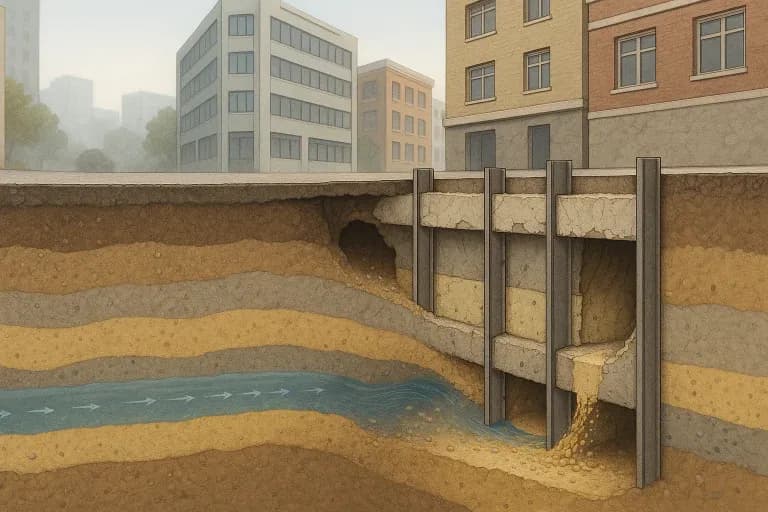
Busan, South Korea — The first collapse on Saebyeok-ro in early 2023 was hardly dramatic—an oval depression that swallowed a small piece of asphalt at an intersection where buses turned sluggishly and market trucks idled while vendors unloaded boxes of produce. Crews arrived before sunrise, closed one lane, and filled the void before commuters noticed anything unusual. Yet the geometry of the depression—its clean inward roll, the way the pavement sank rather than tore—hinted at subsurface movement rather than surface breakage.
Saebyeok-ro is a narrow corridor lined with decades-old sewer laterals, storm drains patched across multiple administrations, telecom conduits installed under different regulatory regimes, and forgotten pipes that exist only in the edges of outdated plans. Engineers familiar with Busan’s alluvial southwest know this landscape: loose silty sand above saturated clay pockets, the groundwater table barely a meter below the surface, utility trenches backfilled in pieces over generations. On paper, the area was never ideal for deep excavation. But the Sasang–Hadan Line—Busan’s newest subway extension—was drawn straight through it.
The first collapse was officially attributed to aging utilities, a familiar explanation in districts where buried infrastructure has long exceeded its design life. That interpretation did not survive the year. Two more depressions formed during the summer monsoon, then several in the dry season, all within roughly 900 meters of the same work zone and most of them near excavation fronts or newly built retaining walls. By late 2024, Saebyeok-ro had become a corridor of repeating subsidence, each incident harder to rationalize as an isolated failure.
The city’s audit office opened an investigation in 2024 and traced much of the problem to deteriorated sewers and rainfall infiltration. Field logs from the site, however, told a sharper story: sediment-laden water pumped from behind retaining walls, groundwater inflow appearing earlier than design assumptions suggested, and changes in the excavation sequence that never passed through formal approval. Some days were documented in meticulous detail; others left almost no record at all.
A second audit, completed in 2025 after a dozen confirmed collapses, shifted the narrative away from aging pipes and toward construction-induced destabilization. Investigators identified unapproved design changes, excavation advancing before groundwater cutoff was installed, incomplete grout curtains and stretches of SGR (soil grouting reinforcement) carried out without a functioning barrier. Under traffic pressure and utility interference, the project created conditions in which water could move freely through the soil mass behind the retaining walls, taking fine particles with it.
The underlying geology made that margin for error unusually small. The corridor sits on the edge of the Nakdong Delta, where borehole logs describe alternating thin layers of silty sand, soft clay and loose deposits with blow counts low enough to be classified as “very loose.” Groundwater stayed close to the surface year-round. In such ground, even a modest hydraulic gradient can trigger internal erosion unless a continuous cutoff is installed before soil is removed.
Project documents show that this requirement was clearly understood in the design phase. The intersections along Saebyeok-ro were supposed to be protected by continuous walls of overlapped CIP piles, with traffic rerouted long enough to install the cutoff. In practice, the market intersection could not be closed without paralyzing a key junction, and the space beneath the pavement was already occupied by storm drains, sewer mains, telecom ducts and medium-voltage power lines. As drilling rigs met these obstacles, the field team proposed an alternative: H-piles and an earth-retention wall supported by SGR injections, a method that reduced surface disruption but left no room for improvisation in its sequencing.
The problem was not the method itself; SGR is routinely used in dense urban environments. The problem was that the method was altered on-site. The audit found that in at least eight collapse locations, excavation proceeded before the cutoff had been installed. In some areas, the SGR injection was attempted laterally across a water-bearing layer without first establishing the vertical barrier necessary to control hydraulic flow. When the drilling rigs encountered underground utilities, the injection pattern was shifted, thinned, or abandoned entirely. None of these changes went through the formal review process required for design modifications.
Once excavation began in these modified zones, the behavior of the soil followed a predictable pattern familiar to geotechnical specialists: water found the weakest point behind the retaining wall, created a narrow seepage path, and carried out fine silty particles. The migration was initially too small to register at the surface. But behind the wall, the soil was gradually losing density, producing subtle voids that expanded as the excavation progressed.
Instrumentation—if consistently recorded—would have provided early warning. But several tiltmeters and piezometers went offline during construction, while others produced readings out of sequence or missing intervals. The audit notes these inconsistencies but stops short of assigning intent, stating only that construction supervision failed to verify instrument integrity. Where data did survive, it showed increasing water pressure behind the walls and micro-settlements occurring weeks before some collapses. The pattern was visible in retrospect but not acted upon in real time.
One entry in a 2024 field log describes “persistent inflow with suspended particles” at a location where the surface remained stable for nearly two months before collapsing. Another mentions “unexpected loss of drilling fluid,” a sign that the soil had already begun to shift. These warnings were recorded, filed, and apparently forgotten—subsumed by the pace of construction, the constraints of maintaining traffic flow, and the project’s pressure to recover lost time.
By 2025, the collapses had become difficult to interpret as anything other than a systemic failure of groundwater management. The audit documented cases where SGR injection was attempted after excavation rather than before, under the assumption that the soil could be stabilized retroactively. Yet in saturated alluvial environments, groundwater does not wait. Once a hydraulic path forms, it tends to expand, eroding the soil matrix grain by grain until a cavity reaches the surface. When that happens, the collapse appears sudden, but it is merely the final stage of a process that may have been underway for weeks or months.
By this point, the narrative surrounding Saebyeok-ro had shifted from happenstance deterioration to a deeper question: How did a major urban construction project proceed through one of the most geotechnically sensitive corridors in the city with such inconsistent control over water, soil, and design sequencing? And why did the ground continue to fail long after early warning signs had appeared in the daily field notes?
The Engineering Decisions That Altered the Ground
The engineering sequence approved for the Saebyeok-ro segment assumed a level of control that the corridor never offered. Planning documents present the section as a clean progression—utilities relocated before excavation, traffic shifted to clear equipment space, and a continuous groundwater cutoff in place ahead of soil removal. But the corridor’s actual conditions—its narrow width, constant traffic pressure, and dense, irregular utility crossings—forced a series of field adjustments. Those adjustments, minor in isolation, accumulated until they altered the subsurface environment more than the design ever anticipated.
One of the earliest deviations occurred where the road narrowed near Saebyeok Market. The original design called for overlapped CIP piles forming a continuous wall, a method favored when groundwater levels are high and soil conditions are loose. CIP construction requires predictable drilling space and enough room for reinforcement cages to be lowered cleanly. But excavators encountered a maze of shallow utilities that had never been relocated—some undocumented, others installed decades earlier under different mapping standards. Construction teams found that the drilling rigs could not achieve alignment without disrupting traffic lanes that the city had insisted remain open.
The workaround was to substitute the CIP wall with an H-pile and earth-retention system reinforced laterally with SGR injections. The alternative method had its merits: faster installation, less surface disruption, and fewer conflicts with shallow utilities. But it demanded strict sequencing—cutoff first, excavation second, no exceptions. Once excavation begins without an established cutoff, the hydrostatic gradient across the wall can reverse rapidly, drawing in water from the surrounding soil. The design review committee would have evaluated the substitution had it been formally submitted, but according to audit records, the change was handled at the field-supervision level and approved only internally within the construction management team.
From that moment, the sequence changed incrementally but significantly. H-piles went in quickly, but the SGR curtain fell behind schedule. In several locations, the injection rigs could not reach their target depths because telecom conduits occupied the alignment. In others, storm drains blocked the drill path, forcing the team to create irregular injection patterns that left thin zones where groundwater could slip through. None of these deviations appeared in the formal daily reports; they survive only in marginal notes added by field engineers and in the audit’s reconstruction of events.
Groundwater conditions, meanwhile, grew more unstable. Once the retaining walls were exposed, water began seeping through joints where cutoff installation was incomplete. Crews pumped continuously, and in some logs the water is described as “clouded” or “brownish,” a sign of suspended particles. Engineers use that description as an early indicator that the soil mass behind the wall is losing fines, even if settlement has not yet appeared at the surface. The notes—some handwritten, others typed hastily—suggest that individual engineers recognized the trend but lacked the authority to halt excavation.
Pressure to maintain progress intensified in early 2024. Delays in utility relocation created constraints upstream, and city officials grew increasingly concerned about traffic disruptions. Meetings between the transit authority and the construction teams referenced “schedule recovery,” “surface impact minimization,” and “adaptive sequencing”—language that, in practice, often translates to accelerating excavation before support systems are fully in place. In one instance documented in the audit, a field supervisor authorized soil removal after a partial cutoff was installed, intending to complete the SGR curtain concurrently with the excavation. That decision, taken to regain lost time, would later align precisely with one of the collapse locations.
The engineering risks of this choice were not abstract. In saturated alluvial soils, excavation in front of an incomplete cutoff initiates a predictable chain of events: groundwater finds the unsealed portion, flows toward the excavation, and carries fine particles with it. The soil behind the retaining wall loses density and begins to settle. Over time, this settlement concentrates along utility trenches and other zones of weakness. Eventually, the surface collapses—but only after weeks or months of internal erosion below.
A veteran geotechnical consultant who reviewed the audit documentation described the sequence as “a classic piping mechanism, with all the textbook triggers present.” The consultant declined to be named due to ongoing work in the region, but their assessment mirrors the audit’s technical analysis. The collapses did not begin at the excavation face; they began behind the cutoff, where water pressure was highest and soil density lowest. Once that mechanism was set in motion, each attempt to stabilize the ground after excavation only added complexity, introducing new grout volumes into a system already compromised by earlier inflow.
Some of the most telling details come from the instrumentation irregularities. Tiltmeters meant to measure retaining-wall deflection recorded values that drifted upward slowly, indicating wall movement consistent with soil loss, but the readings stopped abruptly at several points. Piezometers installed to track groundwater levels registered sudden drops followed by unexplained plateaus—patterns that can suggest instrument failure but are also compatible with the formation of internal drains within the soil. The audit cited the inconsistencies but could not determine whether the gaps resulted from technical malfunction, insufficient maintenance or simple oversight. Regardless of cause, the missing data meant that early warning signs went unrecognized.
One of the clearest examples appears in a sequence of logs from late 2024. Over three weeks, a particular settlement marker showed a downward trend of a few millimeters per day—minor, but unusual given the absence of surface loading. The data was plotted once but not followed up. That same location became the site of a collapse several months later. The audit reconstructs the timeline without assigning individual fault, but the implication is clear: the warning was present, the instruments detected it, but the signal was not acted upon.
By early 2025, the engineering decisions made in the first year of construction had created a landscape where successive collapses were almost inevitable. Each collapse triggered emergency stabilization measures—grout injection, backfill compaction, trench reinforcement—but these interventions addressed only the final symptom, not the underlying mechanism. The groundwater table remained high, the cutoff incomplete in places, and the soil structure weakened by repeated cycles of erosion.
The story of Saebyeok-ro’s failures is often framed as a sequence of isolated events, each with its own explanation. But on the engineering level, the incidents amount to a single pattern: excavation that advanced faster than the support systems designed to protect it. And once the soil began to migrate, the ground beneath the corridor became a system unable to return to equilibrium.
The next question is not merely how the engineering deviated, but how the oversight structure allowed those deviations to become normalized—and why warning signs embedded in the data failed to alter the project’s trajectory.
How Warnings Were Missed, Minimized, or Lost
Oversight on the troubled construction segment did not break in a single dramatic moment; it eroded gradually. The failures accumulated through omissions, delays, untested assumptions, and a diffusion of responsibility across bureaucratic layers where no single authority held full control. A reconstruction of the project’s governance structure shows information moving upward slowly and inconsistently, even as field-level decisions advanced faster than the formal approval process could register or restrain.
The transit authority nominally held supervisory power, supported by a construction management team responsible for verifying compliance with design sequencing. Yet the documents show that much of the day-to-day decision-making occurred within a narrow channel: field supervisors communicating with site engineers under pressure to maintain progress. Daily reports—the primary mechanism for flagging irregularities—varied in detail from meticulous to perfunctory. In several critical weeks leading to the 2024 collapses, the reports include only brief entries noting “routine excavation” or “groundwater manageable,” even as internal notes from the same days record sediment in pumps, minor wall deflection, and partial loss of injection coverage.
The audits later described this discrepancy as “inadequate verification,” but the phrase understates the structural problem. The construction management team had access to the reports but not always to the raw data. Instrument readings were sometimes forwarded only after plotting, meaning anomalies could be smoothed or misinterpreted before supervisors saw them. And once excavation ramps were built, some instruments were physically obstructed by machinery or temporary structures, leaving gaps in the record that the audit could not reconstruct fully.
Several interviews conducted during the audit referenced “operational constraints”—a euphemism for conditions in which field teams could not easily request a work stoppage. Traffic management was one constraint; a halt at the Saebyeok Market intersection would disrupt a vital node linking multiple districts. Another constraint was the pressure to complete each stage of excavation before monsoon season. As the schedules tightened, the authority to pause the work became increasingly ambiguous. Engineers could recommend delays, but only the transit authority could enforce them. The authority, in turn, depended on structured reports rather than informal warnings. When those reports failed to capture the severity of the conditions below ground, the system defaulted toward continuation rather than caution.
One revealing example appears in a correspondence chain from mid-2024. A site engineer submitted a note describing “anomalous inflow” behind a retaining segment and requested inspection before advancing excavation. The message was routed through three layers—field supervisor, construction management representative, and a mid-level official at the transit authority. By the time it reached decision level, the language had been softened to “monitor conditions,” and excavation proceeded. Three months later, the same location subsided.
These slow-moving communication failures were amplified by something more subtle: the normalization of irregularities. As collapses accumulated, the project teams became accustomed to responding to them. Grout crews mobilized quickly, emergency barricades appeared within hours, and surface restorations followed within days. Each incident, once resolved, receded into the background of a project that was already known to be geotechnically challenging. This normalization dulled the urgency that earlier signs might otherwise have carried.
The oversight structure itself made escalation difficult. Responsibility for verifying the completeness of the cutoff was split: the construction management team reviewed the records, the transit authority approved design changes, and field supervisors documented injection patterns. Yet none of these groups had sole accountability for verifying that the cutoff had been installed continuously and in accordance with design assumptions. When the method changed from CIP to H-pile with SGR reinforcement, this fragmentation deepened. The modified method required more oversight, not less, because its success hinged on precise execution. Instead, the change introduced ambiguity—who was responsible for confirming that the injection pattern achieved the intended curtain effect? The audit notes simply: “responsibility was not clearly delineated.”
In technical terms, oversight is strongest when data, authority, and action reside in the same place. On Saebyeok-ro, they were separated. Field engineers possessed the most detailed understanding of the ground but lacked authority to enforce stoppages. Construction management had authority to recommend changes but often lacked full access to raw data. The transit authority had the authority to halt work but depended on reports that filtered out essential details.
This diffusion of responsibility contributed to a crucial pattern: early warnings appeared in logs, in instrument data, in informal messages, and in on-site observations, but they did not converge in a way that compelled action. Instead, they scattered across documents, accumulating quietly until they formed a pattern visible only in hindsight.
One of the clearest examples involves the repeated absence of cutoff verification. Standard practice requires explicit confirmation—signed and logged—before excavation can proceed beyond a designated depth. Yet in multiple locations, excavation advanced in the absence of formal verification. The audit does not describe this as oversight misconduct. Instead, it attributes the issue to “operational pressure and field-level adaptation,” a phrase that leaves open whether these decisions stemmed from necessity, convenience, or a perceived need to avoid delays. Whatever the cause, the effect was the same: excavation proceeded without full assurance that groundwater pathways had been sealed.
Another layer of oversight failure emerged through documentation gaps. In areas where collapses later occurred, photo logs for cutoff installation were incomplete or missing. Injection diagrams were absent from several daily records. In one zone, the only surviving documentation is a sketch added weeks later, likely reconstructed after the fact. These gaps do not imply concealment; they reflect a documentation system strained by pacing, traffic coordination, and reactive problem solving. But in aggregate, the missing details created a vacuum in which neither auditors nor oversight teams could fully understand what had been installed or how thoroughly it had been verified.
The transit authority ultimately acknowledged supervisory shortcomings after the second audit. But its public response focused largely on disciplinary actions—warnings, penalties, internal reforms—rather than on the structural issues revealed by the documents. The audit concluded that oversight teams did not “act upon observed deficiencies,” but the deeper finding, left understated, was that the system lacked a feedback mechanism strong enough to override the momentum of construction once excavation had begun.
By the time collapses continued into early 2025, the oversight structure had not yet adapted. Field teams were still improvising around utility conflicts. Injection patterns remained irregular in several segments. And instrumentation, although nominally restored, still showed inconsistencies. The ground beneath Saebyeok-ro, shaped by decades of urban layering and by the hydrology of the Nakdong Delta, was never a forgiving place to begin with. But the oversight system—fragmented, delayed, and increasingly reactive—allowed early warnings to diffuse rather than concentrate.
The question that follows is unavoidable: if oversight could not stop the collapses, could the city’s infrastructure itself have mitigated them? Or was the ground already predisposed to failure, regardless of the systems built above it?
That brings the investigation to its next layer: the condition of the underground utilities and the role they played—not as the sole cause, but as part of a complex environment where multiple weaknesses interacted until the corridor could no longer hold.
Aging Utilities, Unexpected Conflicts, and the Hidden Risks
The collapses along the affected corridor cannot be explained solely through engineering decisions or oversight failures. The ground itself—what lay beneath the pavement long before excavation began—was a labyrinth of utilities layered over decades, each addition reflecting the regulatory norms of its era and each conflict underscoring how little of the city’s underground is ever fully known.
In the city’s initial statements, aging sewers were cited as a primary catalyst for the early collapses. The explanation was not entirely misplaced. Closed-circuit imagery of main sewer lines shows cracked walls, eroded joints, and intrusion points where tree roots and fine sediment have entered. In several locations, the concrete lining exhibits differential wear, suggesting past leaks that likely contributed to patchwork repairs. But deterioration alone cannot explain why collapses appeared almost exclusively within the subway construction zone. The corridor contains many degraded utilities beyond that footprint, yet subsidence did not occur in areas untouched by excavation.
What complicates the narrative is the condition of the utility trenches themselves. Like many older districts, Saebyeok-ro sits atop backfill that has been disturbed repeatedly—first for sewer installation, later for telecom conduits, then for repairs, replacements, relocations. Each disturbance created a trench that was filled quickly and often inconsistently. Over time, these trenches became preferential pathways for groundwater flow. When hydraulic pressure shifted during excavation, these paths acted like drains, concentrating seepage toward the construction face.
Several collapse sites sit directly above such trenches. The audit’s diagrams illustrate this relationship clearly: voids where soil migrated align with utility runs that had never been sealed or re-compacted to modern standards. The ground surrounding those trenches, already looser than the native soil, yielded more readily when water began mobilizing fines from behind the retaining wall. In this sense, the utilities did not cause the collapses—but they shaped the way collapses unfolded.
Nowhere is this more apparent than at the intersection near Saebyeok Market. Beneath the surface, storm drains from the market stalls connect irregularly to a larger line running east-west. The joint between them, recorded in a 2008 maintenance note as “temporarily reinforced,” appears on camera as a misaligned junction where water bypasses the intended channel. When excavation exposed this system indirectly through changes in groundwater flow, the storm drain acted as a conduit for subsurface movement. Soil erosion did not occur inside the drain but behind it, where it intersected a utility trench filled with loose material. The result was a sinkhole that appeared several meters away from the drain itself, obscuring the relationship for anyone investigating at the surface.
Other utilities presented different challenges. Telecom ducts dating back to the early 2000s lie at shallow depths in several segments, installed at a time when mapping standards were less precise. Their presence obstructed the drilling plan for SGR injection, forcing field teams to adjust patterns to avoid damaging the lines. These adjustments created thin zones in the grout curtain—zones that audit investigators later identified as probable pathways for groundwater migration.
Electric conduits from the regional utility complicate the picture further. In one segment, a medium-voltage line occupies exactly the alignment selected for pile installation in the original design. The relocation of that line was planned but not completed when excavation advanced, resulting in a partial obstruction that altered the geometry of the retaining wall. The wall itself was still functional, but the modified alignment created an asymmetric profile that engineers later connected to uneven groundwater inflow.
The sewer system presents perhaps the clearest example of the city’s underlying vulnerability. Sensors inserted into the sewer mains after the collapses detected suspended sediment in the flow—evidence that fine particles had infiltrated the pipes. This infiltration, however, was not the root cause; rather, it reflected the consequences of soil loss occurring elsewhere. When the soil mass behind the retaining wall destabilized, some of the eroded material found its way into nearby pipes. The pipes did not initiate the collapses; they recorded them.
Yet the classification of sewer deterioration as a “primary cause” in initial city statements set the tone for public interpretation, diverting attention from the more complex interaction among excavation, groundwater, and the city’s layered subsurface. The audits corrected this narrative only partially, describing the sewer conditions as “contributing factors” rather than primary drivers. But even that description understates the structural role of utilities in shaping the ground’s behavior: they served as weak points, as conduits, as boundaries that defined where soil could settle and where voids could propagate.
One utility in particular illustrates this dynamic. A stormwater junction box installed during a 1990s road-widening project contains an abandoned communication duct that penetrates its wall. Under normal conditions, the duct is irrelevant—just another remnant of a previous infrastructure cycle. But when groundwater pressure increased behind the retaining wall, the duct provided a pathway for seepage. The pressure differential drew water toward the junction box, carrying fine sediment with it. Over time, this created a void that migrated upward along the duct’s trajectory until it reached the surface. The collapse appeared in a location far removed from the excavation site, baffling residents who saw no construction activity nearby.
These hidden relationships between utilities and soil behavior were not unknown to specialists. Several internal memos produced before construction began warned of “legacy infrastructure inconsistencies” likely to interfere with cutoff installation and groundwater control. Yet the mapping and verification process fell short. Some utilities were never exposed for confirmation; others were discovered only when they obstructed equipment during drilling. In several cases, the construction management team requested additional time for mapping, but deadlines and traffic pressures prevented extended investigation. The project advanced with partial information, relying on assumptions that the subsurface conditions would align closely enough with the design for deviations to be manageable.
The ground did not cooperate. The alluvial soils, saturated and loosely structured, responded to each disturbance in ways that amplified the weaknesses in the utility network. Where backfill was loose, erosion accelerated. Where abandoned ducts intersected active conduits, groundwater pathways expanded. Where sewer joints were misaligned, inflow intensified. And where injection patterns were thinned to protect telecom lines, the grout curtain lost integrity.
Sinkholes, in this environment, were not singular events. They were convergences—points where structural, hydrological, and historical weaknesses overlapped until the ground could no longer sustain the load above. The subway excavation provided the trigger, but the subsurface maze provided the routes through which the failures spread.
By the time auditors mapped these interdependencies in 2025, the pattern was unmistakable. Yet the existence of this complex underground landscape raised a final, more uncomfortable question—one that neither audit addressed directly: why did the city proceed with a high-risk excavation through one of its least understood subsurface corridors without first resolving or fully mapping the conditions below?
That question leads to the final layer of this investigation: how planning decisions, risk assumptions, and institutional confidence converged to create a project that was vulnerable long before construction began.
How a City Built Its Own Vulnerability
Long before the first retaining wall was drilled, before SGR rigs maneuvered between utility poles and before excavation exposed the ground’s reluctance to stay intact, the Saebyeok-ro corridor had already been quietly primed for failure. The vulnerability was not inherent to the soil alone, nor to the utilities layered within it. It was encoded in the planning assumptions that guided the Sasang–Hadan subway extension—assumptions that, when examined closely, reveal how the project inherited risks that were neither fully acknowledged nor mitigated.
The planning documents for the extension portray Busan as a city confident in its capacity to manage underground space. The reports describe alignment comparisons, cost-benefit analyses, and projected ridership models with the precision expected of a major transit investment. But buried within the thousands of pages of documentation is a subtler pattern: the sections of the line routed through the most geotechnically complex terrain consistently depend on optimistic interpretations of subsurface conditions, even when preliminary investigations indicated the need for extraordinary caution.
The Saebyeok-ro segment is a case in point. Early geotechnical surveys identified the corridor as part of the Nakdong Delta’s alluvial plain, with groundwater levels exceptionally shallow throughout the year. Borehole logs showed loose silty sand and occasional soft clay pockets—conditions that, in typical practice, demand heavy dependence on robust cutoff systems and meticulous sequencing. These findings should have elevated the risk classification for the section. Instead, the project was advanced under Category B risk—considered “manageable with standard mitigation”—a classification that implied disruptions would be localized and predictable.
How this classification survived the internal review process remains unclear. Several engineers involved in the preliminary modeling, who were interviewed by auditors, noted that the delta pattern “should have warranted heightened caution,” but they also acknowledged that no single piece of evidence was catastrophic enough to halt the alignment. In the risk summaries, the corridor’s groundwater challenges were condensed into a single paragraph, its utility density into two lines. The planning framework, as designed, rewarded solutions that minimized cost and construction duration. Elevated risk classification would have triggered more intrusive pre-construction investigations, potential redesigns, and extended utility relocation—all of which carried political and budgetary implications.
This systemic preference for minimal disruption echoed throughout the planning stages. The decision to route the line beneath Saebyeok-ro—rather than adopting a deeper-bore tunnel farther from the utility cluster—was partly financial, partly logistical. A deeper alignment would have required new staging areas and more complex traffic management. A more conservative approach to cutoff installation would have required fully closing intersections for extended durations. The city, balancing the pressures of maintaining daily mobility and advancing long-promised infrastructure, leaned toward a path that maintained surface continuity even as it introduced subsurface complexity.
This planning posture shaped subsequent decisions. When construction teams encountered utility conflicts that prevented full CIP installation, the choice to switch to an H-pile and SGR system fit neatly within the same paradigm: maintain surface traffic, preserve mobility, and adapt the design to the conditions encountered—not by expanding the scope of pre-investigation, but by adjusting the method to the constraints imposed by the street. The project inherited its narrow margins from the planning stage, and those margins grew narrower as field conditions diverged from assumptions.
Institutional confidence also played a role. Busan has constructed dozens of subway sections in challenging terrain, including segments near old riverbeds, reclaimed land, and saturated basins. The city’s experience became part of its rationale—an implicit belief that its engineers had seen similar patterns before and could adapt as needed. Yet past experience, while valuable, became a double-edged sword. It fostered an expectation that deviations could be contained, that groundwater behavior could be managed reactively, and that unexpected soil movement would signal itself clearly enough to allow corrective action.
On Saebyeok-ro, none of these expectations survived contact with the actual ground. The soil moved silently for months before each collapse. Groundwater traveled along old utility trenches and abandoned ducts rather than through the predictable channels modeled in design documents. Partial grouting, rather than stabilizing the subsurface, created differential stiffness that shifted flows elsewhere. The ground’s response was not linear; it was distributed, irregular, and shaped as much by the city’s historical layering as by the project’s engineering choices.
One critical oversight in the planning stage was the absence of a unified subsurface model that integrated utilities, soil behavior, groundwater data, and risk assumptions into a single dataset. Instead, each of these elements was analyzed separately. Utility mapping was conducted largely through existing records, known to be incomplete. Groundwater modeling was performed based on snapshots rather than seasonal monitoring. Soil profiles were drawn from scattered boreholes, some of which were spaced too widely to capture micro-variations characteristic of deltaic deposits. And risk analysis—spread across geotechnical, civil, and planning divisions—never consolidated into one integrated assessment.
This fragmentation was the planning equivalent of the oversight gaps that later emerged during construction. Each group produced competent work within its domain, but no single unit synthesized the information into a comprehensive understanding of how the corridor might behave under excavation. The absence of such synthesis created a blind spot: the system underestimated how small deviations in cutoff installation, sequencing, or groundwater behavior could cascade into broader instability.
Another institutional assumption that shaped the project was the belief that any subsidence emerging during construction would manifest slowly and predictably. The city has decades of experience managing surface settlement during underground works. But sinkholes caused by soil piping—internal erosion initiated by incomplete groundwater control—do not follow the same pattern. They are episodic, sensitive to micro-scale variations, and capable of evolving into collapse without surface precursors. This difference was not fully incorporated into the planning risk models. The conceptual risk framework was based on settlement, not void development. As a result, the project underestimated the consequences of incomplete cutoff installation and the speed with which water could exploit any weakness.
By the time the second audit was released in 2025, the planning assumptions had already been refuted by reality. The audit focused on construction failures, but between the lines lies a more systemic lesson: the vulnerabilities of the Saebyeok-ro corridor were not created by engineering missteps alone; they were embedded from the outset, shaped by a planning structure that underestimated the geotechnical complexity, over-relied on existing records, and assumed adaptability where the ground offered little margin for error.
The implications reach beyond the Sasang–Hadan Line. Busan, like most dense cities with aging underground networks, faces a structural challenge: the administrative separation between the systems that approve major infrastructure projects and the systems that maintain and map existing utilities. The geotechnical conditions beneath Saebyeok-ro were not unusual for the region. What was unusual was the lack of comprehensive subsurface consolidation before committing to a method that required precision, continuity, and full control over groundwater behavior.
The city has since announced reforms—more stringent oversight, new verification protocols, disciplinary actions within the transit authority. These measures may reduce future deviations, but they do not address the deeper issue revealed by the Saebyeok-ro corridor: the city’s infrastructure governance relies on assumptions that no longer match the complexity of its underground environment.
The subway extension will eventually be completed. The surface will be restored, traffic will return, and the corridor will regain its unremarkable appearance. But beneath the street lies a reminder that the ground does not respond to administrative boundaries, to political expedience, or to schedules imposed from above. It responds to pressure, to water, to structure, and to the quiet accumulations of past decisions layered over decades. The collapses on Saebyeok-ro were not a series of accidents. They were the visible expression of a system that moved forward without fully understanding the ground it depended on—until the ground itself forced a reckoning.
Continue this reporting
Reporting on the same issue
Related coverage selected from the article's desk, topics and newsroom relationships.
 NewsOct 16, 2026
What Is Still Worth Going to See?
Busan’s biennale faces questions of artistic judgment and institutional care....
 NewsOct 14, 2026
What Became of Busan’s University Streets?
From 2015 to 2023, registered businesses grew near Pusan National University...
 NewsOct 12, 2026
Bukangi, the Shark That Stayed in Busan’s North Port
A rescue net guided Bukangi toward the sea, but the dusky shark returned to B...
More from the author
More from this byline
Stay with the same line of reporting through more work from this byline.
- NewsOct 14, 2026
What Became of Busan’s University Streets?
 NewsSep 28, 2026
Why Some Commercial Space in Busan Is Hard to Reuse
Reader Signal
Community readWhat did this report leave you with?
Choose the signal that best reflects your reading. Select it again to remove it.
One response per article
No response selected
A moderated conversation about the reporting.
One-level replies and newsroom moderation keep the conversation anchored to this article.
Discussion Status
Open
Please sign in to join the discussion.
Newsletter
Weekly reporting and context from Busan and Korea.