Why Busan Needs a Specialized Maritime Law School and Court
Busan, South Korea - In the heart of South Korea’s maritime industry, a transformation is brewing. Busan, home to one of the world’s busiest ports, is preparing its case to host the nation’s first-ever maritime court. Yet, while the city’s strategic importance as a logistics hub is unquestioned, a critical piece of the puzzle remains missing: a steady pipeline of legal experts equipped to navigate the complexities of maritime law. For Busan to fulfill its ambitions as a global maritime leader, e


Busan, South Korea - In the heart of South Korea’s maritime industry, a transformation is brewing. Busan, home to one of the world’s busiest ports, is preparing its case to host the nation’s first-ever maritime court. Yet, while the city’s strategic importance as a logistics hub is unquestioned, a critical piece of the puzzle remains missing: a steady pipeline of legal experts equipped to navigate the complexities of maritime law. For Busan to fulfill its ambitions as a global maritime leader, establishing a specialized maritime law school at Korea Maritime University (KMU) is not just logical—it is essential.
The current state of maritime legal education in Korea highlights a stark gap. KMU, as the nation’s premier maritime university, provides a strong foundation in maritime law at the undergraduate level through its maritime law department. However, its graduates are forced to pursue legal specialization at generalist law schools in Seoul or other cities. This structural disconnection not only disrupts the continuity of maritime legal training but also undermines the potential for KMU to serve as a national hub for maritime law expertise.
South Korea’s maritime economy is vast, yet its legal infrastructure lags behind. Complex disputes involving shipping contracts, insurance claims, and international arbitration often lead Korean companies to seek recourse in foreign courts, incurring billions in costs each year. The absence of a local maritime court exacerbates this dependency, while the lack of specialized legal training ensures the gap remains.
Globally, maritime powerhouses have long recognized the value of aligning legal education with judicial infrastructure. In London, Queen Mary University’s maritime law programs feed directly into the city’s role as a global arbitration hub. Tulane University in Louisiana, renowned for its LL.M. program in maritime law, has similarly strengthened the United States’ maritime legal framework. Singapore has leveraged its National University’s expertise to position itself as Asia’s leader in maritime arbitration. Even China’s Dalian Maritime University supplies a steady stream of specialists for its network of maritime courts.
Busan, with its unparalleled maritime infrastructure and economic clout, should be no exception. The city handles more than 75% of Korea’s container traffic and ranks among the busiest ports globally. Yet, without a localized pipeline of maritime law professionals, its potential to lead in legal services and arbitration remains untapped.
While Korea Maritime University’s maritime law department lays a strong foundation for undergraduate students, its lack of advanced legal education options forces graduates to pursue their legal studies at generalist law schools elsewhere. This gap in the educational pathway presents significant challenges that undermine both the continuity of maritime legal training and the regional development of Busan as a maritime hub.
The transition from KMU’s specialized maritime law program to generalist law schools often disrupts the focused expertise students develop during their undergraduate studies. Korea’s existing law schools rarely offer comprehensive courses in maritime law, leaving students with limited opportunities to deepen their knowledge in this critical field. This dilution of specialized training not only impacts the quality of maritime legal expertise but also weakens the pipeline of professionals equipped to address the complexities of the industry.
Moreover, the absence of advanced maritime legal education in Busan contributes to a steady talent drain. Graduates from KMU frequently move to Seoul or other regions to pursue legal education, and many do not return to Busan’s maritime sector upon completing their studies. This migration of talent weakens Busan’s efforts to establish itself as a center for maritime legal expertise and diminishes its ability to fully leverage its status as a global port city.
Establishing a maritime law school at KMU would resolve these challenges by creating a seamless educational trajectory from undergraduate to advanced legal studies. Such an institution would retain talent in Busan, fostering a strong pool of legal professionals specialized in maritime law. This would not only support the proposed maritime court but also strengthen the broader maritime industry in the region, creating a synergistic ecosystem that enhances Busan’s position as a global leader in maritime law and logistics.
The proposal to establish a specialized maritime law school at KMU comes at a time when Korea’s regional universities are struggling to stay competitive. The Seoul-centric nature of higher education has not only drained talent from other regions but also stifled innovation and local economic development. By empowering KMU to offer a specialized program, Busan could challenge this imbalance while addressing a critical industry need.
KMU is uniquely positioned to house such a program. As Korea’s premier institution for maritime education, it already boasts the expertise, industry connections, and infrastructure necessary to make a maritime law school a success. The addition of a law school would not only bolster the university’s reputation but also create a symbiotic relationship with the maritime court, reinforcing both institutions’ impact.
This initiative is not just about enhancing Busan’s maritime capabilities; it also addresses systemic issues in Korea’s education system. The country’s university landscape is overwhelmingly Seoul-centric, leaving regional institutions like KMU struggling to compete. By introducing a specialized law school, KMU would not only strengthen its position but also challenge the status quo, offering a model for decentralizing education and fostering regional development. Such a move would align with the government’s broader goals of achieving regional equity and reducing the economic disparities that arise from Seoul’s dominance.
The vision for KMU’s maritime law school extends far beyond traditional legal education. The program would need to include advanced courses on international maritime law, shipping finance, arbitration, and maritime insurance, blending academic rigor with practical applications. Partnerships with global institutions such as Tulane or Queen Mary University could further enhance the school’s reputation and ensure its graduates are prepared for the demands of an increasingly globalized legal landscape. Moreover, by collaborating with local industry stakeholders—shipping companies, insurers, and maritime organizations—KMU could offer hands-on training and job placement opportunities, strengthening the relationship between education and industry.
The economic implications of such a development are profound. By keeping maritime legal cases within Korea, the country could save an estimated 300 billion won annually. Additionally, the establishment of a maritime law school would generate high-value jobs and attract international firms to Busan, solidifying the city’s role as a hub for maritime arbitration and legal services. The ripple effects would extend to the local economy, fostering innovation and creating opportunities for small and medium-sized enterprises in related industries.
Of course, realizing this vision will require legislative and structural reforms. Korea’s current legal framework for law schools focuses on generalist education, making it necessary to revise the Law School Establishment and Operation Act to accommodate specialized programs. This would be a bold but necessary step, one that aligns with the government’s commitment to regional development and economic innovation.
The integration of a maritime law school with the proposed maritime court would create a virtuous cycle, where the court provides real-world cases for educational purposes, and the school supplies the court with a steady stream of highly trained professionals. Such a relationship would not only enhance the court’s functionality but also position Busan as a global center for maritime law and arbitration.
Busan’s bid to host Korea’s first maritime court is an ambitious endeavor, but it cannot succeed in isolation. A dedicated maritime law school at KMU would provide the expertise and talent needed to ensure the court’s success while addressing broader challenges in Korea’s education and economic systems. The question is not whether Busan should pursue this path but how quickly it can bring this vision to life. By investing in specialized education, Busan can secure its place on the global stage, setting a precedent for innovation, equity, and regional development that will resonate far beyond the maritime industry.
Continue this reporting
Reporting on the same issue
Related coverage selected from the article's desk, topics and newsroom relationships.
 NewsOct 16, 2026
What Is Still Worth Going to See?
Busan’s biennale faces questions of artistic judgment and institutional care....
 NewsOct 14, 2026
What Became of Busan’s University Streets?
From 2015 to 2023, registered businesses grew near Pusan National University...
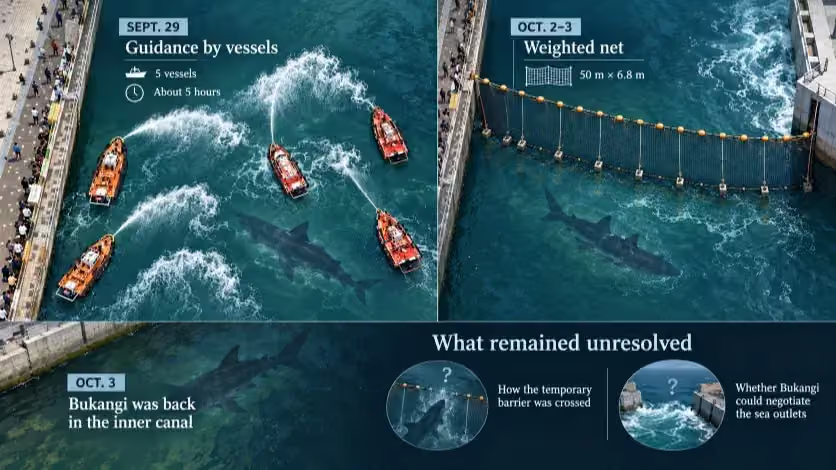 NewsOct 12, 2026
Bukangi, the Shark That Stayed in Busan’s North Port
A rescue net guided Bukangi toward the sea, but the dusky shark returned to B...
More from the author
More from this byline
Stay with the same line of reporting through more work from this byline.
 NewsOct 9, 2026
Why “Busan Is Good” Falls Short as a City Brand
 NewsSep 18, 2026
The Other AI Race Is for the Freedom to Change Course
Reader Signal
Community readWhat did this report leave you with?
Choose the signal that best reflects your reading. Select it again to remove it.
One response per article
No response selected
A moderated conversation about the reporting.
One-level replies and newsroom moderation keep the conversation anchored to this article.
Discussion Status
Open
Please sign in to join the discussion.
Newsletter
Weekly reporting and context from Busan and Korea.