Why Busan Drivers Pay the Highest Toll Road Fees in Korea
Busan drivers face Korea’s highest toll rates. With two tunnels set to go toll-free, pressure mounts to reassess 30-year private road contracts.


Busan, South Korea – In Busan, crossing the city often comes with a financial cost that is increasingly being questioned by both commuters and policy observers. With its mountainous terrain, limited cross-city transit coverage, and vital coastal corridors, Busan depends heavily on a network of bridges and tunnels. Many of these key routes—particularly those connecting the rapidly expanding western districts to the economic centers of the east—are tolled. For years, this has been accepted as a tradeoff: faster infrastructure delivery in exchange for private sector participation. But the long-term implications of this arrangement are now facing scrutiny.
As of 2025, motorists routinely pay between ₩1,000 and ₩1,500 for single crossings of relatively short distances. The Busan Port Bridge, for example, charges ₩1,400 for a 3.3-kilometer span, amounting to ₩424 per kilometer—more than double the national average on privately operated expressways. The Sanseong and Cheonma tunnels, each under four kilometers in length, charge similarly high rates. Even the publicly owned Gwangandaegyo Bridge, often cited as a more affordable alternative, charges ₩1,000 for a 7.4-kilometer crossing, with discounts limited to peak commuting hours.
| Facility Name & Toll Type | Concession Period & Toll |
|---|---|
| Gwangandaegyo Bridge | Public |
| (Public - City-managed) | Ongoing |
| ₩1,000 | |
| Busanhangdaegyo Bridge | Private |
| (Private - BTO) | Until 2044 |
| ₩1,400 | |
| Cheonma Tunnel | Private |
| (Private - BTL) | Until 2049 |
| ₩1,400 | |
| Sanseong Tunnel | Private |
| (Private - BTL) | Until 2048 |
| ₩1,500 | |
| Baekyang Tunnel | Private → Public |
| (Private → Public) | Free from Jan 2025 |
| Free | |
| Sujeongsan Tunnel | Private → Public |
| (Private → Public) | Free from Apr 2027 |
| ₩1,000 |
BTO (Build-Transfer-Operate)
The private sector builds, operates, and maintains the infrastructure, but after a certain period (typically 20-30 years), the infrastructure is transferred to the public sector. This model allows the government to receive the infrastructure after it has been fully constructed and operated, without bearing the initial cost burden.
BTL (Build-Transfer-Lease)
The private sector builds the infrastructure and transfers ownership to the public sector. However, unlike BTO, the private sector continues to operate and lease the infrastructure back to the government for a set number of years. The government pays a lease fee during this period while receiving the service. This model often provides a longer time frame for private sector involvement
The reason behind these high rates lies in the financial structures of the infrastructure itself. Most of Busan’s major toll facilities were built under long-term private concession agreements, many of which include clauses that guarantee revenue to investors or provide compensation when usage falls below projections. These contracts, which often span 30 years or more, were established in a period when public finances were tighter and rapid infrastructure development was a priority. In exchange for up-front private capital, the city agreed to fixed terms that now limit its flexibility to adjust tolls or restructure operations.
These structural constraints are becoming more visible as civic attention shifts toward the cost of living and regional equity. For residents commuting from western areas such as Gangseo to jobs in the eastern districts, tolls can amount to more than ₩50,000 per month, even after modest multi-gate discounts are applied. Busan’s geography already places many workers at a distance from affordable housing, and the added burden of daily tolls is amplifying concerns about inequality and access. Civic organizations, including transportation advocacy groups and neighborhood associations, have begun calling for reviews of the existing system, questioning whether the long-term benefits of these private arrangements still outweigh the costs.
Some changes are beginning to take shape. In January of this year, the Baekyang Tunnel—previously operated under a private contract—was transferred to full public management after its 25-year concession ended. Tolls were eliminated immediately, and city officials report that traffic through the corridor rose by more than 40% in the first month. This week, the city announced that the Sujeongsan Tunnel will follow a similar path. Starting April 19, 2027, the tunnel will become toll-free following the end of its own 25-year private operation. The decision was made after a policy review involving the Busan Institute of Urban Planning and Public Investment and was approved by the city council. Daily operations will be transferred to the Busan Facilities Corporation, while safety oversight will remain under the city’s Infrastructure Safety Office.
The transition of these tunnels marks a policy turning point, even if a quiet one. Instead of seeking new private operators or renegotiating existing toll contracts, the city is allowing the original concessions to expire and is assuming direct control of the infrastructure. For now, this approach avoids the legal and financial complexities of early contract termination, which would likely require significant public funding and creditor consent. Still, it represents a shift in tone: from defending high tolls as necessary for infrastructure development to exploring gradual public integration.
In the meantime, city officials have introduced incremental measures to address growing public concern. These include time-of-day discounts, toll exemptions on major holidays, and pilot programs for smart tolling systems designed to improve traffic flow. However, critics argue that these efforts do little to address the underlying cost structure or the broader equity implications. The fact remains that most of Busan’s key toll routes—including the Busan Port Bridge and the Sanseong and Cheonma tunnels—will remain under private management well into the 2040s. Without structural reform or financial restructuring, the prospects for near-term toll relief remain limited.
There are signs that the administration is at least examining the options. Internal discussions are reportedly underway to evaluate whether refinancing older contracts could free up room for partial toll reductions. Proposals have circulated among city council members to explore income-adjusted pricing or integrate bridge and tunnel tolling into a unified fare system. No legislation has yet been introduced, and such reforms would likely require coordinated support from both city and provincial governments.
What has changed most in recent months may not be the toll rates themselves, but the level of public engagement with them. Where once tolls were viewed as an unavoidable aspect of urban commuting, they are now part of a broader conversation about mobility, fairness, and the future of urban infrastructure. Petitions have gained traction, radio and social media discourse has sharpened, and citizens are beginning to challenge the idea that price should determine access to one’s own city.
Busan’s leaders are not yet promising a toll-free future. But with two major tunnels now moving to public operation and a growing recognition that tolls are more than just a fiscal instrument—they are a political and social issue—there is a sense that change is not only possible, but already underway.
Continue this reporting
Reporting on the same issue
Related coverage selected from the article's desk, topics and newsroom relationships.
 NewsOct 16, 2026
What Is Still Worth Going to See?
Busan’s biennale faces questions of artistic judgment and institutional care....
 NewsOct 14, 2026
What Became of Busan’s University Streets?
From 2015 to 2023, registered businesses grew near Pusan National University...
 NewsOct 12, 2026
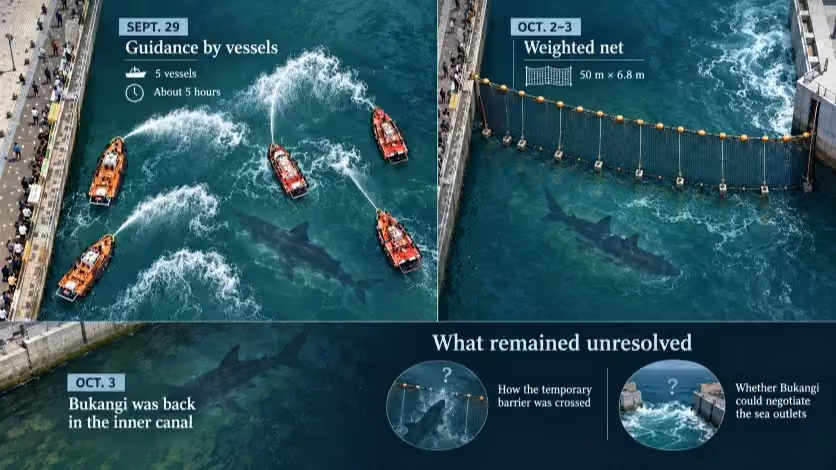
Bukangi, the Shark That Stayed in Busan’s North Port
A rescue net guided Bukangi toward the sea, but the dusky shark returned to B...
More from the author
More from this byline
Stay with the same line of reporting through more work from this byline.
- NewsOct 14, 2026
What Became of Busan’s University Streets?
 NewsSep 28, 2026
Why Some Commercial Space in Busan Is Hard to Reuse
Reader Signal
Community readWhat did this report leave you with?
Choose the signal that best reflects your reading. Select it again to remove it.
One response per article
No response selected
A moderated conversation about the reporting.
One-level replies and newsroom moderation keep the conversation anchored to this article.
Discussion Status
Open
Please sign in to join the discussion.
Newsletter
Weekly reporting and context from Busan and Korea.