Unsold Housing Rises in Busan Amid Construction Sector Strain
South Korea’s unsold housing inventory has reached a post-2013 high, with regional cities like Busan seeing rising vacancy rates. Experts warn that government interventions may prove insufficient without deeper demand recovery.

Busan, South Korea — Busan is facing a deepening imbalance in its housing market. Despite ongoing development across its urban corridors, the city is experiencing a sharp rise in unsold apartment units—many of which are already completed and sitting vacant.
According to the Ministry of Land, Infrastructure and Transport, as of the end of February 2025, South Korea’s nationwide inventory of “malignant unsold” housing—units that remain unsold even after completion—rose to 23,722. That figure marks a 99.9 percent increase year-on-year and the highest level recorded in over 11 years, since September 2013. The vast majority—80.8 percent—of this inventory is concentrated outside the greater Seoul area, with regional cities bearing the brunt of the oversupply.
Among them, Daegu leads with 3,067 post-completion unsold homes, followed by Gyeongbuk (2,502), Gyeongnam (2,459), Jeonnam (2,401), and Busan (2,261). In relative terms, Ulsan recorded the highest year-on-year increase at 312.9 percent, underscoring the steep acceleration of the crisis in non-metropolitan regions. While the Seoul metropolitan area also saw growth—particularly in Gyeonggi (2,212) and Incheon (1,679)—the overall trend indicates a much faster accumulation of inventory in regional markets.
In Busan, the signs are increasingly visible. Across districts such as Gijang and Suyeong, newly built apartment blocks stand largely vacant. Builders face mounting pressure as unsold units delay final payments, freeze cash flow, and in some cases, lead to suspended operations. Construction orders in Busan dropped 71.6 percent year-on-year in February—more than any other major city—while construction sector employment has declined for ten consecutive months.
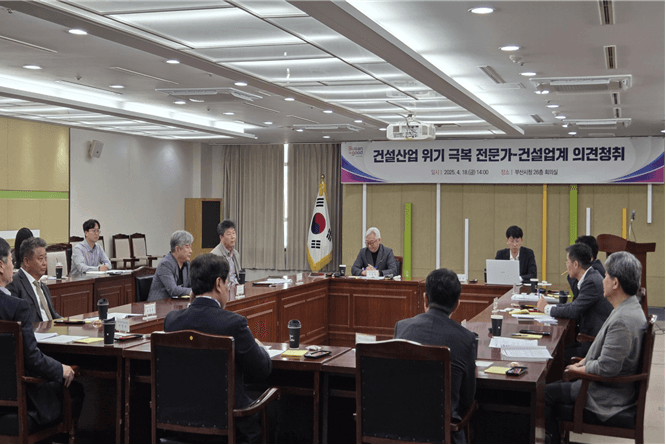
In response, the Busan Metropolitan Government convened a policy roundtable on April 18, bringing together housing policy researchers, academics, public sector financiers, and private sector contractors. While no formal measures were adopted, city officials said the session was the beginning of a broader recovery dialogue. Recommendations included increasing the scale of public-sector construction, streamlining the tendering and approval process, and reassessing the cost benchmarks for public projects. Builders, meanwhile, pushed for earlier project initiations and realistic price adjustments to account for rising material and labor costs.
“Project delays and payment bottlenecks are squeezing smaller firms the hardest,” said one contractor who attended the session. “Without swift intervention, we’re going to see insolvency issues multiply.”
At the national level, the government has moved to respond. The Korea Land and Housing Corporation (LH) plans to purchase 3,000 completed unsold units, focusing on regional markets. Additional measures include interest rate discounts for first-time homebuyers through the Didimdol Loan program and the planned launch of corporate restructuring real estate investment trusts (CR REITs) to manage surplus units in the first half of this year.
Yet observers caution that these measures may prove insufficient given the scale and structural nature of the oversupply. Many of the affected units are not located in high-demand districts and often lack the infrastructure or transportation access that attracts stable buyer interest. As one senior analyst noted, “Without a recalibration of where and how we build, supply-side interventions may only delay—not resolve—the underlying imbalance in regional housing markets.”
Indeed, much of the unsold inventory stems not from overbuilding alone, but from a mismatch between available units and real demand. Many of the vacant units fall into the mid-size category—60 to 85 square meters—which have become unaffordable for local buyers due to high land costs, elevated interest rates, and waning investor confidence. In this climate, even previously stable sales models have become precarious.
Despite the policy responses and local consultations, stakeholders remain cautious. The backlog of unsold units is substantial, and confidence in the short-term efficacy of interventions remains low. While government programs may prevent the crisis from worsening in the immediate term, most observers agree that structural correction—not temporary liquidity—is needed to restore balance to the market.
As development continues in certain high-profile districts, a growing number of towers now remain dark at night—built, but empty. In Busan and beyond, these ghost homes stand as a quiet signal that the country’s housing model may be overdue for reconsideration.
Continue this reporting
Reporting on the same issue
Related coverage selected from the article's desk, topics and newsroom relationships.
 NewsOct 16, 2026
What Is Still Worth Going to See?
Busan’s biennale faces questions of artistic judgment and institutional care....
 NewsOct 14, 2026
What Became of Busan’s University Streets?
From 2015 to 2023, registered businesses grew near Pusan National University...
 NewsOct 12, 2026
Bukangi, the Shark That Stayed in Busan’s North Port
A rescue net guided Bukangi toward the sea, but the dusky shark returned to B...
More from the author
More from this byline
Stay with the same line of reporting through more work from this byline.
 NewsOct 9, 2026
Why “Busan Is Good” Falls Short as a City Brand
 NewsSep 18, 2026
The Other AI Race Is for the Freedom to Change Course
Reader Signal
Community readWhat did this report leave you with?
Choose the signal that best reflects your reading. Select it again to remove it.
One response per article
No response selected
A moderated conversation about the reporting.
One-level replies and newsroom moderation keep the conversation anchored to this article.
Discussion Status
Open
Please sign in to join the discussion.
Newsletter
Weekly reporting and context from Busan and Korea.