The Politics of Banners in Busan Becomes a Battle for the Skyline
Across South Korea’s southern coast, thousands of political banners drape the city of Busan. What began as expression has turned into pollution — and a test of how democracy occupies public space.

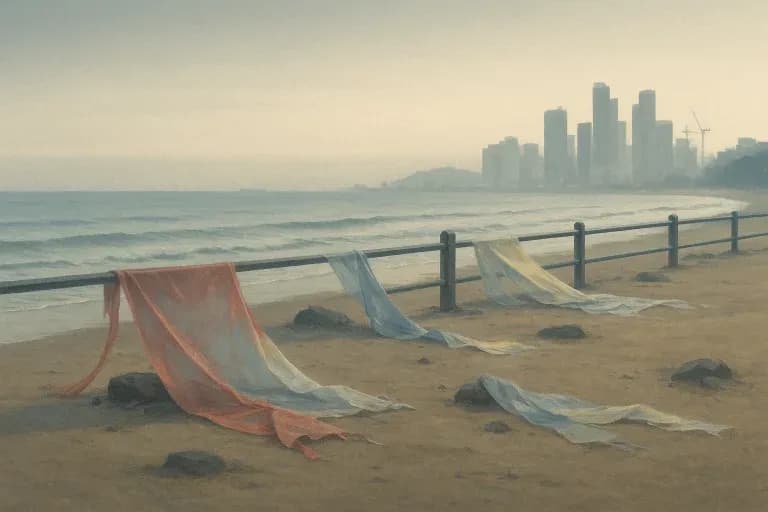
Busan, South Korea — The sea view in Busan is rarely unobstructed. Between the mirrored towers of Haeundae and the sweeping curve of Gwangalli Beach, the city’s lampposts and railings are draped with vinyl banners—faces of politicians, fragments of slogans, half-kept promises. For residents, the sight has become as constant, and as wearying, as the wind coming off the water.
Over the past five years, the number of banners fluttering across Busan’s major roads and beaches has multiplied. Municipal records confirm that every district now operates dozens of officially designated “banner stands” to manage the overflow. According to South Korea’s national open data portal, Busan’s 16 districts together maintain over 2,800 authorized stands, yet the banners that appear illegally — tied to guardrails, trees, or pedestrian bridges — number several times that.
The problem is visible, literal, and political. Local authorities remove thousands every month; within days, they return. The endless cycle has led Busan City Hall to label certain tourist areas “clean corridors,” zones where no banners at all— political, commercial, or administrative — may be displayed. The city’s motivation is pragmatic: banners have become not a form of communication, but a form of clutter.
South Korea regulates outdoor advertising under the Act on the Management of Outdoor Advertisements and Promotion of Outdoor Advertising Industry. The law defines banners as temporary displays that must be placed on authorized structures and removed within a fixed period. Municipal governments, including Busan’s, maintain databases of these locations and issue permits.
But political banners inhabit a gray zone. The Public Official Election Act restricts campaign materials during election periods, while the Outdoor Advertising Act governs general postings. Between these laws lies a loophole: outside official campaign seasons, banners that include “policy promotion,” “holiday greetings,” or “public service messages” are considered permissible expressions.
This ambiguity allows near-constant visibility. Party offices and local representatives post banners year-round, often under the justification of “communication with constituents.” For district officials tasked with enforcement, this means a perpetual cycle of installation and removal. “We take them down, and by the next morning, they’re back,” said one Busan district officer in a 2024 Nocut News report.
Busan’s city government acknowledges the futility. In its 2024 Outdoor Advertisement Management Plan, the city called the current system “unsustainable without legal clarity” and urged national revisions to distinguish between legitimate political communication and visual pollution.
At the heart of the issue is not defiance but ambiguity. Political expression is constitutionally protected in South Korea, and courts have historically ruled in favor of speech when aesthetics collide with rights. In several rulings — including a 2024 case in Ulsan — judges sided with political parties, arguing that banners conveying policy information or greetings fall under free expression rather than campaigning.
For local administrators, the consequence is paralysis. They can remove illegal commercial ads within hours but must hesitate when a banner bears a party logo. As a result, enforcement becomes selective and inconsistent, undermining both the rule of law and public trust.
Critics argue that this inconsistency has eroded the line between communication and propaganda. What once served as a medium for voter information has turned into a permanent display of presence — an unending visual assertion of identity.
The Hidden Cost of Visibility
The physical reality of these banners is far from benign. Most are made from polyvinyl chloride (PVC)-coated polyester, a petroleum-based fabric resistant to decomposition. When incinerated, PVC releases hydrogen chloride and other toxic compounds. The Ministry of Environment classifies such materials as non-recyclable waste, except in small experimental cases involving mechanical separation.
During national and local elections, the scale becomes staggering. According to nationwide waste statistics, thousands of tons of PVC banner waste are collected each year during campaign periods. The Korea Environment Corporation (KECO) estimates that processing this waste requires significant energy and produces measurable carbon emissions.
In Busan, the cost is literal. District budget reports for 2023 and 2024 show recurring line items under “illegal outdoor advertisement removal.” Officials confirm that these expenses — covering collection, transport, and disposal — often exceed tens of millions of won annually per district. None of this is reimbursed by political parties or candidates.
The economic asymmetry is glaring: visibility benefits are private, while cleanup costs are public. Civic organizations such as Green Korea have called for amending national law to assign disposal responsibility to the originating political entity, a principle known internationally as polluter pays.
Even beyond the plastic and the cost, the message itself has thinned. The language of political banners has grown so repetitive and generic that it has lost communicative value. Academic research from communication scholars at major Korean universities — including Pusan National University and Seoul National University — has documented a trend toward “semantic saturation” in political messaging: words such as “hope,” “trust,” and “together” appear so frequently that they no longer convey information.
Analysis of banner text samples collected during the 2022 local elections found that the majority contained no policy-related content, focusing instead on emotional or moral appeal. This shift reflects a larger phenomenon in Korean local politics, where name recognition often outweighs substantive debate.
From a communication ethics perspective, the banner has devolved into a symbolic gesture — a performance of engagement without dialogue. Political scientists warn that this overexposure, rather than increasing transparency, can lead to apathy and distrust.
Clearing the View
In late 2024, Busan began implementing its clean corridor initiative, an urban policy that designates high-traffic tourist zones as banner-free areas. The 1.5-kilometer coastal stretch along Gwangalli Beach was the first to be cleared, followed by the entrances to Haeundae, Songdo, and Dadaepo beaches.
City officials justified the move on environmental and economic grounds, noting that tourism satisfaction surveys had shown a link between visual cleanliness and visitor experience. By mid-2025, public opinion surveys conducted by Busan City Hall indicated majority support for expanding the initiative.
However, the policy’s reach remains limited. It covers only selected zones, leaving residential and commercial districts outside its jurisdiction. Without national legal reform, the city cannot compel political actors to comply elsewhere. The banners, like the politics they represent, simply migrate to the next available pole.
At its core, Busan’s banner problem is a question of visibility — who has it, who pays for it, and what it means. Political presence has become physical, measured in square meters of plastic. For local politicians, the incentive is structural: visibility equals legitimacy. But in an environment already saturated with media, this analog race for attention feels increasingly outdated.
Urban planners and civic designers propose a different model: digital transparency. Rather than banners, candidates could be allocated digital space on municipal websites or interactive boards in public offices, reducing waste while maintaining communication. The Ministry of Environment has begun funding research into biodegradable alternatives, though large-scale adoption remains distant.
Ultimately, the question extends beyond policy. It asks what kind of democracy Busan — and South Korea at large — wishes to see. If political communication depends on physical dominance of space, then the line between participation and pollution will continue to blur.
When the banners were removed from Haeundae’s beachfront last summer, the effect was immediate. The skyline seemed brighter, cleaner — less argumentative. Residents posted photos online, describing the change not as silence but as relief. For the first time in years, the city’s public spaces felt public again.
Busan’s attempt to regulate political banners is neither censorship nor cosmetic policy. It is an experiment in redefining communication: a reminder that democracy’s strength lies not in how loudly it speaks, but in how clearly it is heard.
As the next election season approaches, one question remains for policymakers and citizens alike — whether the nation can build a culture of political expression that respects both freedom and the shared spaces where it unfolds.
Because when every surface becomes a stage, even democracy risks becoming background noise.
Continue this reporting
Reporting on the same issue
Related coverage selected from the article's desk, topics and newsroom relationships.
 NewsOct 16, 2026
What Is Still Worth Going to See?
Busan’s biennale faces questions of artistic judgment and institutional care....
 NewsOct 14, 2026
What Became of Busan’s University Streets?
From 2015 to 2023, registered businesses grew near Pusan National University...
 NewsOct 12, 2026
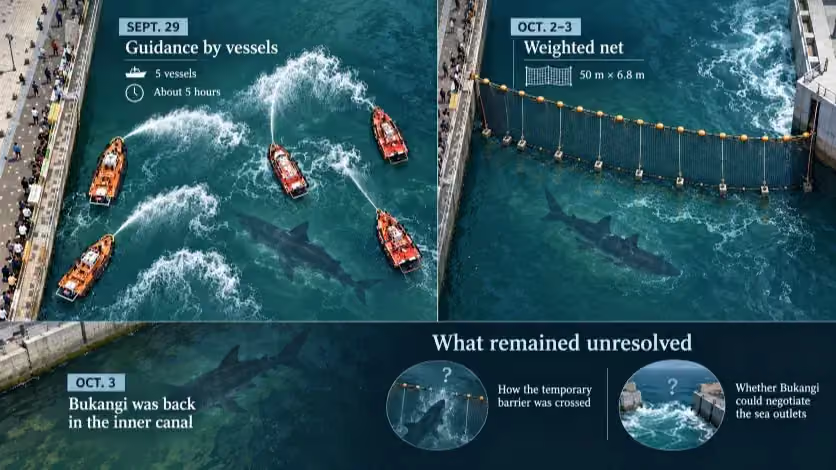
Bukangi, the Shark That Stayed in Busan’s North Port
A rescue net guided Bukangi toward the sea, but the dusky shark returned to B...
More from the author
More from this byline
Stay with the same line of reporting through more work from this byline.
- NewsOct 14, 2026
What Became of Busan’s University Streets?
 NewsSep 28, 2026
Why Some Commercial Space in Busan Is Hard to Reuse
Reader Signal
Community readWhat did this report leave you with?
Choose the signal that best reflects your reading. Select it again to remove it.
One response per article
No response selected
A moderated conversation about the reporting.
One-level replies and newsroom moderation keep the conversation anchored to this article.
Discussion Status
Open
Please sign in to join the discussion.
Newsletter
Weekly reporting and context from Busan and Korea.