The Decade That Decides Busan’s Future: Climate Resilience or Rising Vulnerability?
The 2025 summer delivered record-breaking heatwaves, floods, and economic shocks to Busan. Experts say the next ten years will decide whether the city transforms into a climate-resilient coastal hub—or faces escalating crises with outdated infrastructure and fragmented policies.


Busan, South Korea — The summer of 2025 has pushed Busan into uncharted territory. On July 1, the city logged its earliest tropical night in 111 years of record-keeping, when the thermometer failed to fall below 25 °C in Daecheong-dong. It came 19 days sooner than last year’s record, the clearest signal yet that seasonal rhythms have shifted. By mid-July, the Korea Meteorological Administration was warning of back-to-back heat advisories stretching into August, with daily highs repeatedly topping 34 °C and nighttime temperatures refusing to cool the city’s concrete core.
The ocean offered no relief. Along the South Coast, researchers at the Korea Institute of Ocean Science & Technology confirmed that sea surface temperatures had again crossed the 20 °C threshold—a critical point for species like mackerel and flounder that sustain much of Busan’s fisheries economy. Long-term datasets show the East and South Seas have warmed by 1.58 °C since 1968, more than twice the global average, with the rate of change accelerating sharply over the last two decades.
The consequences have been severe and immediate. In August, a toxic red-tide bloom swept through South Gyeongsang’s aquaculture farms, killing more than 29 million fish and shellfish across 952 sites and inflicting losses of nearly ₩66 billion—the worst since systematic monitoring began. At Busan’s Jagalchi Market, traders reported mackerel landings by weight exceeding seasonal averages, yet larger, market-preferred fish all but disappeared, a pattern marine biologists attribute to heat-stressed growth and shifting migration routes.
On land, the heatwave’s imprint spread beyond markets and fisheries. Korea Meteorological Administration heat-risk maps showed central Busan running up to four degrees hotter at night than surrounding districts, amplifying health risks for the elderly, construction crews, and residents in aging apartment blocks without modern cooling systems. Hospitals across the city documented a sharp rise in heatstroke and dehydration admissions through July, while energy grid data revealed record-breaking electricity demand as households struggled to balance cooling costs with rising power prices.
For Busan—a city built between coastal lowlands, steep hills, and a warming sea—the convergence of marine heatwaves, urban heat islands, and extreme weather has erased any sense that climate change belongs to the future. The real question now is whether the city’s infrastructure, governance, and economic systems can adapt fast enough to keep pace with the heat already here.
Markets, Households, and the Rising Cost of Heat
By late July 2025, the cost of Busan’s heatwave was visible not only in hospital wards and fish farms but also on dinner tables and electricity bills. At Jagalchi Market, Korea’s largest seafood hub, mackerel landings by weight exceeded the previous year’s totals, yet the fish themselves told a different story. The share of larger, consumer-preferred catch collapsed from 12.8 percent in 2024 to barely one percent this summer, a decline marine biologists linked to thermal stress and migration shifts as ocean temperatures surged past ecological thresholds.
Vegetable prices swung sharply upward as alternating drought and sudden cloudbursts battered farmland across South Gyeongsang and the Nakdong River basin. Bank of Korea data show spinach prices rising 171.6 percent over last summer, cabbage 51.7 percent, and pork 4.2 percent as farmers reported heat-stressed livestock and crop failures triggered by erratic rainfall. Economists now describe the phenomenon as heatflation: a feedback loop where extreme weather pushes food and energy prices higher, independent of conventional monetary policy levers.
Energy costs deepened the strain on households already struggling with food price volatility. Korea Power Exchange figures revealed three separate August evenings when Busan’s electricity demand hit record highs, with cooling accounting for more than 40 percent of total load. Reserve capacity margins repeatedly dipped below the 10 percent reliability threshold, prompting warnings from grid operators about potential supply vulnerabilities should another prolonged heatwave arrive before new district cooling systems come online.
Public health impacts were just as severe. Korea Meteorological Administration heat-risk maps showed central Busan running up to four degrees hotter at night than surrounding districts, intensifying health risks for elderly residents, outdoor workers, and low-income families in poorly insulated apartments. A survey by Pusan National University found that more than a third of low-income households cut back on air conditioning use during July’s heatwave despite medical warnings, citing rising power bills—a pattern public health experts now classify as energy poverty.
By August, the convergence of food inflation, energy demand spikes, and health emergencies left policymakers facing a single uncomfortable reality: Busan’s climate risks were no longer confined to any one sector. They now reached into every part of the city’s economy and daily life, demanding a response far beyond the limits of disaster recovery funding alone.
Infrastructure and Policy at a Crossroads
Busan has poured billions into climate adaptation projects over the past decade, yet the events of 2025 reveal how quickly the ground—or the water—keeps shifting beneath those plans. The 3.5-kilometer Oncheoncheon Deep Stormwater Tunnel, designed to protect central districts from flash floods, remains under construction even as hydrologists warn that its rainfall thresholds are already outdated. Data from the Korea Meteorological Administration show that short-duration, high-intensity storms—once considered “50-year events”—now occur with alarming regularity, leaving engineers to question whether infrastructure conceived a decade ago can withstand the climate of the next one.
Heat mitigation measures tell a similar story. Pilot programs in Haeundae and Suyeong have shown that urban wind-path forests and reflective “cool roofs” can lower surface temperatures by up to two degrees. Yet these efforts remain scattered across a few districts, lacking the regulatory muscle to reshape Busan’s heat-prone urban core. Urban planners at Pusan National University argue that without zoning reforms to preserve wind corridors and expand green cover, isolated projects risk becoming showcases rather than systemic solutions.
The much-touted Eco Delta City illustrates the tension between ambition and execution. Marketed as Korea’s flagship climate-smart district at the Nakdong River estuary, it promised automated floodgates, energy-efficient buildings, and real-time water management. But independent assessments by the Korea Research Institute for Human Settlements note that much of the reclaimed land has gone to high-rise housing, with flood retention basins and wetland buffers reduced in scope. Critics now describe the project as “eco” in name only—a real estate development draped in green branding rather than a genuine adaptation strategy.
Underlying these shortcomings is a funding imbalance. The National Assembly Budget Office reports that while Korea’s overall disaster spending has risen since 2023, the share devoted to prevention and climate-resilient R&D has fallen from 10.5 percent to a projected 8.5 percent by 2025. For Busan, this means more money allocated to post-disaster recovery than to early-warning systems, urban cooling networks, or flood-resilient transport corridors. Policy analysts warn that this reactive funding model risks locking the city into a cycle where each new disaster triggers spending without building long-term resilience.
When Other Cities Race Ahead
As Busan struggles to keep pace with its own shifting climate risks, cities facing similar threats have already redefined what urban adaptation can look like. Their approaches vary—massive flood barriers in Europe, underground stormwater networks in Asia, integrated green infrastructure in the tropics—but all share a common trait: speed and scale that Busan has yet to match.
Rotterdam remains the benchmark for coastal resilience. For decades, Dutch engineers have layered flood defense systems that blend hard infrastructure with ecological design. The Maeslantkering storm surge barrier—each gate as long as two Eiffel Towers laid end to end—closes automatically when sea levels breach set thresholds. Surrounding districts rely on “water plazas” that double as public parks in dry weather but store floodwaters during heavy storms. Every year, performance audits are made public, ensuring both transparency and continuous upgrades based on the latest climate projections.
Tokyo, with its vulnerability to cloudbursts, built the Metropolitan Area Outer Underground Discharge Channel—five massive shafts connected by a 6.3-kilometer tunnel capable of diverting 200 cubic meters of stormwater per second. Completed in 2006, it has already prevented more than a dozen major floods. Hydrologists note that Busan’s ongoing Oncheoncheon Deep Stormwater Tunnel is designed for less than a third of that capacity, even as the city faces increasingly similar rainfall intensities.
Singapore takes a different route, weaving adaptation into building codes, zoning laws, and public space design rather than relying solely on megaprojects. Its ABC Waters Programme links reservoirs, canals, and urban parks into a single network that manages stormwater, lowers urban temperatures, and doubles as recreation space. New developments must include green roofs, vertical gardens, and shade corridors, while district cooling systems cut electricity demand during heatwaves. A centralized climate resilience office coordinates across agencies, aligning energy, infrastructure, and public health planning with the same climate forecasts and funding streams.
Busan, by contrast, continues to treat floods, heatwaves, and land-use policy as separate silos. Without unified governance or binding performance metrics, analysts warn, the city risks chasing each crisis as it comes rather than building the kind of integrated, forward-looking adaptation systems now standard in cities that once faced the same dilemmas.
A Decade to Decide Busan’s Future
The next ten years will determine whether Busan continues to react to each heatwave and flood as an isolated crisis or begins to build the resilience needed for a rapidly changing climate. Analysts at the Korea Meteorological Administration and the National Disaster Management Research Institute argue that current adaptation measures—piecemeal flood tunnels, pilot cooling projects, limited zoning reforms—no longer match the scale of the threat.
Flood control must be the first pillar of any long-term plan. Hydrologists at the Korea Water Resources Corporation recommend abandoning outdated 20-year rainfall thresholds in favor of infrastructure designed for 50- to 100-year storm events. That means expanding beyond single stormwater tunnels toward integrated systems: detention basins along the Nakdong River, permeable urban surfaces across flood-prone neighborhoods, and real-time sensor networks linking underpasses, subways, and drainage canals into one automated response system.
Heat adaptation demands the same systemic approach. Public health data from Busan’s Medical Center show heat-related hospitalizations rising even in years without record-breaking temperatures, as urban heat islands amplify baseline warming. Planners are calling for citywide cool roof mandates, shade corridors designed through wind-path mapping, and district cooling networks tied to population density rather than small-scale pilot budgets. Singapore’s building code reforms—requiring green roofs, reflective facades, and tree-lined streets in all new developments—offer a regulatory model that Busan’s voluntary programs have yet to match.
Governance may be the most critical piece. The National Assembly Budget Office projects the share of disaster funding devoted to prevention and climate-resilient R&D will fall from 10.5 percent in 2023 to 8.5 percent by 2025, even as recovery costs soar. Policy experts now argue for a centralized adaptation authority empowered to set citywide targets, publish annual resilience audits, and align infrastructure spending with climate projections rather than political cycles.
Busan’s climate future will not be decided by a single tunnel, park, or building code. It will hinge on whether the city can integrate water, energy, health, and land-use planning into a single framework—one that treats every heatwave and flood not as a one-off disaster but as a warning of the next.
The Clock Is Already Running
By the end of the 2025 summer, Busan had experienced what climate scientists now call a compound crisis: forty consecutive tropical nights, record-breaking marine heatwaves, red-tide losses nearing ₩66 billion, vegetable prices soaring by triple digits, and electricity demand straining the grid through August’s hottest evenings. These were not distant warnings. They were real-time signals of a city already living inside the boundaries of climate change.
Yet the response remains fragmented. The Oncheoncheon Stormwater Tunnel continues to inch toward completion while rainfall records move faster than construction schedules. Eco Delta City carries the language of resilience yet delivers housing towers where floodplains were once promised. Budget data show disaster recovery spending climbing even as preventive investment and climate-resilient R&D shrink year after year.
Rotterdam, Tokyo, and Singapore demonstrate that adaptation succeeds only when engineering, urban design, and governance converge under clear targets tied to climate projections. Busan, by contrast, continues to treat heatwaves, floods, and urban growth as separate problems in a world where the climate no longer makes such distinctions.
The question now facing Busan is not whether another summer like 2025 will arrive—it is whether the city can transform its infrastructure, policies, and planning before the next decade of heat and water extremes overwhelms what remains of its defenses. The clock is already running, and the window for incremental fixes is closing fast.
Continue this reporting
Reporting on the same issue
Related coverage selected from the article's desk, topics and newsroom relationships.
 NewsSep 20, 2026
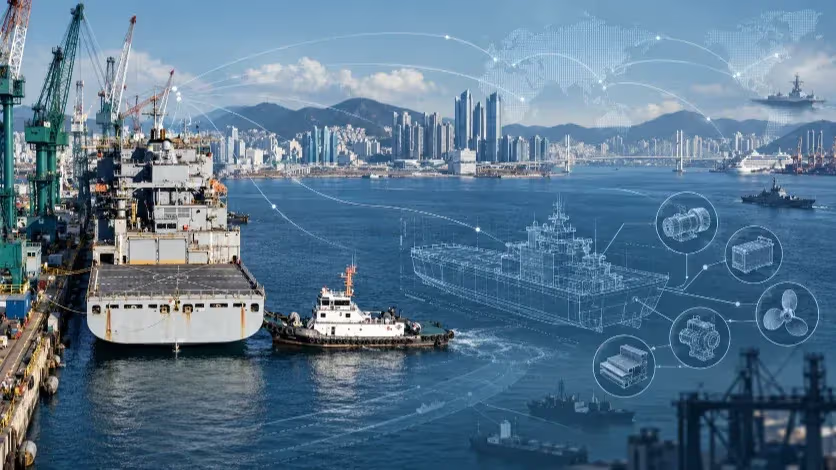
What It Takes for U.S. Navy Repair Work to Become a Busan Industry
HJ Shipbuilding has brought U.S. Navy maintenance work to Yeongdo. Whether it...
 NewsSep 17, 2026
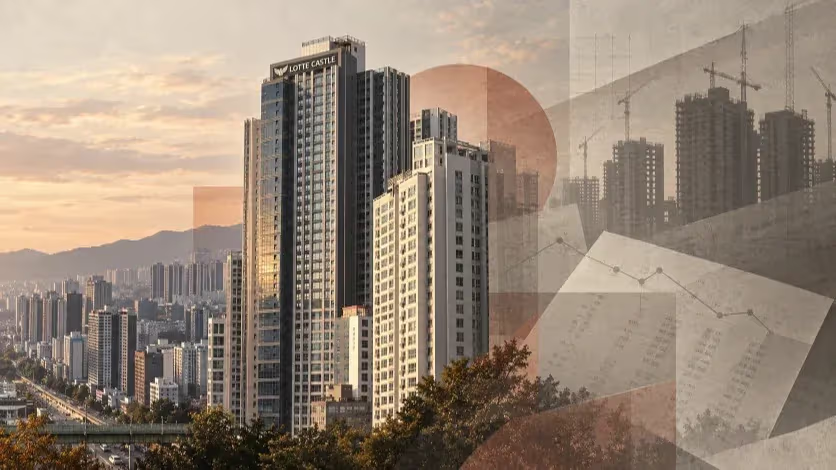
Busan’s Finished Homes, Unfinished Projects
Busan’s unsold homes sit in one monthly total, but they belong to very differ...
 NewsSep 16, 2026
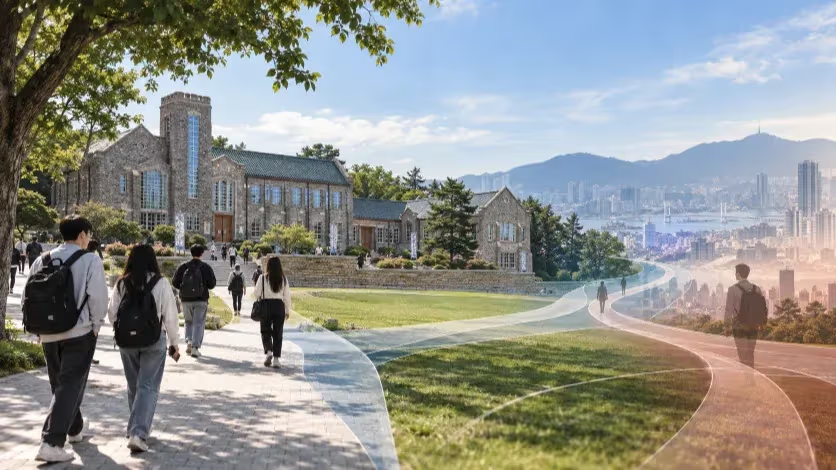
Busan’s Young-Adult Migration Turns Sharply at 25–29
Busan can still draw young adults into the city, but keeping them becomes far...
More from the author
More from this byline
Stay with the same line of reporting through more work from this byline.
- NewsSep 17, 2026
Busan’s Finished Homes, Unfinished Projects
Editorial Record
Corrections, sourcing notes and newsroom disclosures remain part of the published record. View Newsroom Notes →
Reader Signal
Community readWhat did this report leave you with?
Choose the signal that best reflects your reading. Select it again to remove it.
One response per article
No response selected
A moderated conversation about the reporting.
One-level replies and newsroom moderation keep the conversation anchored to this article.
Discussion Status
Open
Please sign in to join the discussion.
Newsletter
Weekly reporting and context from Busan and Korea.