The Crisis Behind Busan’s Real Estate Hype
While developers tout “premium units” and local media cheer on the crowds, more than 5,000 unsold homes sit vacant—and thousands of residents are quietly leaving.


Busan, South Korea — Busan’s real estate market is once again drawing headlines. Model houses of new high-rise apartment complexes are attracting thousands of visitors over weekends.
Reports of multi-million won “premiums” on pre-sale units are circulating on social media. Even illegal brokers, once driven underground, are reappearing near construction sites in tents and vans, promising high profits for early buyers.
But while these scenes suggest a resurgence, they obscure a different reality.
According to data released by the Ministry of Land, Infrastructure and Transport, Busan recorded over 5,400 unsold apartment units as of May 2025—the highest level in recent years.
Among them, more than 2,500 units are already completed, sitting vacant as developers struggle to secure buyers. Despite isolated cases of strong demand in luxury developments, the citywide housing inventory continues to accumulate.
This contradiction lies at the heart of a deeper crisis. While local newspapers report “enthusiastic crowds” at premium sites, the city as a whole is undergoing demographic decline, employment stagnation, and widening regional disparities.
In 2023 alone, over 13,000 residents left Busan, with the majority of them in their 20s and 30s. Most moved to the Seoul metropolitan area, drawn by greater economic opportunities and education access. The population drain marks the continuation of a decade-long trend: Busan is aging rapidly and struggling to retain its workforce.
Employment indicators appear superficially positive—Busan’s June employment rate hit a record high of 68.5% for the working-age population—but the numbers conceal an inconvenient truth.
Job growth is concentrated in short-term contracts and service roles. The city’s traditional industrial base—shipbuilding, logistics, and heavy manufacturing—remains weakened. Young workers are increasingly seeking stable positions elsewhere.
Meanwhile, development remains highly uneven. Projects in Haeundae, Suyeong, and Nam-gu districts continue to attract attention, fueled by strong brand recognition and speculative interest.
Yet in the city’s west—Sasang, Buk-gu, and Gangseo—many apartment complexes face sluggish sales and slow infrastructure expansion. Residents cite poor public transit access, a lack of schools and hospitals, and limited retail recovery in post-pandemic neighborhoods. The result is a two-speed city: one glittering, one forgotten.
Local media coverage has done little to challenge this divide. In recent months, several Busan-based outlets have run prominent stories highlighting model house lines, so-called “premium resale values,” and renewed investor interest.
But few have examined the broader context: the unresolved glut of vacant units, the resurgence of illegal broker activity, and the mismatch between supply and actual household demand. In some reports, illegal sales tactics were even portrayed as signs of recovery rather than symptoms of market distortion.
As construction resumes on large-scale developments—such as the Summit Limited Namcheon or Seomyeon The New—there is a growing risk that speculative narratives will continue to outpace the facts.
Without deeper structural changes, Busan's brief return to the housing spotlight may only serve to delay a more difficult reckoning.
Real urban resilience will not come from resale premiums or model house lines. It must come from revitalized industry, balanced development, and policies that prioritize real residents over speculative flows. Until then, the city risks confusing construction with recovery—and headlines with truth.
Continue this reporting
Reporting on the same issue
Related coverage selected from the article's desk, topics and newsroom relationships.
 NewsOct 16, 2026
What Is Still Worth Going to See?
Busan’s biennale faces questions of artistic judgment and institutional care....
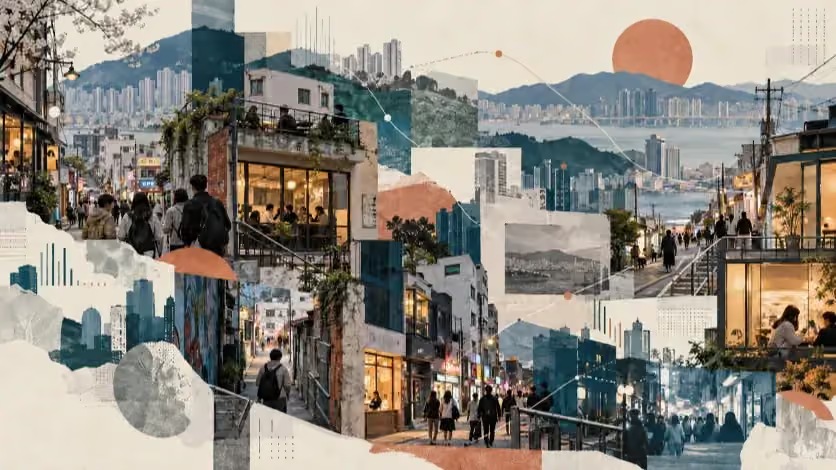 NewsOct 14, 2026
What Became of Busan’s University Streets?
From 2015 to 2023, registered businesses grew near Pusan National University...
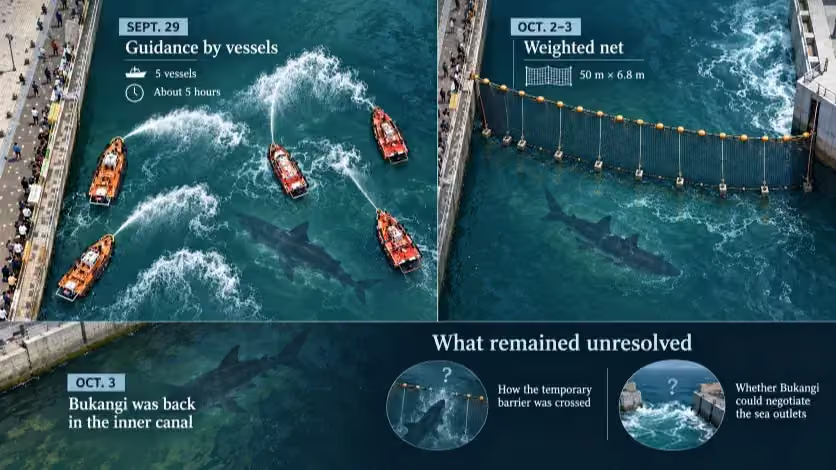 NewsOct 12, 2026
Bukangi, the Shark That Stayed in Busan’s North Port
A rescue net guided Bukangi toward the sea, but the dusky shark returned to B...
More from the author
More from this byline
Stay with the same line of reporting through more work from this byline.
- NewsOct 14, 2026
What Became of Busan’s University Streets?
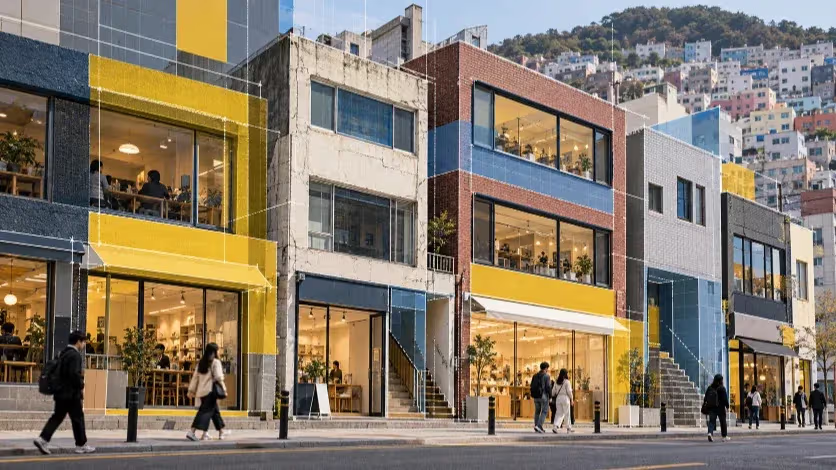 NewsSep 28, 2026
Why Some Commercial Space in Busan Is Hard to Reuse
Reader Signal
Community readWhat did this report leave you with?
Choose the signal that best reflects your reading. Select it again to remove it.
One response per article
No response selected
A moderated conversation about the reporting.
One-level replies and newsroom moderation keep the conversation anchored to this article.
Discussion Status
Open
Please sign in to join the discussion.
Newsletter
Weekly reporting and context from Busan and Korea.