The 15-Minute City in Busan: Global Urban Ideal Meets Local Urban Limits
Busan has embraced the 15-minute city concept, but does the city’s fragmented geography, vertical density, and uneven service access support the model?


In recent years, the idea of the “15-minute city” has gained momentum as a globally endorsed model for sustainable, human-scale urban life. Coined by French-Colombian academic Carlos Moreno, the concept proposes that residents should be able to access essential services—work, education, healthcare, leisure—within a 15-minute walk or bike ride from home. Paris adopted it as a flagship urban strategy, and cities from Melbourne to Bogotá have since followed suit.
Now, Busan—the mountainous, coastal metropolis of South Korea—is attempting its own interpretation of the model. With over 3.3 million residents spread across a dense patchwork of neighborhoods, the city has launched initiatives such as child-friendly cultural hubs, ESG-based community centers, and walkable routes like Galmaetgil, branding them as cornerstones of a localized “15-minute city.”
Earlier this year, Professor Moreno himself visited Busan and praised its efforts, calling it a rare case of “realization through adaptation.” The city responded by releasing a high-production video dialogue between Moreno and the mayor, reinforcing the image of Busan as a rising exemplar of the global proximity paradigm.
But behind the narrative lies a more complicated urban reality. While the vision is seductive, critics argue that Busan’s spatial structure, demographic divides, and development practices may be fundamentally misaligned with the assumptions that underpin the 15-minute city. The question emerges: is Busan adapting the concept—or simply appropriating its branding?
What is the 15-Minute City, Really?
The “15-minute city” is less a strict planning formula than a normative ideal—an urban ecosystem where residents can live, work, learn, and play without needing to travel far. At its core, the model emphasizes proximity, diversity, density, and digitalization as foundational principles for rethinking post-pandemic urban life.
Carlos Moreno introduced the concept in 2016 and popularized it during the COVID-19 pandemic, as lockdowns exposed the fragility of centralized, car-dependent cities. The idea found a prominent platform in Paris, where Mayor Anne Hidalgo integrated it into the city’s strategic urban transformation agenda. The objective: to decentralize city life by ensuring that essential services—healthcare, education, commerce, green space, culture—are evenly distributed across neighborhoods.
Rather than imposing a new physical infrastructure, the 15-minute city calls for reorganizing existing urban assets. A school doesn't need to be built anew if one already exists nearby but is underused; a public library can double as a community center; a parking lot can become a market square. The model is as much about functional adaptation as it is about spatial planning.
Importantly, Moreno’s framework is not meant to be prescriptive. He has consistently described it as a “compass, not a blueprint,” adaptable to different geographic, cultural, and political contexts. But that flexibility also opens the door to interpretation drift—where cities claim alignment with the model without necessarily adhering to its systemic goals.
Busan, in its current trajectory, exemplifies this ambiguity. It invokes the 15-minute city in official discourse, but whether it is engaging with the full depth of the idea—or simply leveraging its international appeal—is an open question.
Why Busan Is Structurally at Odds with the Model
Rather than integrated neighborhoods, the city is shaped by spatial isolation and topographical discontinuity. For many residents, particularly in older or peripheral districts, “15-minute access” remains a distant promise—not a lived reality.
Busan’s effort to embrace the 15-minute city model faces a complex structural reality—one shaped not only by urban planning decisions, but by the city’s deep-rooted geography, socio-economic divides, and historical patterns of development. While the concept of localized, proximity-based living resonates in theory, the spatial logic of Busan’s urban form often runs counter to the conditions that make the 15-minute city viable.
Geographically, Busan is fragmented by nature. Nestled between steep mountain ranges and an irregular coastline, the city has grown in response to topographical constraints rather than cohesive urban vision. Neighborhoods are frequently isolated from one another by dramatic elevation shifts, tunnels, and highways, resulting in a city that is spatially segmented. In this context, the notion of a uniformly walkable or bikeable 15-minute radius becomes more symbolic than practical. Physical proximity, in Busan’s case, is often undermined by the sheer difficulty of traversing terrain that is vertical, discontinuous, and highly car-dependent.
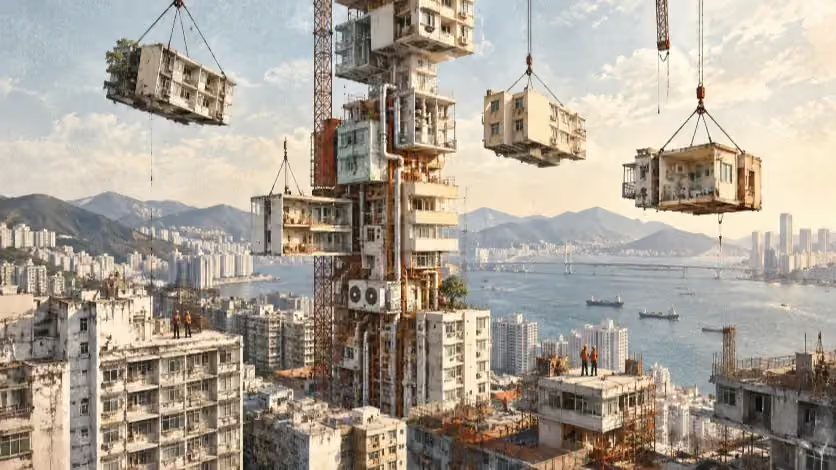
Compounding this challenge is the city’s distinctive built environment. Unlike the mid-rise, mixed-use neighborhoods of Paris—where the 15-minute city first gained global attention—Busan’s dominant form is high-rise residential blocks arranged into functionally self-sufficient but socially insular super-complexes. While many of these developments contain basic services—small clinics, convenience stores, daycare facilities—they tend to operate as inward-facing enclaves. Their design facilitates efficiency but discourages permeability, reducing the likelihood of organic interactions between adjacent communities. Rather than fostering polycentric urban life, these vertical enclaves reproduce a pattern of isolated living zones, each with varying levels of access to essential services beyond the basics.
At a broader scale, the city still operates on a long-distance logic of urban life. Key economic, educational, and medical functions remain concentrated in specific central zones—such as Seomyeon, Centum City, and the Medical Campus in Yangjeong—requiring many residents, particularly those living in outer districts, to commute well beyond the 15-minute threshold. In areas like Gijang or Saha, daily travel times of 30 to 60 minutes are routine, not exceptional. The infrastructure may be modern, but the city’s spatial rhythm remains tethered to a model of centralized work and decentralized residence—a structure that is largely incompatible with the principles of decentralized, neighborhood-centered urbanism.
Furthermore, the uneven distribution of infrastructure across the city reflects not just geographic conditions, but also socio-political choices. While newly developed areas benefit from planned integration of amenities and services, older neighborhoods—especially those with high elderly populations or aging housing stock—often suffer from infrastructural neglect. In practice, the benefits of the 15-minute city are experienced not as a universal right, but as a geographically contingent privilege. For some, the city offers convenience, cohesion, and accessibility. For others, particularly those in marginal or overlooked areas, the 15-minute city remains a distant ideal.
In this light, Busan’s use of the term "15-minute city" reveals a critical tension between aspiration and spatial reality. It is not that the city is unwilling to pursue localized urbanism, but that its existing form resists easy transformation. Without substantial investment in connective infrastructure, public services, and horizontal integration of neighborhoods, the city's adoption of the 15-minute label risks remaining a rhetorical gesture rather than a structural achievement.
The Illusion of Uniform Accessibility
The promise of the 15-minute city lies in its democratic appeal: a spatial structure that affords all residents equal access to essential services, regardless of income, age, or location. In rhetoric, it suggests an urban model grounded in equity and human dignity. In practice, however, especially in a city like Busan, this vision remains unevenly realized—more a cartographic ideal than a lived condition.
A closer look at Busan’s urban landscape reveals a stark disparity between the planned proximity promoted in official discourse and the actual accessibility experienced by residents on the ground. The city’s flagship initiatives—such as Deullaknalak centers for children, ESG-focused community hubs, and walkable “healing trails” like Galmaetgil—are disproportionately concentrated in newer or high-investment districts. These spaces are designed with care, often situated near planned residential zones, and serve as visual anchors for the city’s branding of the 15-minute model.
Yet in older, lower-income neighborhoods—particularly in Yeongdo, Seo-gu, Dong-gu, and parts of Buk-gu—the story is markedly different. Residents here frequently report insufficient access to healthcare, elderly services, green space, or safe walking environments. In some cases, public facilities exist but are functionally inaccessible, either due to poor maintenance, lack of staffing, inconvenient hours, or geographic isolation. A community center located on paper just a kilometer away may, in reality, require crossing steep roads, navigating unsafe pedestrian conditions, or enduring long waits for infrequent bus service. These invisible frictions erode the promise of “proximity.”
The exclusion is not merely infrastructural—it is also demographic and experiential. The city’s definition of essential services often reflects the needs of the median commuter family: young children, two working parents, middle-class housing. But what of the elderly resident who lives alone in a hillside neighborhood? The migrant family unfamiliar with public signage? The disabled commuter who finds most footpaths inaccessible? For these groups, the 15-minute city is not only unattainable—it is often unacknowledged in design and implementation.
This selective accessibility generates what could be called a “curated proximity”: one that is planned, optimized, and showcased in development zones, while remaining aspirational—or irrelevant—in others. In this sense, the 15-minute city in Busan begins to resemble a two-tiered system, where some neighborhoods function as working prototypes and others as rhetorical afterthoughts.
Moreover, without clear mechanisms for evaluating lived accessibility—beyond spatial buffers or isochrone maps—the city risks equating presence with function. The existence of a childcare facility or a clinic within 1 kilometer is not equivalent to meaningful access if it is overbooked, understaffed, or culturally unwelcoming. Without usage data, qualitative feedback, or equity-focused metrics, the success of Busan’s proximity model remains technocratically claimed rather than empirically demonstrated.
Ultimately, the illusion of uniform accessibility in Busan reflects a broader issue embedded in the global uptake of the 15-minute city: the danger of flattening socio-spatial complexity into policy slogans. In a city marked by demographic aging, topographic variation, and entrenched development hierarchies, equity must be more than a peripheral value. It must be a structural imperative.
Why the Origin City Works Differently
| Category | Paris (Model City) | Busan (Adopting City) |
|---|---|---|
| Urban Density & Structure | Medium-density, low-rise, mixed-use neighborhoods | High-rise, high-density apartment clusters with functional separation |
| Geographical Context | Flat terrain, ideal for walking and cycling | Mountainous and coastal, fragmented connectivity |
| Administrative Governance | 20 arrondissements with budgetary autonomy | Centralized metropolitan control, limited district-level agency |
| Public Service Distribution | Equitably distributed across neighborhoods | Concentrated in new town zones; underserved legacy areas |
| Civic Participation | Structured public forums and citizen co-design processes | Minimal participatory planning; top-down design |
| Mobility Strategy | Pedestrian- and bicycle-first; strong car-reduction policies | High car dependence, fragmented walkability and weak cycling networks |
The 15-minute city model was not simply imagined in Paris—it was cultivated through decades of spatial policy, institutional frameworks, and civic norms that fundamentally differ from those found in Busan. Comparing the two cities illuminates why the concept has gained traction in one while encountering friction in the other. It also reveals the risks of applying a culturally and structurally situated idea as a universal solution.
Paris benefits from a legacy of urban planning that supports proximity. Its neighborhoods—many of which predate modern zoning laws—are mid-rise, human-scale environments, built with a blend of residential, commercial, educational, and civic uses within walkable distances. This mixed-use urban fabric makes the core logic of the 15-minute city feel intuitive, even in the absence of a formal label. Long before the term was coined, Parisians were already living aspects of it.
Moreover, the administrative structure of Paris reinforces localized governance. The city is divided into 20 arrondissements, each with a mayor, budget authority, and planning autonomy. This decentralization allows urban interventions—such as library upgrades, school placements, or plaza renovations—to respond directly to neighborhood-level needs. It also cultivates a culture of participatory planning, where residents contribute to shaping the public realm through institutional channels.
In contrast, Busan’s planning structure remains highly centralized and top-down, with limited neighborhood-scale agency. Most civic infrastructure is decided at the metropolitan or district level, often reflecting macroeconomic imperatives rather than local needs. This has led to an uneven geography of development: certain areas receive concentrated investment and amenity planning, while others are left to cope with outdated infrastructure and under-resourced services.
Furthermore, Paris’s approach to the 15-minute city is deeply intertwined with its public asset strategy. The city has made deliberate efforts to redistribute cultural, health, and recreational facilities, not merely to build new ones. Closed schools have been repurposed as co-working spaces; public libraries serve as social hubs; schoolyards double as weekend parks. In contrast, Busan’s strategy has largely relied on project-based delivery, such as constructing new facilities (e.g., Deullaknalak centers) without necessarily addressing service integration or reuse of existing spaces.
Transportation policy also sets the two cities apart. Paris’s recent push for “la ville du quart d’heure” coincided with major investments in bike infrastructure, pedestrianized streets, and car-use reduction. These measures directly support the spatial logic of the model. Busan, while expanding its public transportation network, has yet to adopt a similar mobility paradigm shift; many neighborhoods remain car-dependent, and pedestrian safety is a persistent concern.
Ultimately, Paris demonstrates how the 15-minute city functions not as a standalone project, but as a multi-layered cultural, institutional, and infrastructural ecosystem. Busan, by contrast, has adopted the language of the concept while operating within a development model that remains oriented toward centralization, real estate-led growth, and symbolic urbanism. The result is a conceptual gap: Busan is invoking the form of the 15-minute city without fully engaging with its function.
Critical Theoretical Flaws in the Moreno Model
| Issue Area | Critique |
|---|---|
| Conceptual Vagueness | The model lacks clear definitions of "essential services" and offers no standardized metrics for implementation or success. |
| Overidealization | The concept assumes that cities can be easily reorganized around local living without fully accounting for economic specialization or urban inertia. |
| Equity Blind Spots | It risks privileging well-served neighborhoods while failing to address disparities in infrastructure, mobility, or access for marginalized groups. |
| Mobility Constraints | By emphasizing hyper-localism, it may undervalue regional connectivity and limit access to broader job markets, education, or healthcare systems. |
| Policy Elasticity | The model’s flexibility makes it politically attractive but operationally ambiguous, enabling superficial adoption without structural change. |
The appeal of the 15-minute city is unmistakable: it promises a more humane, sustainable, and equitable urban life by organizing services around the everyday rhythms of local communities. Yet as the model has spread from Paris to Seoul, Melbourne, and now Busan, its growing influence has also exposed conceptual vulnerabilities. While Carlos Moreno’s intentions are undeniably progressive, the model he promotes carries several embedded assumptions that may not withstand scrutiny across diverse urban contexts.
At its core, the 15-minute city proposes a proximity-driven reorganization of urban life. However, it fails to adequately define what constitutes “essential services,” nor does it offer a consistent framework for measuring success. A grocery store may satisfy basic needs, but what of affordable housing, specialized healthcare, or culturally specific public spaces? Without clear thresholds or metrics, the model risks being adopted in name only—its presence marked by symbolic infrastructure rather than meaningful transformation.
Furthermore, the model implicitly assumes a degree of urban flexibility that many cities, especially those shaped by decades of market-driven development or fragmented governance, do not possess. While Paris could retrofit existing buildings and rezone uses within walkable districts, cities like Busan operate within a more rigid framework: real estate-led growth, siloed planning departments, and limited neighborhood-level agency. Under such conditions, retrofitting neighborhoods into complete 15-minute units is not only technically difficult—it is politically and economically fraught.
There is also a fundamental tension between proximity and scale. Modern cities operate through interdependence: jobs, education, culture, and healthcare are often unequally distributed for systemic reasons. Many residents rely on regional transit to access opportunities that do not—and realistically cannot—exist within 15 minutes of home. By valorizing hyper-local access, the 15-minute city risks downplaying the importance of mobility, specialization, and urban diversity. In doing so, it may inadvertently constrain rather than expand access for marginalized communities who must travel further for adequate services.
Additionally, the model’s emphasis on localization can mask its exclusionary potential. Critics have warned that enhanced public amenities in certain districts can accelerate gentrification, pricing out the very communities that policies intend to serve. This “soft segregation” creates curated zones of accessibility that appear equitable but in fact deepen spatial inequality. In cities with high land speculation—such as Busan—this dynamic is not theoretical but observable.
Lastly, the 15-minute city presents a rhetorical clarity that obscures operational ambiguity. Its flexibility, often touted as a virtue, can serve as a shield against critique. Because the model is framed as a "compass, not a blueprint," cities can claim alignment without accountability. The result is a policy discourse in which proximity becomes an aesthetic ideal rather than a measurable social goal.
In sum, the 15-minute city functions well as an aspirational narrative, but its transposability across cities with vastly different spatial, cultural, and institutional profiles is deeply questionable. Applied indiscriminately, the model can become a universal slogan detached from local specificity, generating more symbolic planning than structural reform.
Toward a Meaningful Urban Structure
As the 15-minute city continues its ascent in global urban discourse, it becomes increasingly necessary to disentangle its ideological allure from its practical application. In cities like Busan, where the spatial, social, and economic conditions differ markedly from its European origin, the model’s implementation reveals not a seamless transition but a set of deep contradictions.
Busan’s embrace of the 15-minute framework reflects a desire to modernize, to humanize urban life, and to align with international sustainability narratives. But when the discourse outpaces the reality—when symbolic infrastructure replaces structural equity—the risk is that proximity becomes performative. A city cannot claim transformation merely by placing facilities within mapped buffers or by broadcasting new branding strategies. It must confront harder questions: Who uses these spaces? Who can reach them safely and with dignity? Who was involved in deciding what “essential” means?
To move beyond the limits of the 15-minute model, cities like Busan must adopt a locally grounded, socially reflexive approach. This requires rethinking not just spatial proximity but functional, cultural, and institutional access. Proximity alone cannot address generational poverty, spatial segregation, or systemic underinvestment in older districts. Nor can it substitute for democratic urban governance, where residents shape their neighborhoods beyond the passive role of service users.
Indeed, the future of equitable urbanism lies not in minutes, but in relationships—between people, between institutions, and between policy and practice. Metrics matter, but so do lived experiences. The true test of a 15-minute city is not whether infrastructure exists within a 1-kilometer radius, but whether that infrastructure enriches daily life, reduces burdens, and brings people into fuller participation with their urban environment.
Busan has the opportunity to take the 15-minute idea seriously—not as a branding exercise, but as a catalyst for systemic reform. That would require listening more carefully to residents in overlooked areas, investing not just in new spaces but in the rehabilitation of old ones, and integrating mobility, land use, and social inclusion into a holistic planning framework.
In the end, time is not the enemy. But when urban policy is measured only in minutes, it can easily lose sight of meaning. A just city, after all, is not the one that is closest—it is the one that is open, accessible, and shared.
Continue this reporting
Reporting on the same issue
Related coverage selected from the article's desk, topics and newsroom relationships.
 NewsOct 25, 2026
The Long Bill for Busan’s Apartment City
Busan has about 958,000 apartments even as its population declines. Elevators...
 NewsOct 23, 2026
Busan’s Twelve-Year School Account Faces a Test Beyond Access
Busan’s PENZ promises one school account for 12 years, while BeAT brings AI t...
 NewsOct 22, 2026
Busan Port’s LNG and Methanol Plan: Who Pays to Keep Fuel Ready?
Busan already supplies ships with LNG and methanol, drawing on regional and i...
More from the author
More from this byline
Stay with the same line of reporting through more work from this byline.
 NewsOct 9, 2026
Why “Busan Is Good” Falls Short as a City Brand
 NewsSep 18, 2026
The Other AI Race Is for the Freedom to Change Course
Reader Signal
Community readWhat did this report leave you with?
Choose the signal that best reflects your reading. Select it again to remove it.
One response per article
No response selected
A moderated conversation about the reporting.
One-level replies and newsroom moderation keep the conversation anchored to this article.
Discussion Status
Open
Please sign in to join the discussion.
Newsletter
Weekly reporting and context from Busan and Korea.