Suyeong Bay’s 40-Year Drift from Public Maritime Vision to Private Vertical Enclave
Suyeong Bay’s long journey from civic maritime district to high-rise enclave reveals how incremental decisions, not grand plans, are reshaping Busan’s urban economy.


Busan, South Korea — Busan’s latest promise to “reclaim” Suyeong Marina—with new berths, cultural spaces, and a revived maritime identity—arrives in a district that no longer resembles the place imagined when the shoreline was first carved out of the sea. Over four decades, the bay’s public purpose has been quietly recast by fragmented decisions and the steady rise of residential towers that now define its skyline and its limits. The city still speaks of maritime ambition, but the waterfront surrounding the marina tells a different story: one shaped less by civic intent than by the gravitational pull of private development. And as other commercial districts across Busan follow a similar path, the question is no longer what Suyeong Bay could have been, but what kind of city Busan will become if its most valuable spaces continue drifting toward the same narrow future.
Busan City announced the long-anticipated groundbreaking of the Suyeong Marina redevelopment project, describing it as a major step toward creating a “world-class marine leisure hub” and an “open cultural waterfront” that would expand public access to the bay. The project, scheduled for completion in 2027, includes upgraded berthing facilities, a yacht exhibition hall, commercial and cultural spaces, and a redesigned civic waterfront. Framed through the city’s press communications, the initiative appears to mark a confident return to Busan’s maritime identity.
Yet the redevelopment begins on a waterfront whose character has already been shaped—arguably constrained—by the past four decades of urban decisions. Suyeong Bay, originally reclaimed for public maritime and commercial purposes in the 1980s, has evolved into one of South Korea’s most concentrated clusters of luxury residential towers. The physical and functional transformation of the district from a public maritime asset into a private high-rise enclave now determines the limits of what any new redevelopment can accomplish. The city’s language suggests a revival of the waterfront’s original purpose; the built environment surrounding the marina suggests something quite different. Understanding why this dissonance exists—and how it emerged—requires tracing the bay’s long drift from its initial civic vision to the present reality.
A Waterfront Once Designed for Public Access and Economic Purpose
When Suyeong Bay was reclaimed in the early 1980s, it formed part of an assertive national strategy to position Busan as a maritime gateway at a time when South Korea was rapidly industrialising and seeking international visibility. The reclaimed land was not conceived as a blank canvas for private development but as a coordinated public project built around the Asian Games and the Seoul Olympics, which required a world-class sailing venue and associated maritime infrastructure. Early planning documents presented the bay as a cornerstone of a mixed waterfront district that would integrate international sporting facilities with tourism, commerce, and civic access to the sea.
The logic was consistent with the urban ambitions of the period. Busan sought to expand its coastal identity beyond its industrial port and to develop a waterfront comparable to those emerging in other Asian cities. The marina was intended to function not merely as an event site but as an anchor for new economic activity: a five-star hotel, a convention and exhibition facility, marine education centres, and publicly accessible promenades were all part of the initial development framework. Residential use, where contemplated, was secondary—an accessory to tourism and hospitality rather than the dominant land use.
This vision depended on a unified development structure. The state and its private partner, Daewoo, were expected to implement the project in coordinated phases, preserving a balance between public waterfront access and commercial activation. Similar governance models later defined successful waterfront redevelopment elsewhere in Asia, most notably in Yokohama’s Minato Mirai and, on a different scale, Singapore’s Marina Bay. For Suyeong Bay, this continuity never materialised. The public-facing vision would be disrupted before its second phase could take shape, setting the stage for the fragmented and increasingly residential trajectory that followed.
How the Collapse of a Single Developer Unraveled a Unified Waterfront Plan
The coherence that once held Suyeong Bay’s development together began to unravel in the late 1990s, long before the district had the chance to resemble the mixed maritime hub envisioned in its early plans. When the Asian Financial Crisis hit and the Daewoo Group entered insolvency, the waterfront was swept into the much larger disassembly of the conglomerate’s holdings. Parcels that had been treated as components of a single, long-term development strategy were put on the market one by one. In the space of a few years, the entire shoreline passed from a coordinated public–private framework into the hands of multiple private developers with little connection to the original blueprint.
The shift did not produce an immediate or dramatic rupture. Instead, the effect was cumulative. Once the parcels were individually owned, no mechanism existed to ensure the land would continue to serve the maritime and commercial functions that had justified its reclamation. Developers facing a sluggish post-crisis economy gravitated toward the most reliable source of revenue available in Busan at the time: high-density housing aimed at a growing upper-middle-class market. Each new residential proposal, approved in the absence of a unified development authority, made the next one more likely. By the early 2000s, the pattern had become self-reinforcing.
City planners had few tools to counter this momentum. The regulatory instruments that might have preserved the district’s original balance—phased development conditions, binding land-use requirements, or a consolidated waterfront oversight body—were either weak, politically unpopular, or never fully implemented. What emerged instead was a type of planning drift: the slow but steady redefinition of Suyeong Bay’s purpose through a sequence of ad-hoc approvals that reflected market pressures more than public strategy.
By the time the economy recovered, the bay’s trajectory had already shifted. The district no longer resembled a civic maritime project awaiting completion but a collection of private developments whose growing residential scale was beginning to shape expectations for the area as a whole. What followed in the 2000s and 2010s—the zoning changes, density concessions, and high-rise approvals—did not cause this transformation so much as formalise it. The decisive break had already occurred when the bay stopped being developed as a single place and started being sold as individual opportunities.
Incremental Approvals That Steered the Bay Toward Residential Priority
By the early 2000s, the cumulative effects of fragmented ownership had already begun steering Suyeong Bay toward a residential future, but it was the city’s planning decisions during the following decade that gave this trajectory its definitive shape. With no overarching framework left to protect the district’s intended mix of maritime and commercial uses, zoning revisions and development permissions were issued on a case-by-case basis, each approval reinforcing the logic of the last. What emerged was not a deliberate policy to turn the bay into a high-rise enclave, but a sequence of administrative choices that aligned, almost inevitably, with the economic pressures surrounding the area.
The mechanics of this shift were subtle. Developers who had acquired parcels after the Daewoo collapse submitted proposals that pushed the boundaries of what the district’s land-use designation could accommodate—larger residential components, greater heights, and more flexible interpretations of mixed-use zoning. These proposals did not arrive in isolation; each was accompanied by arguments emphasising market feasibility, the scarcity of available land in central Busan, and the need to “activate” the waterfront. In the absence of a central development authority, such arguments were difficult to counter. As one approval followed another, the district’s profile began to tilt decisively toward residential massing, even as official documents continued to describe the area as a commercial and maritime zone.
Tensions occasionally surfaced. The local district office in Haeundae objected to several large-scale residential proposals, citing concerns about traffic congestion, loss of public access, and the cumulative shadowing effect of towers rising along the shoreline. But those objections rarely translated into sustained institutional resistance. The city’s planning authority, which had the final say, often prioritised economic recovery and development momentum over the preservation of the waterfront’s original purpose. Regulatory adjustments—permitted floor-area ratios, height allowances, and interpretations of what constituted acceptable “commercial-residential balance” in a mixed-use zone—were gradually recalibrated in ways that legitimised what the market was already producing.
By the mid-2010s, the transformation was unmistakable. Suyeong Bay’s skyline had hardened into a continuous wall of luxury towers, redefining not only the district’s visual identity but also the functional possibilities of the waterfront. What had initially been conceived as a civic and economic asset tied to maritime industries now operated as a high-density residential district whose expectations, traffic patterns, and social composition left little room for the kind of working waterfront the original plan had imagined. The planning pivot of the 2000s did not cause the bay’s shift toward residential dominance; it formalised it, giving regulatory shape to a pattern already embedded in the area’s post-crisis evolution.
A Vertical Shoreline That Limited What the Marina Could Become
As high-rise development consolidated across Suyeong Bay, the physical character of the waterfront began shifting in ways that were difficult to reverse. The towers did more than alter the skyline; they reoriented how the district functioned. What had once been planned as a porous, civic waterfront gradually became a space defined by vertical residential massing, creating a shoreline that was visually striking but operationally constrained. The accumulation of height along the bay produced a wall-like effect that limited sightlines from the city interior and restricted the natural flow of wind and light across the coastal edge. These changes did not simply affect aesthetics; they shaped the microclimate, the conditions of public access, and the experience of the shoreline itself.
The transformation also narrowed the practical role the waterfront could play in Busan’s maritime economy. Marina districts depend on a mix of uses—boat repair, training facilities, storage, and access routes for equipment and fuel—that operate most effectively when noise, traffic, and industrial activity are tolerated as part of the landscape. In Suyeong Bay, the residential density made such activities increasingly difficult to sustain. Complaints about noise, congestion, and visual disruption became more frequent, and functions essential to a working marina were gradually relocated or reduced. Instead of a diversified maritime district, the area evolved into a landscape where the marina remained as a visual amenity but struggled to operate as the economic engine originally intended.
These physical and functional constraints were accompanied by social ones. The concentration of high-end residential buildings created a waterfront environment driven more by the expectations of its residents than by the needs of the broader public. Commercial activity increasingly catered to a narrow consumption base, with little of the variety or street-level vitality that mixed-use waterfronts typically generate. Public access, though not formally restricted, became more symbolic than substantive, shaped by the dominance of private frontage and controlled circulation routes. The waterfront was still there, but its role in the city had subtly shifted—from a shared civic space with economic purpose to a backdrop for a residential enclave whose presence shaped what the district could accommodate and what it could no longer support.
City Ambitions Meeting a Waterfront Already Fixed in Form and Function
When Busan City introduced its latest redevelopment plan for Suyeong Marina, the project was framed as an opportunity to reclaim the district’s maritime purpose. Official statements emphasised upgraded berthing facilities, cultural amenities, and a revitalised waterfront that would serve both residents and visitors. The language echoed earlier visions of Suyeong Bay—visions that predated the residential build-up and imagined the area as a centre for marine leisure, tourism, and civic activity. On paper, the plan suggests a return to that trajectory, as if the district could be steered back toward the mixed maritime identity that shaped its origins.
But the physical and social landscape surrounding the marina complicates these ambitions. The district now functions primarily as a high-density residential zone, and its rhythms reflect that reality. Noise sensitivity, congestion concerns, and residents’ expectations for privacy and controlled activity have already constrained the scope of what the waterfront can accommodate. The kinds of uses that underpin a vibrant marine leisure district—training spaces, repair functions, nighttime operations, and the broader mix of visitors such activity brings—are difficult to integrate into a setting dominated by private towers and the everyday routines of the people who live in them. Even modest increases in public activity often face resistance, not out of hostility to the waterfront’s development but because the district has become structured around assumptions of residential stability rather than commercial dynamism.
These constraints are not merely behavioural; they are spatial. The land available for new cultural or commercial facilities is limited, and any intervention must navigate a shoreline already reshaped by private frontage and circulation patterns centred on residential access. The marina remains, but largely as a visual amenity rather than as the anchor of a broader maritime economy. Claims that the redevelopment will support MICE activity or significantly expand marine tourism sit uneasily with this spatial reality. Without the surrounding commercial infrastructure—hotels, event spaces, mixed-use streets, and transit-linked public squares—the marina alone cannot deliver the kind of economic uplift that the city associates with international waterfront districts.
For these reasons, the redevelopment’s likely impact is more modest than its public framing suggests. It may improve amenities, refine the waterfront’s appearance, and strengthen the marina’s role as a recreational space, but it cannot easily restore the functions that the original district was meant to support. The built environment that grew around the bay has set boundaries that no project of this scale can fully overcome. The city’s language gestures toward renewal; the shoreline that surrounds the marina reveals the limits of what renewal can mean in a district whose trajectory was fixed long before this redevelopment began.
When the Urban Landscape Itself Narrows the City’s Future Options
By the time Busan revived its ambition to shape Suyeong Bay into a maritime district, much of the area’s future had already been determined by the decisions made in the decade following the financial crisis. The residential concentration that emerged during that period did more than change the land-use patterns along the bay; it created a structural environment that now governs what the waterfront can become. In urban development, shifts of this kind tend to accumulate quietly until they define the limits of later policy, and Suyeong Bay illustrates this phenomenon with unusual clarity. The district’s present form is not merely the result of a market trend but the product of a sequence of choices that hardened into constraints long before policymakers attempted to reverse course.
The core of the structural trap lies in the misalignment between the district’s physical form and the functions the city now hopes to reintroduce. A maritime hub depends on a broad ecosystem—commercial streets that can support tourism, flexible spaces for events and services, and a waterfront that is porous enough to accommodate industry, recreation, and public access alongside one another. Suyeong Bay today offers little of that. The skyline that rose over the past two decades created a land-use monoculture: high-density residential towers with limited commercial depth and circulation patterns designed primarily for the people who live there. Such an environment is resistant to diversification. New uses must fit into a spatial framework built around private frontage, controlled movement, and strict thresholds for noise, activity, and night-time operations. The possibilities for transformation are therefore narrowed not by policy ambition but by the built reality inherited from earlier phases of development.
Institutional dynamics reinforce these constraints. Because so much of the district’s land is now privately held and tied to residential ownership, any significant change to the waterfront must navigate a planning process shaped by property rights, residents’ expectations, and the political cost of imposing new burdens on a concentrated voter base. This is not unique to Busan; waterfronts across the world exhibit similar tensions once large-scale residential development takes root. But in Suyeong Bay, the effect is particularly pronounced because the original public purpose of the reclaimed land was never fully institutionalised. Without a strong waterfront governance structure—one that could protect public access, maintain maritime uses, or coordinate development across parcels—the district was left vulnerable to incremental redefinition. That vulnerability continues to shape it, limiting the scope of what redevelopment can realistically accomplish today.
These conditions produce a kind of structural inertia. Even well-intentioned redevelopment initiatives struggle to escape the gravitational pull of the existing urban form. The city can enhance amenities, refine public spaces, or improve the marina’s facilities, but it cannot easily introduce the density or diversity of uses required for a robust maritime economy. Nor can it reconfigure the district to support the commercial or cultural infrastructure needed for major tourism or MICE activity. The vision remains, but the conditions that might have allowed it to take root—public control over key parcels, coherent land-use sequencing, and governance mechanisms capable of guiding long-term development—are no longer present. Suyeong Bay’s future, in many respects, was decided in the years when the city allowed its most important waterfront to be shaped by residential momentum rather than a sustained maritime strategy.
A Citywide Pattern That Risks Hollowing Busan’s Commercial Core
The development path that reshaped Suyeong Bay has not remained confined to the waterfront. Over the past decade, Busan has gradually embraced a development model in which underperforming commercial sites, ageing retail blocks, and even core urban districts are converted into high-rise residential complexes. What began as a response to the financial disruptions of the early 2000s has evolved into a pervasive pattern that now extends far beyond the marina. The city’s traditional retail centre in Seomyeon, once anchored by department stores and mid-rise offices, is undergoing the same transformation. When a major department store closed its doors, the site did not become a modern retail hub or a business complex; it was earmarked for a tall apartment tower. Similar transitions are unfolding in other districts, where buildings that once supported street-level commerce or small offices are being replaced by residential towers marketed to higher-income buyers. The cumulative effect has been a steady narrowing of land uses in areas that once functioned as the city’s commercial backbone.
The consequences of this shift are not immediately visible because the new towers are visually impressive and attract substantial investment, but the underlying transformation is more structural. As commercial sites disappear, so do the conditions that support broad-based urban consumption—dense retail corridors, diverse storefronts, small offices, and accessible public spaces that sustain daily economic life. In neighborhoods where multiple residential towers rise in succession, commercial activity becomes limited to the retail podiums attached to apartment complexes, spaces that rarely replicate the complexity or vitality of older urban blocks. Over time, this pattern produces a quieter, more inward-looking district: stores serving local residents rather than the city at large, reduced foot traffic, and fewer opportunities for new businesses to emerge. It is a subtle form of urban contraction, one that does not resemble decline at first glance but gradually limits the environments in which economic variety can take root.
These dynamics become more pronounced when viewed across the wider city. In redevelopment zones near the port, districts once promoted as opportunities to expand Busan’s business and cultural infrastructure are drifting toward residential proposals that overshadow their original non-residential functions. The logic is familiar: high-rise apartments promise predictable returns, while commercial projects require coordination, long-term planning, and a market ecosystem that Busan has struggled to cultivate. Yet each residential approval makes it harder to introduce alternative uses in the future. Cities rarely lose their commercial capacity all at once; instead, the available land gradually narrows until few places remain where companies might cluster or where cultural and civic institutions could feasibly be built. Busan is entering a phase where these constraints are beginning to matter. Signs of oversupply in high-end housing are already emerging, while the city’s office stock remains limited and aging, suggesting a mismatch between where people live and where businesses can realistically grow.
Other cities confronted similar pressures but chose different strategies. In Seoul, recent redevelopment efforts have shifted land from residential toward commercial or mixed-use functions, aiming to preserve and strengthen the business core rather than allowing market pressures to steer it toward housing. Internationally, cities such as Yokohama and Vancouver have used governance structures that protect key waterfront and commercial districts from being subsumed by residential demand, ensuring that strategic land retains economic diversity. Busan’s recent trajectory stands in contrast. By allowing prime commercial, cultural, and waterfront parcels to transition into predominantly residential projects, the city risks creating an urban landscape that is visually dense but economically thin.
The long-term risk is not an immediate collapse but a gradual hollowing out. If Busan continues to convert its central commercial districts and strategic waterfronts into residential enclaves, it may find, a decade from now, that it has an abundance of towers but a shortage of the everyday urban environments—offices, retail corridors, cultural venues, mixed-use streets—where a city’s economic and social vitality actually resides. The danger is not that these neighborhoods will be empty, but that they will be full in a way that leaves too little room for the kinds of activity that sustain a dynamic urban economy. In that sense, Suyeong Bay is not merely a cautionary tale; it is a preview of the future that awaits if Busan continues to treat housing as the default answer to every urban question.
A Future Still Open—But With Less Room Than Before
The story of Suyeong Bay captures a broader truth about Busan: the shape of the city today is not the result of a single decision or a single era, but of a long sequence of choices that gradually redirected the city’s most valuable land toward a narrow set of uses. What began as a maritime district designed to anchor public life and economic activity became, over time, a landscape defined by residential demand and the absence of structures capable of guiding development toward more varied ends. This shift did not happen abruptly. It accumulated quietly, parcel by parcel, until the city’s aspiration to build a working waterfront found itself constrained by the very urban form that had grown around it.
Those constraints now extend far beyond the marina. As redevelopment across Busan increasingly resolves into high-rise housing, the city’s commercial spine is thinning, and the environments that sustain everyday economic and social activity are becoming harder to protect or renew. Apartment towers create the appearance of growth, but they do not replace the dense retail corridors, mid-sized offices, cultural venues, and mixed-use streets that support a diverse urban economy. If this trajectory continues, Busan may enter the next decade with an abundance of vertical housing but a shortage of spaces where businesses can establish a foothold or where public life can gather at a meaningful scale.
The risk is not dramatic decline but gradual narrowing. Cities rarely become empty; they become quieter, less varied, and less capable of generating the economic momentum that once seemed inevitable. Busan is not condemned to that outcome, but neither is it insulated from it. Other cities have shown that careful governance, land-use discipline, and a willingness to preserve commercial and civic functions can keep residential pressure from overwhelming the urban balance. Busan has not consistently taken that path, and the consequences are beginning to surface in the form of shrinking commercial districts and rising residential concentration in places once reserved for broader public purpose.
Yet the city’s future is not fixed. The choices that limited Suyeong Bay’s evolution were incremental, and the choices that shape its next decade will be as well. The question is whether Busan can resist the convenience of development patterns that promise immediate returns but reduce long-term flexibility. A dynamic waterfront—and a dynamic city—depends on leaving space for activities that cannot be measured in unit counts or tower heights. Suyeong Bay, in its current form, stands as a reminder of what is lost when those spaces disappear, and as a prompt to consider what might still be preserved before the city’s remaining possibilities narrow further.
Continue this reporting
Reporting on the same issue
Related coverage selected from the article's desk, topics and newsroom relationships.
 NewsOct 25, 2026
The Long Bill for Busan’s Apartment City
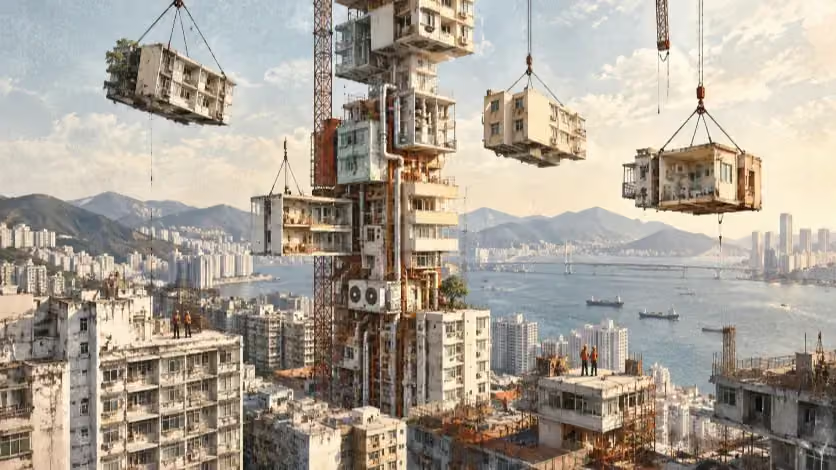
Busan has about 958,000 apartments even as its population declines. Elevators...
 NewsOct 23, 2026
Busan’s Twelve-Year School Account Faces a Test Beyond Access
Busan’s PENZ promises one school account for 12 years, while BeAT brings AI t...
 NewsOct 22, 2026
Busan Port’s LNG and Methanol Plan: Who Pays to Keep Fuel Ready?
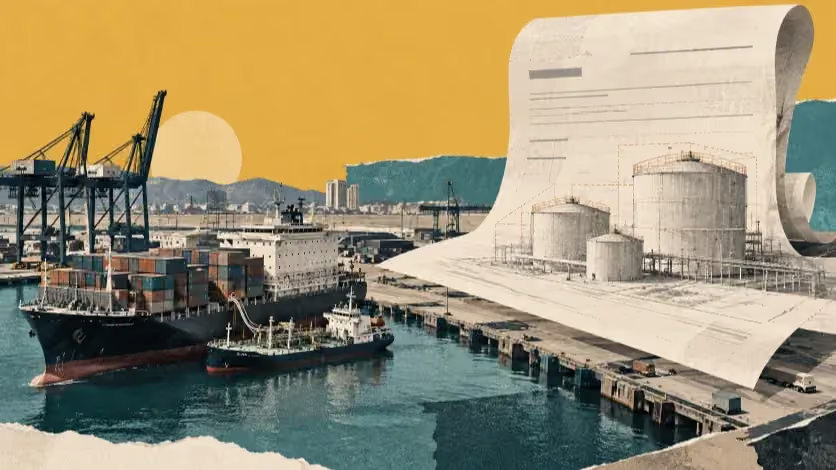
Busan already supplies ships with LNG and methanol, drawing on regional and i...
More from the author
More from this byline
Stay with the same line of reporting through more work from this byline.
 NewsOct 21, 2026
What a Small Mackerel Is Worth
Reader Signal
Community readWhat did this report leave you with?
Choose the signal that best reflects your reading. Select it again to remove it.
One response per article
No response selected
A moderated conversation about the reporting.
One-level replies and newsroom moderation keep the conversation anchored to this article.
Discussion Status
Open
Please sign in to join the discussion.
Newsletter
Weekly reporting and context from Busan and Korea.