Pine Wilt Invasion from Japan Threatens Busan’s Forests
Busan, South Korea - Pine forests, cherished for their ecological and cultural importance, face a growing menace in both Busan and Japan: pine wilt disease (PWD). This disease, caused by the pinewood nematode (Bursaphelenchus xylophilus), has rapidly spread across Asia and Europe, threatening biodiversity and causing significant economic losses in forest-rich regions. In Busan, pine wilt disease was first detected in 1988 on Geumjeongsan Mountain, marking the start of a persistent battle that c

Busan, South Korea - Pine forests, cherished for their ecological and cultural importance, face a growing menace in both Busan and Japan: pine wilt disease (PWD). This disease, caused by the pinewood nematode (Bursaphelenchus xylophilus), has rapidly spread across Asia and Europe, threatening biodiversity and causing significant economic losses in forest-rich regions.
In Busan, pine wilt disease was first detected in 1988 on Geumjeongsan Mountain, marking the start of a persistent battle that continues today. Meanwhile, Japan, where the disease first emerged in the early 20th century, has struggled for decades to contain the devastation. As both countries seek solutions, they are turning to a mix of traditional methods and cutting-edge technology to manage the disease’s spread and reduce its impact on vital forest ecosystems.
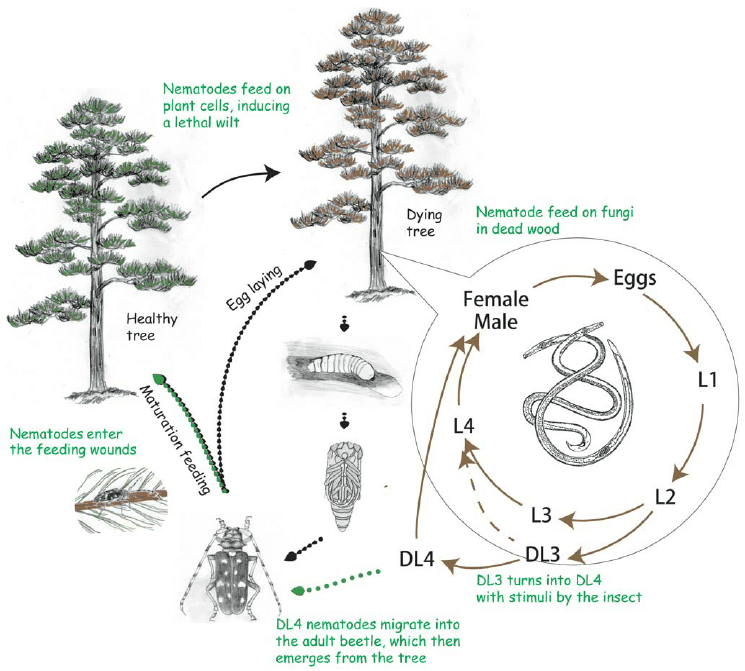
Pine wilt disease is a lethal infection caused by the pinewood nematode (Bursaphelenchus xylophilus), which invades pine trees and disrupts their water transport systems, ultimately leading to tree death within months. The nematode is spread by the Japanese pine sawyer beetle, which carries the microscopic worm from tree to tree as it feeds and lays eggs.
Once inside the tree, the nematode rapidly reproduces, blocking resin canals and causing the tree to lose its ability to transport nutrients and water. Symptoms, such as wilting needles and loss of resin flow, are usually followed by the tree’s death within six months.
Busan, the first city in Korea to experience an outbreak of pine wilt disease, continues to be one of the hardest-hit areas. Infected regions such as Geumjeongsan Mountain and the iconic Taejongdae tourist spot have seen widespread tree loss. Despite concerted efforts to manage the disease, the infection rate has persisted, driven by favorable environmental conditions for the nematode and its insect vector.
To combat the disease, the Busan city government has implemented a range of measures, including drone-based aerial spraying, chemical injections, and the removal of infected trees. In 2024, the government secured national funding to further these efforts, with a particular focus on protecting tourist areas like Taejongdae, which are critical to both the local environment and economy.
Busan also employs non-infection certificates to prevent the illegal movement of infected timber, a practice that can contribute to the disease’s spread if unchecked. Public awareness campaigns are ongoing, aimed at involving citizens in the monitoring and reporting of potentially infected trees.
In Japan, pine wilt disease has been a devastating issue for over a century. Introduced from North America in the early 1900s, the disease has decimated large areas of Japan’s pine forests, which play a critical role in the country's timber industry and natural heritage.
Japan’s traditional control measures include chemical fumigation, insecticide applications, and the clear-cutting of infected trees. However, these methods come with significant environmental and economic drawbacks. The high labor costs associated with tree removal, coupled with the environmental impact of chemical usage, have prompted Japan to explore alternative solutions.
One of the most promising developments is the research into phytochemicals, which are plant-based compounds that have shown effectiveness in killing the nematodes without the environmental risks associated with synthetic pesticides. These eco-friendly solutions are still in the early stages of development but offer a potential breakthrough in managing the disease sustainably.
Both Busan and Japan are looking to technology to support their fight against pine wilt disease. In Busan, drones are being used for precision spraying of nematicides in hard-to-reach forest areas. Drones allow for more efficient targeting of infected trees and reduce the need for manual labor in dangerous or difficult terrains.
Meanwhile, Japan is advancing research into phytochemicals, which have shown potential as a low-toxicity alternativeto chemical pesticides. These plant-derived compounds are not only more environmentally friendly but also target the nematodes effectively, reducing the spread of the disease.
Additionally, GIS mapping and monitoring tools are being used in both countries to track the disease’s spread in real time. This technology helps foresters identify new outbreaks early, allowing for faster responses and more effective containment.
The environmental impact of pine wilt disease cannot be overstated. In both Busan and Japan, the loss of pine trees threatens biodiversity, disrupts ecosystems, and undermines efforts to protect soil and water resources. The economic costs are equally staggering, with valuable timber resources being lost and the tourism industry, especially in places like Taejongdae, facing potential declines as forests die off.
Moreover, the labor-intensive and expensive process of managing the disease adds further financial strain on local governments. Both Busan and Japan have had to allocate significant resources to remove infected trees, treat forests, and conduct research into more sustainable management practices.
As pine wilt disease continues to devastate forests in both Busan and Japan, the need for innovative solutions has never been more urgent. While traditional methods of control remain necessary, new technologies such as drones and eco-friendly phytochemicals offer hope for a more sustainable future.
The fight against pine wilt disease is not just a local issue—it is a global one. International collaboration and continued research will be crucial in ensuring that this devastating disease does not spread further. Governments, scientists, and local communities must work together to protect our forests and preserve them for future generations.
Continue this reporting
Reporting on the same issue
Related coverage selected from the article's desk, topics and newsroom relationships.
 NewsOct 16, 2026
What Is Still Worth Going to See?
Busan’s biennale faces questions of artistic judgment and institutional care....
 NewsOct 14, 2026
What Became of Busan’s University Streets?
From 2015 to 2023, registered businesses grew near Pusan National University...
 NewsOct 12, 2026
Bukangi, the Shark That Stayed in Busan’s North Port
A rescue net guided Bukangi toward the sea, but the dusky shark returned to B...
More from the author
More from this byline
Stay with the same line of reporting through more work from this byline.
 NewsOct 9, 2026
Why “Busan Is Good” Falls Short as a City Brand
 NewsSep 18, 2026
The Other AI Race Is for the Freedom to Change Course
Reader Signal
Community readWhat did this report leave you with?
Choose the signal that best reflects your reading. Select it again to remove it.
One response per article
No response selected
A moderated conversation about the reporting.
One-level replies and newsroom moderation keep the conversation anchored to this article.
Discussion Status
Open
Please sign in to join the discussion.
Newsletter
Weekly reporting and context from Busan and Korea.